
Did Gold and Silver Find a Floor as Geopolitical Tensions Ease?

Market Context
Precious metals experienced a notable rebound early this week, with Gold (XAU/USD) and Silver (XAG/USD) recovering from their year-to-date lows. On Monday, Gold found support and began to climb after reports emerged that U.S. President Trump had postponed planned strikes against Iran's energy infrastructure. This news provided a much-needed reprieve from the sharp sell-off that had characterized recent trading sessions. Silver also staged a recovery on Monday, halting a slide that briefly saw it breach its lowest points of the year during Asian trading. This price action suggests that bargain hunters stepped in as geopolitical fears momentarily subsided.
Analysis & Drivers
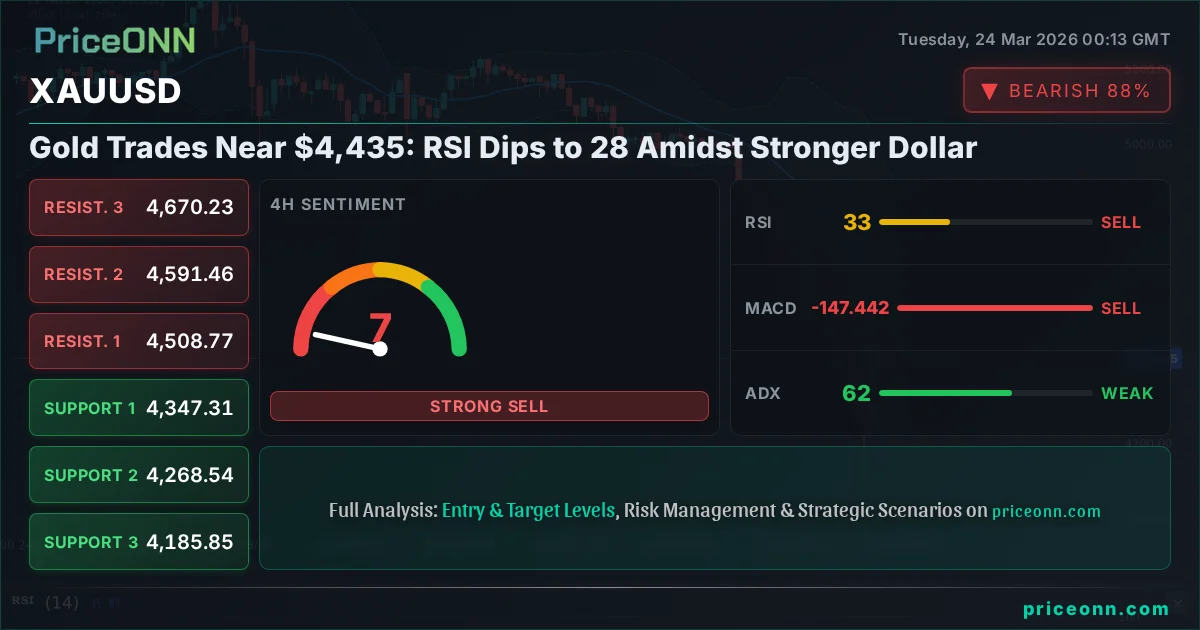
The primary driver behind the recent volatility and subsequent rebound in Gold and Silver has been geopolitical uncertainty, particularly concerning the Middle East. Historically, Gold has been a go-to safe-haven asset during times of global instability. Its appeal as a hedge against inflation and currency depreciation, coupled with significant central bank accumulation – with reserves increasing by 1,136 tonnes worth around $70 billion in 2022 – underpins its long-term value. Silver, while also benefiting from safe-haven flows, has a dual nature, serving both as a store of value and an industrial commodity. Its price is sensitive to geopolitical events, but also to shifts in industrial demand, particularly in sectors like electronics and solar energy, and its correlation with the U.S. Dollar.
The inverse relationship between precious metals and the U.S. Dollar is a critical factor. A strengthening dollar typically exerts downward pressure on Gold and Silver prices, as they are priced in dollars. Conversely, a weaker dollar often provides a tailwind for precious metals. Market data indicates that central bank buying, particularly from emerging economies like China, India, and Turkey, has been robust, adding a layer of structural support. Furthermore, interest rate expectations play a role; as yield-less assets, Gold and Silver tend to perform better in an environment of lower interest rates.
Trader Implications
The recent price action presents a mixed picture for traders. The immediate catalyst for the bounce was the perceived de-escalation of Middle East tensions. However, the underlying geopolitical risks remain, meaning any renewed escalation could quickly send prices higher again. Traders should monitor headlines closely for any shifts in the geopolitical landscape. Key technical levels to watch include the recent lows as potential support, and the previous resistance levels that were tested during the prior uptrend. For Gold, a sustained move above $4,450 could signal further upside potential, while a break below the recent lows around $4,300 might indicate a continuation of the bearish trend. For Silver, holding above its recent lows is crucial; a clear break below $25 could open the door to further declines, while a rally back towards $26.50 would be an initial sign of strength.
The correlation with the U.S. Dollar index (DXY) is also paramount. A weaker dollar would likely support further gains in precious metals, while a strong dollar could cap any upside. Additionally, traders should be aware of the broader market sentiment towards risk assets. A sell-off in equity markets typically favors precious metals, while a rally in stocks might weigh on them.
Outlook
While the immediate threat of conflict escalation appears to have receded, the Middle East remains a volatile region, and geopolitical risks could resurface at any moment. This suggests that Gold and Silver may continue to see periods of heightened volatility. The ongoing central bank demand provides a fundamental floor, but the direction will likely be heavily influenced by the U.S. Dollar's trajectory and any further developments in global political arenas. Traders should remain cautious, prepared for potential shifts in sentiment driven by both economic data and geopolitical events.
Frequently Asked Questions
What caused Gold prices to rebound from year-to-date lows?
Gold prices rebounded from year-to-date lows primarily due to a perceived de-escalation of geopolitical tensions in the Middle East, specifically after news of postponed U.S. strikes against Iran's energy infrastructure. This eased safe-haven demand, allowing prices to recover from earlier lows, with some recovery seen near $4,440 on Tuesday.
How do central bank reserves impact Gold prices?
Robust central bank accumulation provides underlying support for Gold prices. In 2022 alone, central banks added 1,136 tonnes of Gold. This diversification strategy, especially by emerging economies, enhances perceived economic strength and currency stability, acting as a structural demand driver.
What are the key levels traders should watch for Gold and Silver?
Traders should monitor Gold's ability to hold above recent lows around $4,300 and potentially challenge levels near $4,450. For Silver, holding support above its recent lows is critical; a sustained move above $25 is needed to signal strength, with resistance eyed around $26.50.
Track markets in real-time
Empower your investment decisions with AI-powered analysis, technical indicators and real-time price data.
Join Our Telegram Channel
Get breaking market news, AI analysis and trading signals delivered instantly to your Telegram.
Join Channel

PriceONN