
Gold Recovers from Lows as Geopolitical Fears Ease, Silver Follows Suit
Gold (XAU/USD) staged a notable recovery on Monday, bouncing back from its year-to-date lows. This upward movement occurred as market participants reacted to news indicating a postponement of planned strikes against Iran's energy infrastructure, thereby easing immediate geopolitical anxieties.
Market Context
The precious metal had experienced a sharp sell-off leading into the session, pushing it to fresh lows for the year. However, the announcement of a potential de-escalation in the Middle East provided a much-needed reprieve, triggering a wave of bargain hunting among investors. This price action highlights gold's enduring role as a safe-haven asset, sensitive to shifts in global stability. The market's rapid response underscores the delicate balance between risk aversion and speculative positioning in the current economic climate.
Analysis & Drivers
Gold's recovery was primarily fueled by a reduction in perceived geopolitical risk. Reports suggested that planned military actions targeting Iran's energy sector were delayed, diminishing immediate fears of a wider conflict that could disrupt global energy supplies and destabilize regional economies. Historically, gold has consistently demonstrated its appeal during times of uncertainty, serving as a hedge against inflation and currency depreciation. Its inverse correlation with the U.S. Dollar also plays a crucial role; a weaker dollar typically supports gold prices, while a stronger dollar can exert downward pressure.
Central banks continue to be significant players in the gold market. In 2022, these institutions collectively added approximately 1,136 tonnes of gold to their reserves, marking the highest annual purchase on record. This sustained demand, particularly from emerging economies like China, India, and Turkey, provides a fundamental layer of support for the yellow metal. Furthermore, gold's status as a yield-less asset makes it more attractive when interest rates are low. Conversely, higher borrowing costs can weigh on its price. The recent price action suggests that while the threat of conflict temporarily drove safe-haven demand, the easing of that threat allowed for a correction, influenced by broader market sentiment and the U.S. dollar's performance.
Trader Implications
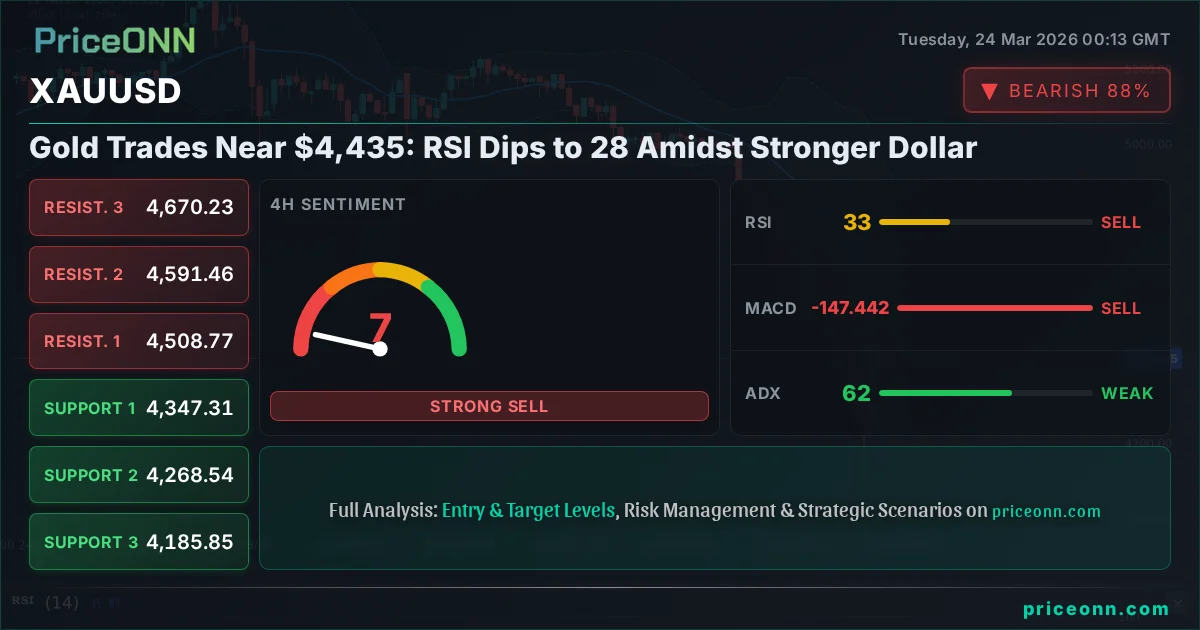
Traders should monitor key technical levels closely. Immediate resistance for gold is observed around the $2,400 mark, with a decisive break above this level potentially signaling further upside. Conversely, support is being tested near the recent lows around $2,300. The U.S. Dollar Index (DXY) remains a critical indicator; any sustained weakness in the dollar could provide further impetus for gold's recovery. Attention should also be paid to upcoming economic data releases and any further developments from the Middle East, as these will dictate the short-term direction. For traders looking to capitalize on this volatility, a cautious approach is advised, focusing on risk management and clearly defined entry and exit points. A break below the $2,300 support could signal a deeper correction, while a sustained move above $2,400 might invite further bullish sentiment.
Silver (XAG/USD) mirrored gold's resilience, also recovering from its year-to-date lows. While silver's industrial demand provides a baseline of support, its price is often more volatile than gold's. Traders will be watching for silver to reclaim key resistance levels, potentially around $28.00, with support holding firm at $26.00. The interplay between geopolitical factors, U.S. dollar strength, and industrial demand will be crucial for silver's trajectory.
Outlook
The outlook for gold and silver remains cautiously optimistic, contingent on the sustained de-escalation of geopolitical tensions. While the immediate threat has receded, the underlying instability in the Middle East could resurface, reigniting safe-haven demand. Investors will be closely watching central bank policy, particularly U.S. Federal Reserve interest rate expectations, which significantly influence the dollar and, consequently, precious metal prices. A continued trend of central banks increasing gold reserves could provide a long-term tailwind for the yellow metal, even amidst periods of market calm. For now, the market appears to be digesting the recent events, with price action likely to remain sensitive to geopolitical headlines and macroeconomic data.
Frequently Asked Questions
What caused gold prices to rebound from year-to-date lows?
Gold prices rebounded from year-to-date lows on Monday following news that planned strikes against Iran's energy infrastructure were postponed. This eased immediate geopolitical fears, prompting bargain hunting and a recovery from earlier lows around $2,300.
What are the key levels to watch for gold and silver?
For gold, traders should watch resistance near $2,400 and support around $2,300. For silver, key levels are resistance at approximately $28.00 and support at $26.00. A decisive move beyond these levels will indicate future direction.
What is the outlook for precious metals amid ongoing geopolitical uncertainty?
The outlook remains cautiously optimistic, heavily influenced by the de-escalation of geopolitical tensions and U.S. Federal Reserve policy. While current fears have eased, any resurgence of conflict could quickly boost safe-haven demand. Central bank accumulation of gold provides a potential long-term supportive factor.
Track markets in real-time
Empower your investment decisions with AI-powered analysis, technical indicators and real-time price data.
Join Our Telegram Channel
Get breaking market news, AI analysis and trading signals delivered instantly to your Telegram.
Join Channel

PriceONN