
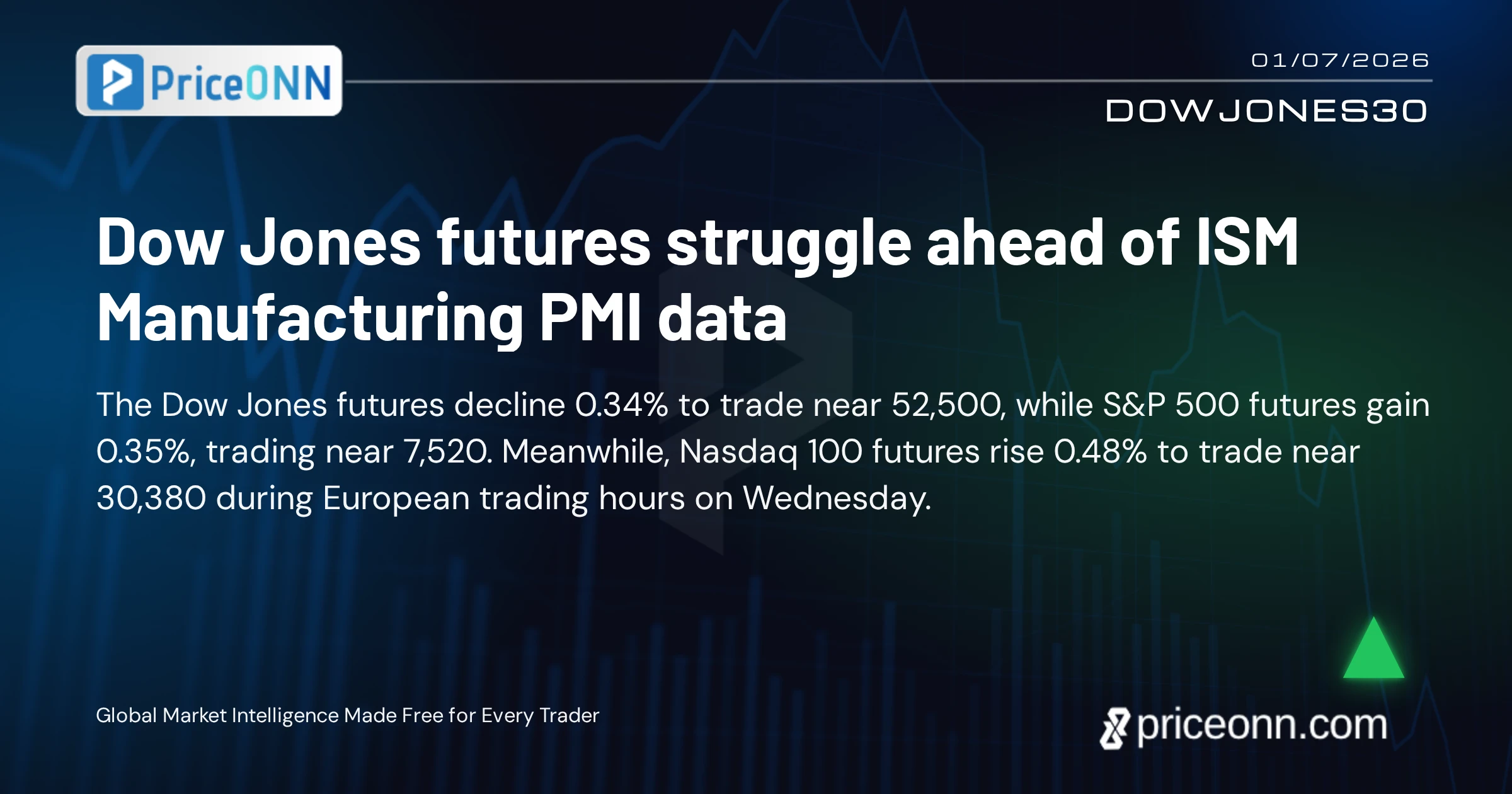
Dow Jones futures struggle ahead of ISM Manufacturing PMI data
 PriceONN Editorial Desk
Multi-source verification
PriceONN Editorial Desk
Multi-source verification
Market Signals Ahead of Key Economic Release
Futures tracking the Dow Jones Industrial Average signaled a cautious start to Wednesday's session, dipping 0.34% to hover near the 52,500 mark. This minor retreat contrasts with the more optimistic sentiment seen in other major indices, as S&P 500 futures edged up 0.35% to trade around 7,520, and the 100 futures posted a more substantial gain of 0.48%, reaching approximately 30,380 during European trading hours.
This divergence in pre-market movement highlights a market poised for direction from upcoming economic indicators. Investors and traders are keenly awaiting the release of the Institute for Supply Management (ISM) Manufacturing Purchasing Managers' Index (PMI) data. This report is a critical gauge of the health and activity within the US manufacturing sector, often influencing broader market sentiment and expectations for economic growth.
Understanding the Dow Jones Industrial Average
The Dow Jones Industrial Average (DJIA), a venerable benchmark in the financial world, represents the collective performance of 30 prominent US-traded companies. Unlike indices that are weighted by market capitalization, the DJIA employs a price-weighted methodology. Its calculation involves summing the stock prices of its components and dividing by a specific divisor, currently set at 0.152. Established by Charles Dow, the index has a long history, though it has faced scrutiny for its limited scope compared to broader measures like the S&P 500, given its focus on a select group of large corporations.
Numerous elements shape the trajectory of the DJIA. Foremost among these is the aggregated financial health of its constituent companies, as reflected in their quarterly earnings reports. Beyond corporate performance, macroeconomic data released by the US and globally significantly impacts investor sentiment, thereby influencing the index. The monetary policy stance of the Federal Reserve, particularly its interest rate decisions, also plays a crucial role. Higher borrowing costs, a consequence of elevated interest rates, can affect corporate reliance on credit and subsequently impact valuations.
Inflationary pressures and other economic metrics that guide the Fed's policy considerations are therefore significant drivers. Charles Dow's original methodology, known as Dow Theory, sought to identify the primary market trend by observing the simultaneous movement of both the DJIA and the Dow Jones Transportation Average (DJTA). Volume was considered a confirmation signal, and the theory identified three distinct phases of a trend: accumulation, public participation, and distribution, marking shifts in the actions of informed investors and the general market.
Trading Avenues for the DJIA
Market participants have several avenues for gaining exposure to the DJIA. Exchange Traded Funds (ETFs), such as the SPDR Dow Jones Industrial Average ETF (DIA), offer a simplified way to invest in the index as a single security. This bypasses the need to purchase individual shares of each of the 30 component companies.
Furthermore, futures contracts on the DJIA allow traders to speculate on its future price movements, providing leverage and flexibility. Options on the index grant the right, though not the obligation, to buy or sell at a specified price by a future date, offering strategies for hedging or speculative plays. Mutual funds also provide a diversified approach, pooling investor capital to buy a basket of DJIA stocks, thereby mirroring the index's overall performance.
Reading Between the Lines
The current pre-market movement, with the Dow Jones futures showing a slight decline while tech-heavy 100 futures climb, suggests a potential rotation or a market seeking clearer signals from upcoming data. The ISM Manufacturing PMI is a critical release, as it can offer insights into the resilience of the US economy amidst broader inflationary concerns and interest rate uncertainty. A weaker-than-expected PMI could heighten recession fears and weigh on risk assets, potentially pushing the Dow lower. Conversely, a stronger report might bolster confidence in economic recovery, benefiting equities across the board, but perhaps favoring cyclical sectors over growth stocks depending on the narrative around inflation and Fed policy.
For traders, the key will be monitoring the reaction to the PMI print. Beyond the headline number, the subcomponents, such as new orders and employment, will provide deeper context. Keep an eye on the US Dollar Index (DXY); a strong PMI could support the dollar, while a weak one might lead to its depreciation. Additionally, Treasury yields will be sensitive to inflation expectations embedded in the report, potentially impacting sectors sensitive to borrowing costs like technology and real estate. The contrast between Dow futures and futures warrants attention, indicating differing sector appetites ahead of definitive data.
Track markets in real-time
Empower your investment decisions with AI-powered analysis, technical indicators and real-time price data.
Join Our Telegram Channel
Get breaking market news, AI analysis and trading signals delivered instantly to your Telegram.
Join Channel PriceONN News
Dow Jones futures gain 0.29% to trade around 52,220 during European trading hours on Tuesday. Meanwhile, S&P 500 futures and Nasdaq 100 futures advance 0.44% and 1.12%, trading near 7,520 and 29,100, respectively.
PriceONN News
(RTTNews) - Gold prices have edged higher on Friday, partially offsetting the losses from yesterday's plunge after crude oil prices plummeted, lowering both oil-linked inflation concerns and the consequential expectations of an interest-rate hike by the U.S. Federal Reserve.
PriceONN News
(RTTNews) - Gold prices have tumbled on Thursday as the Middle East crisis deepens after Iran-backed Houthi militants of Yemen attacked two Saudi Arabian vessels in the Red Sea, raising concerns of intense oil supply disruption for an extended period. The possibility of an intere
PriceONN News
(RTTNews) - Gold prices fell from a two-week high on Thursday as escalating West Asia tensions rekindled inflation fears and clouded the outlook for interest rates.
PriceONN News
(RTTNews) - Gold prices traded higher on Wednesday, extending gains for a fourth consecutive session and hitting a two-week high as investors reacted to escalating Middle East tensions and looked ahead to next week's Federal Reserve meeting.
PriceONN News
(RTTNews) - Oil prices traded sharply higher on Wednesday to hit a seven-week high as risks to global supply spread beyond the Middle East to the Black Sea.
PriceONN News
Dow Jones futures lose 0.30% to trade around 52,290 during European trading hours on Wednesday. Meanwhile, S&P 500 futures and Nasdaq 100 futures decline 0.38% and 0.85%, trading near 7,520 and 29,070, respectively.
PriceONN News
Gold’s rally this week may prove to be one of the more important developments across financial markets-not simply because prices have reclaimed the $4,100 level, but because the move appears to contradict the macro forces that have governed precious metals for much of the second quarter. Silver has joined the advance, climbing back toward $60, […] The post Gold Defies Higher Oil and Yields. Is the Market Entering a New Regime? appeared first on ActionForex.
PriceONN News
Gold (XAU/USD) rallies to an over two-week high, around the $4,140-$4,141 area, during the Asian session on Wednesday amid hopes that US-Iran diplomacy could ease energy prices and temper hawkish US Federal Reserve (Fed) expectations.
PriceONN News
Silver price (XAG/USD) gains ground for the fourth successive day, trading around $59.70 per troy ounce during the Asian hours on Wednesday. Silver prices are surging despite rising rate-hike expectations, as powerful market forces outweigh the drag of higher interest rates.
PriceONN News
US President Donald Trump approved a landmark agreement with Saudi Arabia that could potentially provide the kingdom with uranium enrichment capability for its civilian nuclear program, the Wall Street Journal reported on Wednesday.
PriceONN News
Yemen’s Houthis said that they have closed the Bab el-Mandeb Strait to Saudi-linked shipping in retaliation for the kingdom’s blockade on Yemen and a recent attack on the international airport in Yemen’s rebel-held capital, Sanaa, the Guardian reported on Wednesday.