
ECB’s Simkus: Important to stay calm for next policy meeting, don't overreact
 PriceONN Editorial Desk
Multi-source verification
PriceONN Editorial Desk
Multi-source verification

Calmness Key for ECB Amid Geopolitical Storms
A member of the European Central Bank's (ECB) Governing Council, Gediminas Simkus, who also heads Lithuania's central bank, has emphasized the need for a measured response to the economic challenges presented by the ongoing conflict in the Middle East. He cautioned against hasty decisions regarding monetary policy.
Simkus highlighted that while a deepening crisis could impact both price stability and economic growth, the ECB must base its decisions on the most current information available at the time of the next policy meeting. This suggests a data-driven approach, prioritizing careful analysis over knee-jerk reactions.
Euro's Reaction
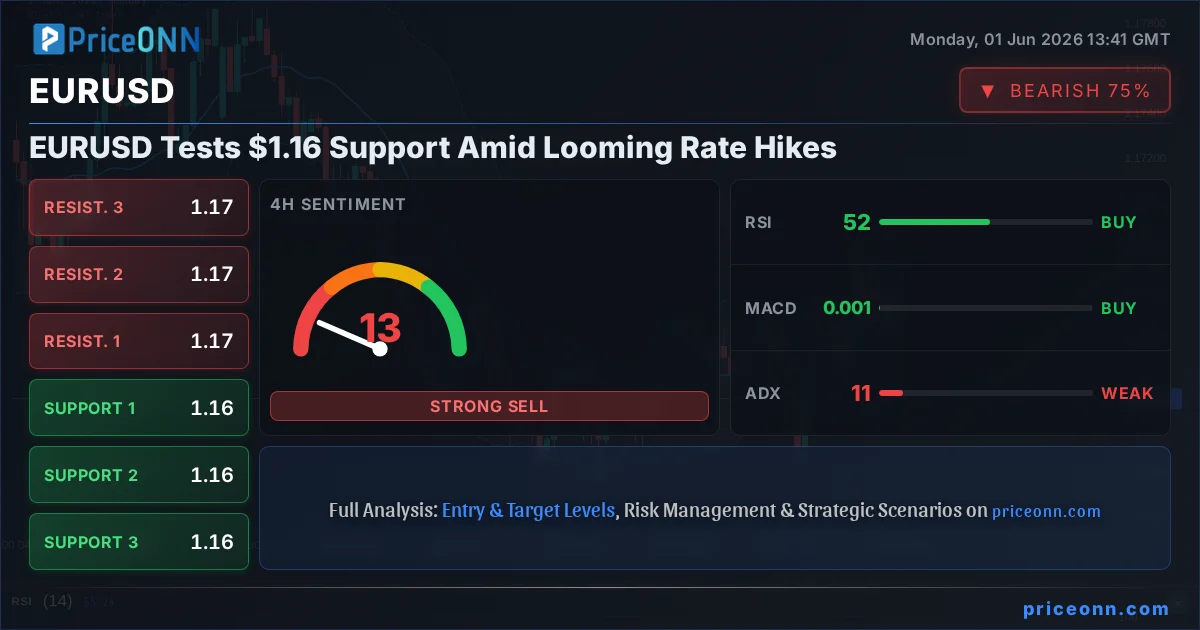
Following these remarks, the EUR/USD pair experienced a modest recovery, trading near 1.1650, a 0.12% increase on the day. This indicates a degree of market confidence in the ECB's commitment to stability, even amidst external pressures.
Understanding the ECB's Toolkit
The ECB, headquartered in Frankfurt, serves as the central bank for the Eurozone. Its primary function is to maintain price stability, targeting an inflation rate of around 2%. The bank manages monetary policy for the 20 countries that use the euro.
Interest rate adjustments are the ECB's primary tool. Higher rates tend to strengthen the euro, while lower rates typically weaken it. The Governing Council, composed of the Eurozone national bank heads and six permanent members including ECB President Christine Lagarde, convenes eight times annually to make these critical decisions.
Unconventional Measures: QE and QT
In situations where conventional rate adjustments prove insufficient, the ECB can resort to Quantitative Easing (QE). This involves injecting liquidity into the financial system by purchasing assets, typically government or corporate bonds, using newly printed euros. QE generally exerts downward pressure on the euro's value.
Quantitative Tightening (QT), the reverse of QE, occurs when the ECB reduces its balance sheet by halting bond purchases and ceasing reinvestment of maturing bond principal. QT is generally considered a bullish signal for the euro.
What Smart Money Is Watching
Simkus's comments underscore a critical balancing act for the ECB: addressing inflationary pressures while mitigating the potential economic fallout from geopolitical instability. The central bank must carefully weigh the risks of overtightening, which could stifle growth, against the dangers of allowing inflation to become entrenched.
For traders, this means paying close attention to upcoming economic data releases, particularly inflation figures and growth indicators. Any surprises could trigger significant market movements in the EUR/USD, as well as impact European bond yields. Keep an eye on the German Bund, which often serves as a benchmark for Eurozone debt. The Euro Stoxx 50 index may also reflect investor sentiment regarding the region's economic outlook. Finally, a risk-off environment caused by geopolitical tensions could strengthen the US dollar.
The key risk lies in the potential for a policy misstep. Should the ECB react too aggressively to short-term fluctuations, it could inadvertently trigger a recession. Conversely, a failure to address persistent inflation could erode consumer confidence and undermine long-term economic stability.
Track markets in real-time
Empower your investment decisions with AI-powered analysis, technical indicators and real-time price data.
Join Our Telegram Channel
Get breaking market news, AI analysis and trading signals delivered instantly to your Telegram.
Join Channel PriceONN News
EUR/USD stalled below 1.1660 as the US Dollar defied expectations, refusing to weaken despite reports of a US-Iran ceasefire extension. Market participants remain cautious, awaiting concrete confirmation and assessing lingering inflationary pressures.
PriceONN News
EUR/USD closed at 1.1640, showing resilience amid mixed signals. Easing US-Iran tensions initially pressured the dollar, but persistent inflation concerns and political ratification hurdles are keeping the greenback surprisingly steady.
PriceONN News
The EUR/USD faces headwinds as core US PCE inflation unexpectedly rose to 3.3% year-over-year, reinforcing a 'higher for longer' interest rate narrative. Meanwhile, a US-Iran ceasefire extension boosted global risk appetite, potentially drawing capital away from safe-haven currencies.
PriceONN News
EUR/USD stabilized around 1.1640 as reports of a US-Iran ceasefire extension and potential Strait of Hormuz reopening eased inflation fears. However, the US Dollar's resilience suggests lingering caution among forex traders.
PriceONN News
USD/JPY is testing the critical 160 level as stalled US-Iran negotiations and hawkish Federal Reserve rhetoric fuel inflation concerns and a potential for further rate hikes. Traders are closely watching upcoming US Non-Farm Payrolls and Eurozone CPI data for direction.
PriceONN News
The USD/JPY pair is flirting with the 160 level as stalled US-Iran negotiations and hawkish Federal Reserve rhetoric fuel inflation concerns. Traders are closely watching upcoming US Non-Farm Payrolls and Eurozone CPI data.
PriceONN News
The US Dollar experienced a notable dip as a renewed ceasefire between the US and Iran spurred a rally in global equities, particularly in tech stocks. However, persistent core PCE inflation at 3.3% YoY continues to fuel 'higher for longer' rate expectations.
PriceONN News
USDJPY has returned to the area of previous interventions. The ECB is moving towards a rate hike in June. The US dollar retreated on Friday amid new record highs for stock indices and rumours of amendments to the US-Iran agreement. However, tit-for-tat exchanges between the adversaries pushed the dollar index back into the support zone […] The post Yen Braces for a New Storm appeared first on ActionForex.
PriceONN News
The US Dollar experienced a notable decline last week as markets priced in a potential diplomatic resolution to the US-Iran conflict, leading to a drop in oil prices and Treasury yields. This shift in sentiment suggests a move away from stagflation fears towards a more stable economic outlook.
PriceONN News
Markets are pricing in a potential de-escalation in the US-Iran conflict, leading to a significant drop in crude oil prices and a weakening US Dollar as diplomatic efforts appear to be gaining traction.
PriceONN News
The New Zealand Dollar surged on Friday, with investors interpreting Reserve Bank of New Zealand (RBNZ) comments as a sign that interest rate hikes could resume sooner and be larger than previously anticipated. This hawkish pivot has created significant trading opportunities.
PriceONN News
Canada's labor market is showing signs of stabilization, with analysts predicting a dip in the unemployment rate to 6.8% in May, driven by an expected 25,000 new jobs. This follows a period of sluggish GDP growth and rising joblessness earlier in the year.