
EUR/JPY Price Forecast: Edges lower below 185.00, while near-term bullish bias holds
 PriceONN Editorial Desk
Multi-source verification
PriceONN Editorial Desk
Multi-source verification
Eurozone Inflation Surprise Weakens Euro's Stance
The Euro, representing twenty nations within the European Union, experienced a downturn in early European trading, falling to approximately 184.95 against the Japanese Yen. This move follows a more substantial than anticipated decrease in Eurozone inflation for June. The unexpected slowdown in price increases has notably reduced the immediate pressure on the European Central Bank (ECB) to enact further interest rate hikes at its July 23rd meeting.
As the world's second most liquid currency, trailing only the US Dollar, the Euro's global financial footprint is immense. In 2022, it commanded a significant 31% share of all foreign exchange market transactions, with daily trading volumes exceeding a staggering $2.2 trillion. This global reach means that economic shifts within the Eurozone can have far reaching implications across international markets.
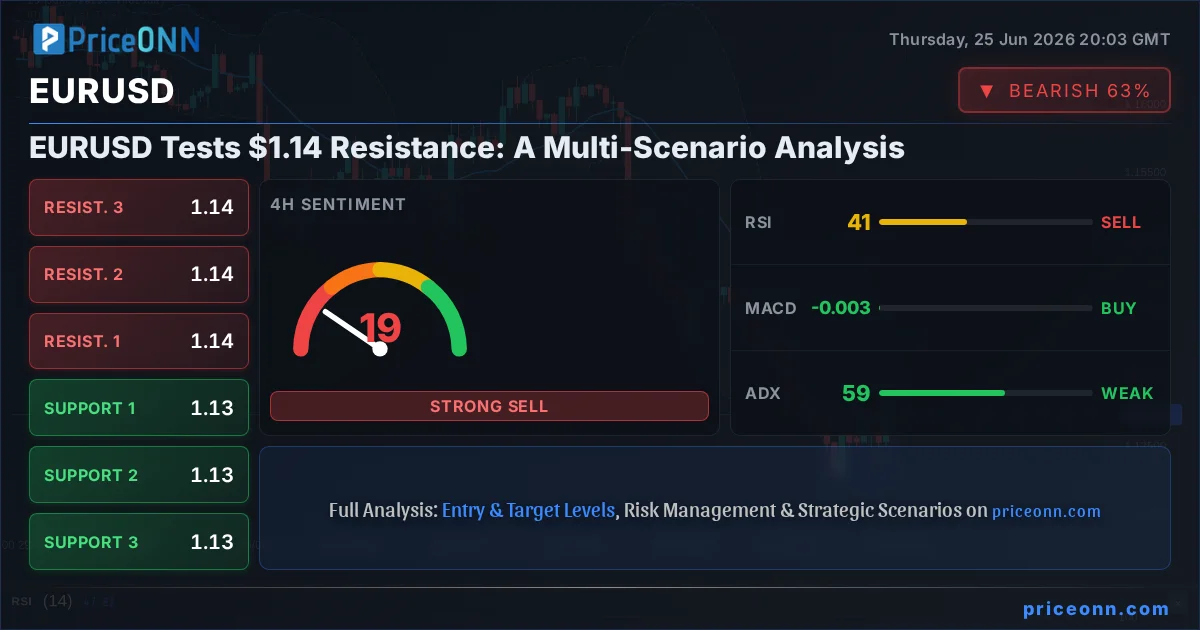
The EUR/USD pair stands as the most actively traded currency combination globally, accounting for an estimated 30% of all trades. Following closely are other major pairings such as EUR/JPY, representing 4% of the market, alongside EUR/GBP at 3% and EUR/AUD at 2%. Overseeing the monetary landscape for this crucial currency bloc is the European Central Bank, headquartered in Frankfurt, Germany. The ECB's core responsibilities include setting interest rates and steering monetary policy for the entire Eurozone.
ECB's Balancing Act: Price Stability vs. Growth
The ECB's fundamental objective is to ensure price stability, a dual mandate that involves managing inflation and, when necessary, stimulating economic expansion. Its primary instrument for achieving this balance is the adjustment of interest rates. Generally, higher interest rates, or even the anticipation of such increases, tend to bolster the Euro's value. Conversely, a trend of declining or stagnant rates typically exerts downward pressure on the currency.
Monetary policy directives are formulated by the ECB Governing Council during eight scheduled meetings annually. These critical decisions are reached through the collective input of the governors of the Eurozone's national central banks, alongside six permanent members, including the ECB's President, Christine Lagarde. For the Euro, the Harmonized Index of Consumer Prices (HICP), which gauges Eurozone inflation, serves as a key economic indicator. A surge in inflation, particularly if it surpasses the ECB's target of 2%, compels the central bank to implement rate hikes to regain control over price pressures.
When the Eurozone offers relatively high interest rates compared to other major economies, it enhances the region's appeal for international investors seeking yield. This inflow of capital can significantly strengthen the single currency. Economic data releases provide crucial insights into the health of the Eurozone economy and can directly influence the Euro's trajectory. Key indicators such as Gross Domestic Product (GDP) figures, Purchasing Managers' Indexes (PMIs) for manufacturing and services sectors, employment statistics, and consumer confidence surveys all play a role in shaping the currency's performance.
Market Ripple Effects
A robust economy within the Eurozone not only attracts foreign investment but also provides fertile ground for the ECB to consider increasing interest rates, thereby directly supporting the Euro. Conversely, weak economic data often leads to a depreciation of the Euro. The economic performance of the four largest Eurozone economies Germany, France, Italy, and Spain is particularly consequential, collectively contributing 75% to the bloc's overall economic output. Their data releases carry amplified weight for the Euro's direction.
Another vital data point influencing the Euro is the Trade Balance. This metric quantifies the difference between a nation's earnings from exports and its spending on imports over a specific period. When a country's exports are in high demand globally, its currency tends to appreciate due to increased demand from international buyers. Consequently, a positive net Trade Balance is a bullish signal for a currency, whereas a negative balance typically signals weakness.
Trader Takeaways
The recent dip in Eurozone inflation below expectations presents a complex scenario for EUR/JPY traders. While the immediate effect is a headwind for the Euro, the underlying bullish bias for EUR/JPY might still hold if the Japanese Yen faces its own headwinds or if other factors support the pair. The key takeaway is the softened outlook for ECB rate hikes, which removes a significant tailwind for the Euro in the short term. This could lead to increased volatility as markets re-evaluate rate expectations and economic growth prospects.
Traders should closely monitor the upcoming ECB meeting for any subtle shifts in forward guidance. Beyond the Euro, this inflation data could indirectly impact other currency pairs and risk assets. For instance, a less hawkish ECB might slightly temper demand for the Euro, potentially benefiting pairs like USD/JPY if the US Federal Reserve maintains a tighter monetary stance. Furthermore, a weaker Euro could put pressure on European equity indices like the DAX, while potentially offering a boost to export-oriented sectors globally if it signals broader disinflationary trends. The critical risk to watch is whether this inflation slowdown is a temporary blip or the start of a sustained trend, which could force a reassessment of the ECB's long-term policy path.
Track markets in real-time
Empower your investment decisions with AI-powered analysis, technical indicators and real-time price data.
Join Our Telegram Channel
Get breaking market news, AI analysis and trading signals delivered instantly to your Telegram.
Join Channel PriceONN News
The EUR/USD pair trades on a negative note near 1.1410 during the early European trading hours on Wednesday. Cooling inflation in Germany has lowered expectations for the European Central Bank (ECB) rate hikes, weighing on the Euro (EUR) against the US Dollar (USD).
PriceONN News
The EUR/GBP cross loses ground to around 0.8565 during the early European trading hours on Thursday. Fading expectation that the European Central Bank (ECB) will raise the interest rates this year weweighsn the Euro (EUR) against the British Pound (GBP).
PriceONN News
EUR/GBP may have passed a turning point that extends well beyond this week’s inflation data. The sharp break below key technical support reflects more than a softer Eurozone CPI report-it signals that one of the market’s biggest policy trades of recent months is beginning to unwind, and intensifying. Investors are no longer betting that the […] The post EUR/GBP Accelerates Through Key Support as ECB/BoE Yield Convergence Trade Reverses appeared first on ActionForex.
PriceONN News
European Central Bank (ECB) Governing Council Member and President of the Deutsche Bundesbank, Joachim Nagel, said during the European trading session on Wednesday that the monetary policy path is still on the upside, citing upside inflation risks.
PriceONN News
Eurozone manufacturing remained in expansion territory in June despite a modest slowdown in headline activity. The S&P Global Eurozone Manufacturing PMI eased from 51.6 to 51.4, a four-month low, while the Manufacturing Output Index rose from 51.3 to 51.7, its highest level in two months. The data suggest factory production continued to strengthen even as […] The post Eurozone PMI Manufacturing Shows Resilience, but Inventory Tailwind May Be Ending appeared first on ActionForex.
PriceONN News
USD/CAD has lost its recent gains from the previous day, trading around 1.4190 during the European hours on Thursday. Traders adopt a cautious stance ahead of the highly anticipated June Nonfarm Payrolls (NFP) report.
PriceONN News
USDJPY needs interventions and rate hikes. Monetary policy divergence is pushing EURUSD lower. The US dollar found no clues in Kevin Warsh’s comments, and attention shifted to the US labour market report for June. The Fed Chair noted a reduction in inflationary risks and reaffirmed the central bank’s commitment to bringing inflation back to the […] The post Will USDJPY Reach 200 Without Intervention? appeared first on ActionForex.
PriceONN News
Japan may not have spent a dollar today, but it may have achieved one of the key goals of intervention anyway. USD/JPY plunged from 162.59 to below 161.30, a move large enough to trigger immediate speculation that Tokyo had stepped into the market. There is no confirmation of actual intervention yet, but that may be […] The post USD/JPY’s 150 Pips Fall: A Tactical “Intervention” Masterclass by Japan Ahead of NFP appeared first on ActionForex.
PriceONN News
The Australian Dollar (AUD) remains practically flat against the US Dollar (USD) on Thursday, consolidating losses after having depreciated nearly 4% in June. The AUD/USD pair is trading within a broadly 65-pip range, with downside attempts contained at 0.6865 and bulls limited below 0.6930 so far.
PriceONN News
The British Pound (GBP) trades higher against its major currency peers, rising 0.1% to near 1.3290 against the US Dollar (USD) during the European trading session on Thursday.
PriceONN News
The Indian Rupee (INR) opens higher against the US Dollar (USD) on Thursday after a sharp decline the previous day. The USD/INR pair declines to near 95.00 as lower oil prices due to progress in talks between the United States (US) and Iran have improved the appeal of the Indian Rupee.
PriceONN News
USD/IDR inches lower after opening at a bullish gap, remaining in the positive territory for the fourth consecutive day, trading around 18,030 during the Asian hours on Thursday.