
Australian Dollar licks its wounds around 0.6900 awaiting US Nonfarm Payrolls data
 PriceONN Editorial Desk
Multi-source verification
PriceONN Editorial Desk
Multi-source verification
Market Pause Before US Data Deluge
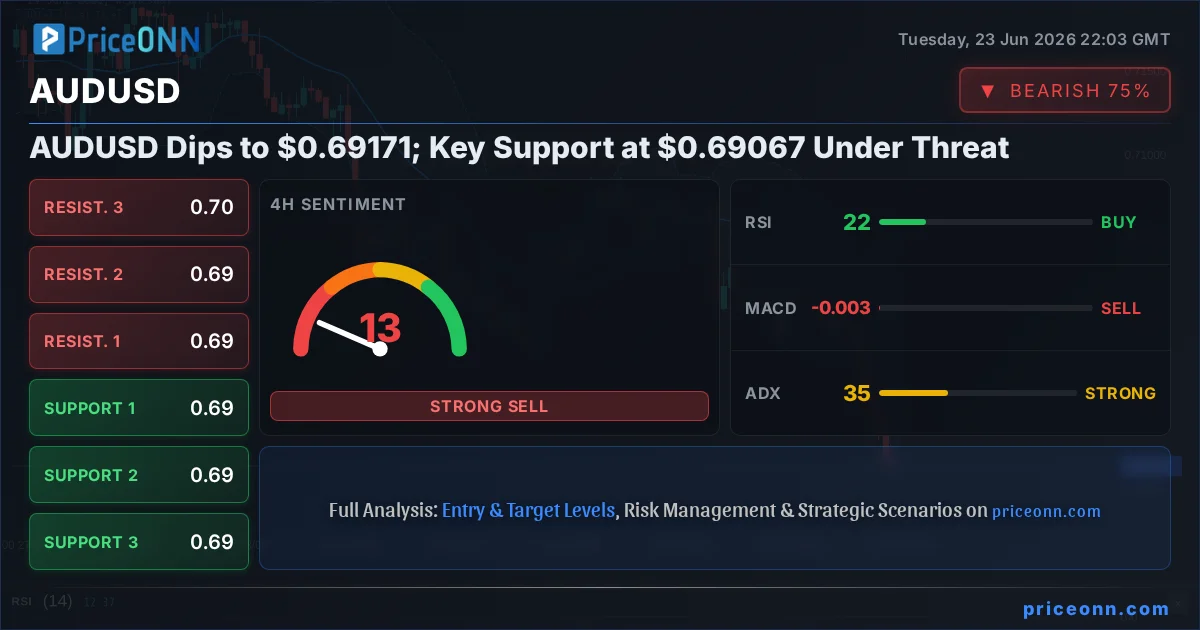
The Australian Dollar found itself in a holding pattern on Thursday, barely budging against its US Dollar counterpart. This period of consolidation follows a challenging June for the AUD, which saw it shed nearly 4% of its value. Trading activity has been confined to a narrow 65-pip band, with dips toward 0.6865 finding immediate support while advances above 0.6930 have been curtailed. This quiet before the storm sets the stage for significant volatility, contingent on upcoming US economic figures.
Domestic Trade Dynamics and Global Labor Market Watch
Earlier data from the Australian Bureau of Statistics offered a glimpse into the nation's economic health via its trade balance. This figure, representing the disparity between exports and imports of goods, acts as a key barometer. Robust export demand typically signals strengthening Australian growth, while import levels can indicate domestic consumption strength. A consistent rise in export demand generally translates to a positive trade balance, a scenario historically favorable for the AUD.
Meanwhile, all eyes are now fixed on the United States Bureau of Labor Statistics (BLS) and its imminent release of the Nonfarm Payrolls report. This monthly jobs creation data is arguably the single most influential economic indicator for forex traders worldwide. The figures, unveiled on the first Friday after the month's close, are closely watched as they directly correlate with the broader US economic performance. Policymakers, including the Federal Reserve, scrutinize labor market developments closely, as full employment is a core mandate influencing monetary policy decisions. These policy shifts, in turn, have a profound impact on currency valuations.
The inherent volatility of monthly payroll changes, coupled with the potential for significant revisions to prior months' data, often triggers sharp movements across the forex board. While a higher-than-expected job creation number is generally perceived as bullish for the USD, and a lower figure bearish, the market's ultimate reaction is complex. It hinges on the collective assessment of all components within the BLS report, including the unemployment rate and prior data reviews, rather than just the headline payrolls number.
Reading Between the Lines
The current stalemate in AUD/USD reflects a market caught between the anticipation of US economic data and the lingering effects of a challenging month for the Australian Dollar. The trade balance figures, while providing some domestic context, are overshadowed by the sheer weight of the Nonfarm Payrolls report. This US labor data is not just a snapshot of job creation; it's a critical input for the Federal Reserve's future interest rate decisions. Expectations for these decisions directly fuel USD strength or weakness.
Traders understand that surprises in the Nonfarm Payrolls report can unleash substantial market swings. A consensus beat often leads to a stronger USD, but the devil is in the details. The market's interpretation of wage growth, participation rates, and revisions to previous months' data can dramatically alter the impact of the headline number. This complexity means that even seemingly clear data can lead to unexpected currency reactions, a dynamic that seasoned traders are keenly aware of.
The AUD/USD pair's tight range suggests that major players are adopting a cautious stance, likely waiting for the US jobs data to provide a clearer directional signal. The 0.6900 level is a psychological pivot, with a decisive break above or below potentially initiating a new trend. Until then, expect choppy, range-bound trading as liquidity may thin ahead of the key release.
Market Ripple Effects
The impending US Nonfarm Payrolls report carries significant implications beyond just the AUD/USD pair. A strong jobs report could bolster the US Dollar Index (DXY), reflecting increased confidence in the US economy and potentially lifting demand for safe-haven assets. Conversely, a weaker-than-expected outcome might dampen the DXY and prompt a flight to riskier assets, potentially benefiting currencies like the AUD or even cryptocurrencies such as Bitcoin.
Furthermore, the data's influence will likely extend to global equity markets. A robust US labor market often correlates with higher consumer spending and corporate earnings, providing a tailwind for stock indices like the S&P 500. However, if the data suggests an overheating economy, it could also raise inflation concerns and fuel expectations of more aggressive Federal Reserve tightening, which could act as a brake on stock market gains. The implications for commodities, particularly those priced in USD like Gold, are also noteworthy. A stronger dollar typically makes gold more expensive for holders of other currencies, potentially pressuring prices downward, while weaker dollar scenarios can support gold prices.
Track markets in real-time
Empower your investment decisions with AI-powered analysis, technical indicators and real-time price data.
Join Our Telegram Channel
Get breaking market news, AI analysis and trading signals delivered instantly to your Telegram.
Join Channel PriceONN News
USD/CAD has lost its recent gains from the previous day, trading around 1.4190 during the European hours on Thursday. Traders adopt a cautious stance ahead of the highly anticipated June Nonfarm Payrolls (NFP) report.
PriceONN News
The NZD/USD pair edges higher following the previous day's two-way price moves and trades around the 0.5685 region during the Asian session on Friday.
PriceONN News
USDJPY needs interventions and rate hikes. Monetary policy divergence is pushing EURUSD lower. The US dollar found no clues in Kevin Warsh’s comments, and attention shifted to the US labour market report for June. The Fed Chair noted a reduction in inflationary risks and reaffirmed the central bank’s commitment to bringing inflation back to the […] The post Will USDJPY Reach 200 Without Intervention? appeared first on ActionForex.
PriceONN News
Japan may not have spent a dollar today, but it may have achieved one of the key goals of intervention anyway. USD/JPY plunged from 162.59 to below 161.30, a move large enough to trigger immediate speculation that Tokyo had stepped into the market. There is no confirmation of actual intervention yet, but that may be […] The post USD/JPY’s 150 Pips Fall: A Tactical “Intervention” Masterclass by Japan Ahead of NFP appeared first on ActionForex.
PriceONN News
The British Pound (GBP) trades higher against its major currency peers, rising 0.1% to near 1.3290 against the US Dollar (USD) during the European trading session on Thursday.
PriceONN News
The EUR/GBP cross loses ground to around 0.8565 during the early European trading hours on Thursday. Fading expectation that the European Central Bank (ECB) will raise the interest rates this year weweighsn the Euro (EUR) against the British Pound (GBP).
PriceONN News
The Indian Rupee (INR) opens higher against the US Dollar (USD) on Thursday after a sharp decline the previous day. The USD/INR pair declines to near 95.00 as lower oil prices due to progress in talks between the United States (US) and Iran have improved the appeal of the Indian Rupee.
PriceONN News
EUR/GBP may have passed a turning point that extends well beyond this week’s inflation data. The sharp break below key technical support reflects more than a softer Eurozone CPI report-it signals that one of the market’s biggest policy trades of recent months is beginning to unwind, and intensifying. Investors are no longer betting that the […] The post EUR/GBP Accelerates Through Key Support as ECB/BoE Yield Convergence Trade Reverses appeared first on ActionForex.
PriceONN News
USD/IDR inches lower after opening at a bullish gap, remaining in the positive territory for the fourth consecutive day, trading around 18,030 during the Asian hours on Thursday.
PriceONN News
The EUR/JPY cross trades on a negative note around 184.95 during the early European session on Thursday. Eurozone inflation fell more than expected in June, easing pressure on the European Central Bank (ECB) to raise rates at its next meeting on July 23.
PriceONN News
GBPUSD continues to show an incomplete bearish sequence from the January 27, 2026 high, keeping the bias tilted lower. The potential target can be measured using the 100% to 161.8% Fibonacci extension from that peak. This calculation defines a zone between 1.252 and 1.295, which remains the key area of interest for traders. The near‑term […] The post GBPUSD Elliott Wave Bearish Structure Calls for Further Weakness appeared first on ActionForex.
PriceONN News
The GBP/USD pair gains traction to near 1.3290 during the Asian trading hours on Thursday. The British Pound (GBP) strengthens against the US Dollar (USD) as the UK's likely next Prime Minister, Andy Burnham, has eased market concerns by pledging strict fiscal discipline.