

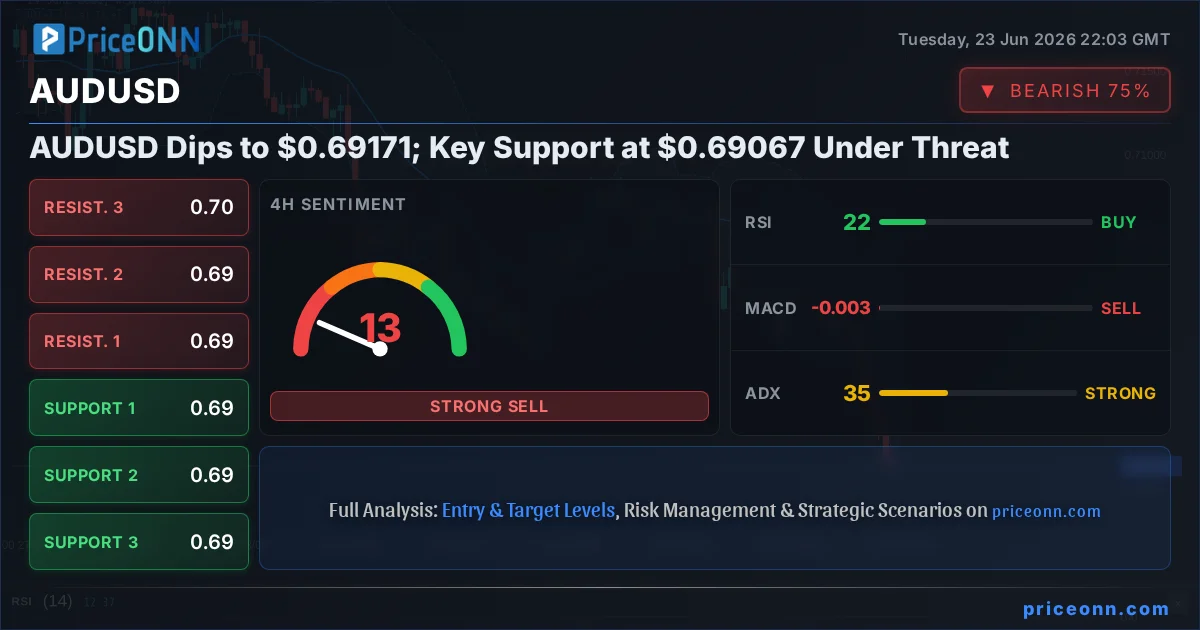
In a week marked by a resurgent US Dollar and a palpable shift in global risk appetite, the Australian Dollar against the US Dollar (AUDUSD) has succumbed to significant selling pressure, testing critical support levels. The pair is currently trading at $0.69171, reflecting a substantial daily decline and raising questions about the potential for further downside. This move is not happening in a vacuum; it's deeply intertwined with broader market forces, including the aggressive stance of the Federal Reserve and ongoing geopolitical tensions that are bolstering demand for safe-haven assets. Understanding these interconnected dynamics is crucial for navigating the current choppy waters.
- AUDUSD is trading at $0.69171, down -1.18% for the day, pressured by a strong DXY and risk aversion.
- The immediate support level at $0.69067 is under intense pressure, with a break below potentially signaling further declines.
- On the 4-hour chart, ADX at 35.06 indicates a strong downtrend, suggesting momentum is firmly with sellers.
- The US Dollar Index (DXY) is strong, trading at 101.42, reinforcing the bearish sentiment for AUDUSD.
- A break below $0.69067 could target $0.68827, while a recovery requires holding above $0.69331.
The narrative driving AUDUSD lower is multi-faceted, but the strength of the US Dollar, as measured by the DXY index trading at $101.42, stands out. A rising DXY typically exerts downward pressure on commodity-linked currencies like the Australian Dollar, as it makes the greenback more expensive for holders of other currencies and signals a preference for perceived safe-haven assets. This dynamic is amplified when global risk sentiment sours, as it appears to be doing now. The Nasdaq 100's sharp 2.99% drop to $29,439.29 and the S&P 500's 0.74% rise to $6,572.87, while showing divergence, highlight underlying nervousness in equity markets, particularly in tech-heavy indices, which often leads investors to seek refuge in the dollar.
Adding to the pressure on AUDUSD is the broader commodity complex, where gold and silver are experiencing significant declines. XAUUSD is down 1.93% to $4110.25, and XAGUSD has plunged 5.38% to $61.56. These moves suggest a broad-based risk-off sentiment where even traditional safe havens are being liquidated, potentially to cover margin calls or reallocate capital to cash or highly liquid dollar-denominated assets. The correlation between AUDUSD and gold has historically been strong, and a sharp downturn in the precious metal often foreshadows or accompanies weakness in the Aussie. The news that gold has fallen for the third consecutive week, with the precious metal starting the week near $4,150 USD per troy ounce, underscores this bearish sentiment in the broader commodity space.
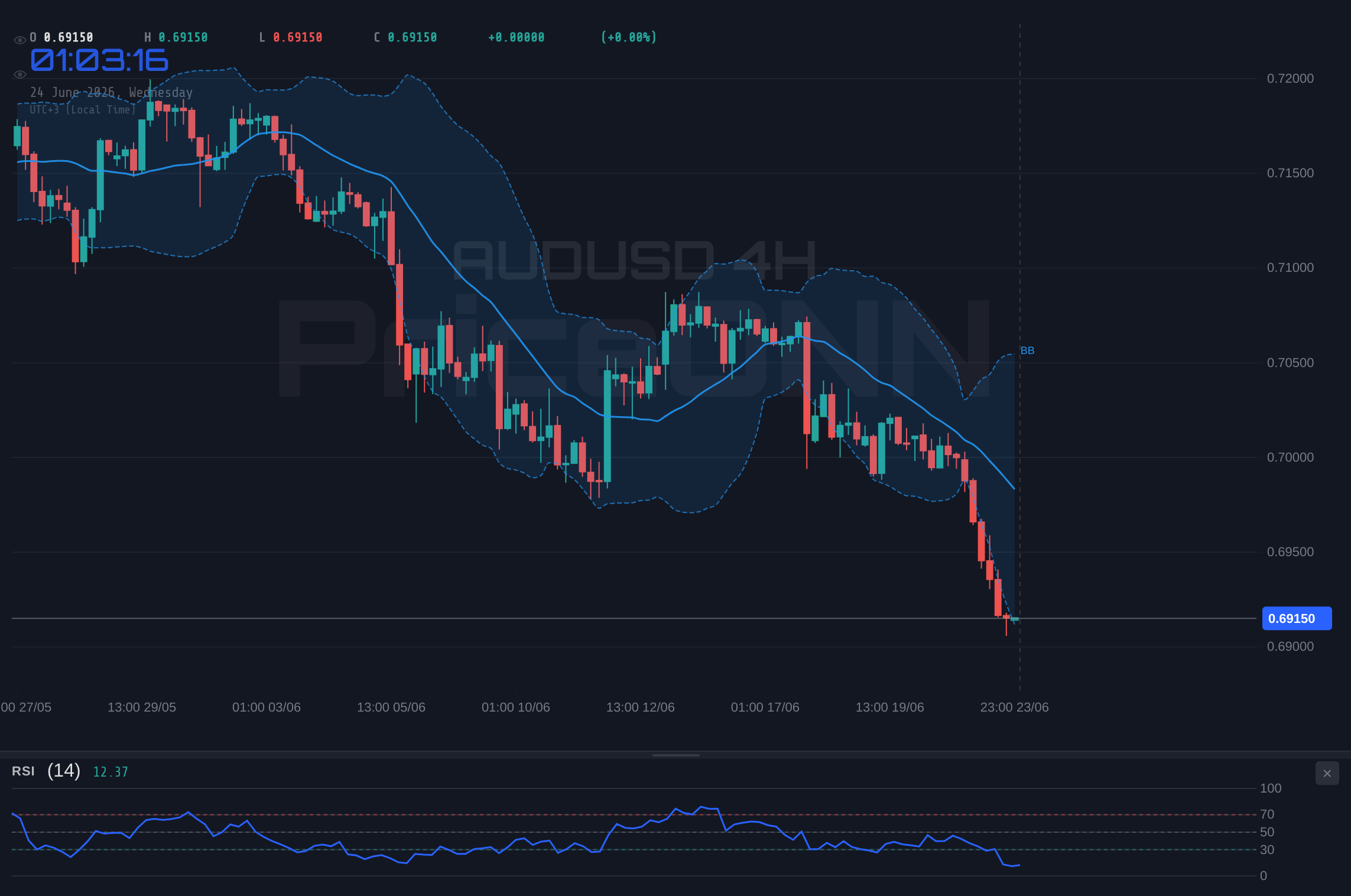
The Technical Picture: A Downtrend Intensifies
Examining the technical indicators for AUDUSD reveals a market firmly in the grip of sellers, particularly on the shorter and medium-term timeframes. On the 1-hour chart, the trend is decisively bearish with 93% strength, supported by an RSI(14) at 25.24, deep in oversold territory. While oversold conditions can sometimes signal a potential for a bounce, the accompanying ADX value of 46.34 suggests a powerful trend is in play, meaning that oversold conditions might persist or deepen before any significant reversal occurs. The Stochastic indicator, with K=23.05 and D=10.01, also confirms the bearish momentum, showing %K below %D and both well within the oversold zone.
The 4-hour timeframe reinforces this bearish outlook. The trend remains strongly downwards with 100% strength, and the ADX at 35.06 indicates a robust trend, far from the choppy, directionless conditions where price action can reverse quickly. The RSI(14) at 22.35 is even deeper in oversold territory than on the 1-hour chart, and the Stochastic (K=5.24, D=10.17) is similarly depressed. The MACD on this timeframe also shows negative momentum, with the MACD line below its signal line, confirming the prevailing downtrend. Bollinger Bands on both the 1H and 4H charts are showing the price trading below the middle band, a classic sign of bearish pressure.
Even on the daily chart, the trend is showing a strong bearish bias (87% strength), despite the RSI(14) at 29.39 still being in oversold territory. The ADX at 33.38 confirms a strong trend, indicating that the current downward move has significant legs. The Stochastic oscillator (K=17.34, D=30.65) continues to point lower, and the MACD remains in negative territory. This consistent bearish signal across multiple timeframes paints a clear picture: the path of least resistance for AUDUSD currently lies to the downside. The immediate focus is on the support level at $0.69067.
Key Levels and Price Action: The Battle for $0.69067
The critical support zone for AUDUSD currently lies between $0.69067 and $0.68827. The first level, $0.69067, represents the immediate floor. A decisive close below this level on a significant timeframe, such as the 4-hour or daily chart, would likely trigger further selling pressure, attracting more sellers and potentially leading to a rapid decline towards the next support at $0.68827. The daily range has seen the price dip to $0.69058, indicating that this level is already being tested in real-time. The high volatility, evidenced by the wide daily range of 0.7003 - 0.69058, suggests that significant price swings are occurring.
On the resistance side, the immediate hurdle for any potential recovery is the price level at $0.69171 (the current price), followed by $0.69331. A sustained move above $0.69331 would be required to invalidate the immediate bearish outlook and suggest a potential retest of higher levels. However, given the prevailing market conditions and the strength of the downtrend, such a recovery seems less probable in the short term without a significant shift in macro sentiment or a change in the DXY's trajectory. The news that the Eurozone economy is showing signs of stabilization, with the Flash Composite PMI Output Index rising, could offer some indirect support to riskier currencies if it signals a broader improvement in global economic health, but the immediate focus remains on the dollar's strength.
Scenario Analysis: Navigating the Downside Risk
Given the confluence of bearish technical signals and a strong US Dollar, the immediate outlook for AUDUSD remains tilted to the downside. However, markets are rarely one-directional, and it's essential to consider various scenarios.
Bearish Scenario: Downside Momentum Continues
65% ProbabilityNeutral Scenario: Consolidation Around Support
25% ProbabilityBullish Scenario: Short-Covering Rally
10% ProbabilityThe current technical setup, with multiple strong sell signals across timeframes and a robust ADX indicating a strong trend, favors the bearish scenario. The high probability assigned to the downside reflects the prevailing macro conditions and the technical evidence. However, traders should remain vigilant for any signs of capitulation or a shift in market sentiment that could trigger a short-covering rally. The news from the Eurozone PMI showing stabilization might offer a sliver of hope for risk assets, but it's unlikely to counteract the dollar's strength without more concrete positive developments.
Economic Calendar and Forward Guidance
Looking ahead, the economic calendar holds several key events that could influence AUDUSD's trajectory. On the Australian side, the upcoming inflation data and RBA announcements will be closely watched. The recent news highlighting 'Inflation, Jobs and 0.7000: A Defining Week for RBA and AUD/USD' suggests that market participants are keenly awaiting clarity on the RBA's next move. The question of whether the RBA is done hiking rates or if one final move is still on the table will be crucial. If data suggests further tightening is needed, it could provide some support for the AUD, but this may be overshadowed by global factors.
From a US perspective, any commentary from Federal Reserve officials regarding inflation and future policy will be paramount. Chicago Fed President Austan Goolsbee's recent statement that the key question is whether inflation stays at 3%-4% highlights the Fed's focus on the persistence of price pressures. If future data or commentary suggests a more hawkish stance or a longer path to rate cuts, it would likely reinforce the US Dollar's strength and keep pressure on AUDUSD. Conversely, any hint of a dovish pivot or a faster-than-expected disinflationary trend could offer some relief to the pair, though this seems unlikely given current market pricing and commentary. The interplay between domestic Australian economic data and global monetary policy expectations will be key.
The influence of geopolitical events cannot be overstated. The ongoing tensions and their impact on energy prices, as seen with the Hormuz Crisis sparking a Middle East Pipeline Boom, contribute to global uncertainty. While this can sometimes boost commodity currencies, the current risk-off environment seems to be channeling capital towards the US Dollar, regardless of commodity price action. This complex interplay means that traders need to monitor a wide range of factors, from central bank speeches to geopolitical headlines, to fully grasp the potential drivers of AUDUSD.
What This Means for Traders
For short-term traders, the current environment presents significant downside risk. The strong bearish trend signals across multiple timeframes suggest that fading rallies and looking for short opportunities on pullbacks could be a viable strategy. The key is to manage risk tightly, using the specified support and resistance levels as guides for entry and exit points. A break below $0.69067 would be a strong signal to consider a short position, targeting $0.68827, with a stop-loss placed just above the invalidation level of $0.69331.
For swing traders, the situation calls for patience and discipline. The strong ADX values indicate that trends are well-established, meaning that attempting to catch a falling knife is a risky endeavor. Waiting for a clear confirmation of a trend reversal or a significant pullback that offers a better risk-reward ratio for a long position would be prudent. Alternatively, shorting on intraday rallies that fail to break significant resistance levels could offer tactical opportunities. The current data suggests that the bearish momentum is likely to continue in the near term.
Longer-term investors might view the current price levels as potentially attractive for accumulating AUDUSD, especially if they anticipate a shift in global risk sentiment or a change in monetary policy direction. However, even for long-term plays, caution is advised. Entering positions during a strong downtrend carries significant risk. It might be wiser to wait for a clearer signal of stabilization, such as the formation of a double-bottom pattern or a sustained break above key resistance levels, before committing significant capital. The market's current disposition is risk-averse, and that sentiment needs to shift before sustainable upside for AUDUSD can be expected.
The Path Forward: Watching for Confirmation
The AUDUSD pair is currently navigating a challenging technical and fundamental landscape. The overwhelming evidence points towards continued bearish pressure in the short to medium term, driven by a strong US Dollar and a risk-off global sentiment. The critical support at $0.69067 is the immediate level to watch. A failure to hold this level could open the door to further significant declines, potentially revisiting levels not seen in months. The ADX reading of 33.38 on the daily chart underscores the strength of this prevailing downtrend, indicating that sellers are firmly in control.
Traders should be looking for confirmation of the bearish thesis by monitoring the DXY's trajectory and any shifts in global risk appetite. A sustained rise in the DXY above 101.42 and further declines in major indices like the Nasdaq 100 would reinforce the bearish outlook for AUDUSD. Conversely, any signs of stabilization in commodities or a dovish shift in central bank rhetoric could provide a reprieve. For now, the data suggests that caution is warranted, and any attempts to catch the falling knife should be met with stringent risk management. The market is sending clear signals, and adhering to them is paramount for survival and potential profit in these volatile conditions.
Bearish Scenario: Downside Momentum Continues
65% ProbabilityNeutral Scenario: Consolidation Around Support
25% ProbabilityBullish Scenario: Short-Covering Rally
10% ProbabilityFrequently Asked Questions: AUDUSD Analysis
What happens if AUDUSD breaks below the key $0.69067 support level?
A break below $0.69067 would likely trigger further selling pressure, with the next target at $0.68827. This scenario is currently assigned a 65% probability due to strong bearish technicals and a robust USD.
Should I consider buying AUDUSD at current levels around $0.69171 given the oversold RSI?
While the RSI is oversold at 29.39 on the daily chart, the strong ADX of 33.38 confirms a powerful downtrend. Buying now carries significant risk; a more prudent approach would be to wait for a confirmed trend reversal or a break above resistance at $0.69331.
Is the Stochastic signal of K=17.34, D=30.65 a strong sell signal for AUDUSD on the daily chart?
Yes, with %K below %D and both in the oversold zone, this Stochastic reading on the daily chart aligns with the broader bearish trend. It suggests that downward momentum is still dominant, even if extreme oversold conditions are present.
How will the upcoming RBA decision and US inflation data affect AUDUSD this week?
If the RBA hints at a pause or dovish stance while US inflation remains sticky, it could exacerbate AUDUSD's decline. Conversely, a hawkish RBA surprise coupled with cooling US inflation could offer temporary relief, but the strong dollar trend remains a significant headwind.
Track markets in real-time
AI-powered analysis, technical indicators and real-time price data.
Join Our Telegram Channel
Breaking market news, AI analysis and trading signals instantly.
Join Channel