

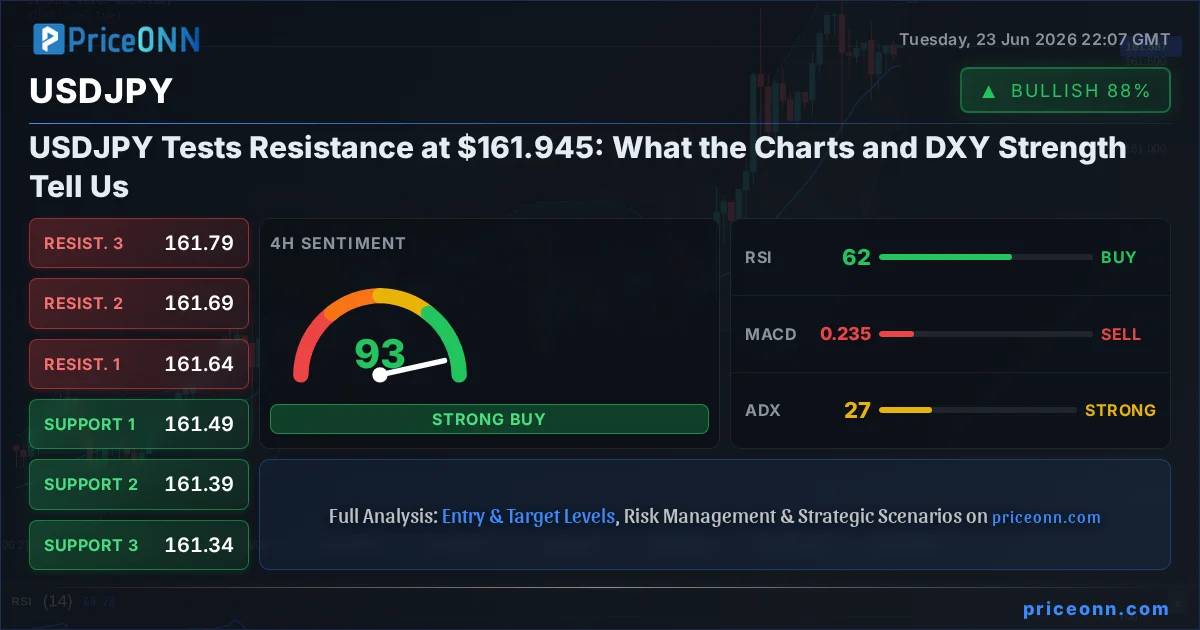
Amidst a robust dollar surge, USDJPY is currently testing critical resistance levels around the $161.945 mark. The latest market data shows the Dollar Index (DXY) climbing strongly, a familiar narrative that often puts pressure on pairs like USDJPY. But is this just another retracement in a broader uptrend, or are we on the cusp of a significant shift? This analysis dives deep into the technical underpinnings and macro currents shaping USDJPY's immediate future, leveraging real-time data to paint a clear picture for traders.
- With the DXY at 101.42, USDJPY faces pressure near its resistance at $161.945.
- The 1-hour chart shows a strong 94% downtrend bias for XAUUSD at $4,111.45, indicating broader market risk aversion.
- USDJPY's 1-day RSI stands at 70.47, signaling overbought conditions that could precede a pullback.
- The strong dollar trend, evidenced by DXY's 0.4% gain to 101.42, is a key driver supporting USDJPY's upward momentum.
The Dollar's Grip: DXY at the Forefront
The overarching theme in the FX market right now is the resurgent strength of the US Dollar, as measured by the Dollar Index (DXY). Currently trading at 101.42, the DXY has seen a notable 0.4% daily gain, pushing into levels not seen since early 2026. This surge is not happening in a vacuum; it's fueled by a confluence of factors, including expectations surrounding the Federal Reserve's monetary policy and a general shift towards safer assets. When the dollar strengthens this significantly, it tends to exert downward pressure on gold and other major currency pairs. The data clearly shows this correlation playing out, with XAUUSD currently falling 1.9% to $4,111.45, and XAGUSD down a stark 5.26% to $61.63. This risk-off sentiment, driven by dollar strength, is a crucial backdrop for understanding USDJPY's current positioning.
USDJPY's Ascent: Technical Signals on Multiple Timeframes
Turning our attention to USDJPY, the pair is currently trading at $161.57, hovering just below a significant resistance level at $161.945. The technical picture across different timeframes presents a somewhat mixed, yet predominantly bullish, outlook. On the 1-hour chart, the trend is neutral with 50% strength, but the ADX at 9.74 indicates a weak trend overall, suggesting choppy conditions rather than a clear directional move. However, the RSI(14) at 52.49 shows a slight upward inclination, and the MACD is positive, with the MACD line above its signal line. Stochastic is showing a potential dip, but the overall sentiment on this timeframe leans towards caution.
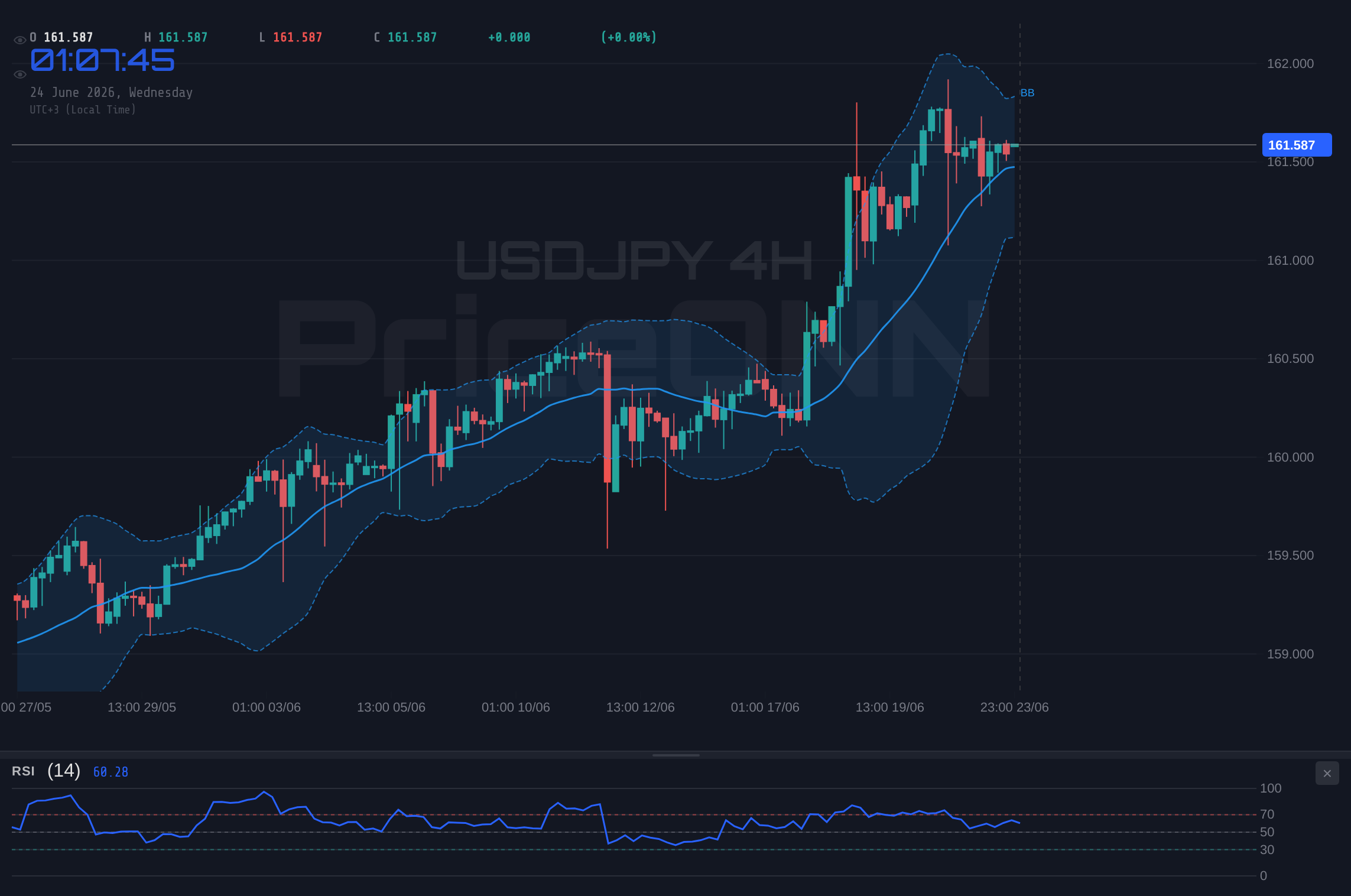
Stepping back to the 4-hour chart, the trend shifts to a clearer bullish stance, with 78% strength. Here, the RSI(14) at 61.3 remains in neutral territory but points upwards, reinforcing the bullish momentum. The MACD, while showing negative momentum, has its line below the signal line, which can sometimes precede a bullish crossover. Crucially, the Stochastic K is above D (58.53 vs 55.73), indicating a bullish signal in this timeframe. The ADX at 26.88 suggests a strong trend is developing, lending credence to the bullish bias. This aligns with the general market sentiment favoring the dollar.
The daily chart solidifies the bullish narrative for USDJPY. The trend is firmly established as bullish with 89% strength. The RSI(14) is at 70.47, firmly in overbought territory. This is a key point of caution; while it confirms strong upward momentum, it also suggests that a pullback or consolidation might be on the horizon. The MACD is positive and above its signal line, indicating sustained bullish momentum. Stochastic also shows overbought conditions (K=81.91, D=80.44), reinforcing the idea that the pair is nearing a point where profit-taking could occur. Despite the overbought signals, the strong trend indicated by the ADX at 18.46 (though classified as a weak trend in the data, it's in a zone that often precedes stronger moves after consolidation) suggests that the upward pressure could persist, especially if key resistance levels are breached.
Correlation Analysis: DXY, Equities, and the Yen
Understanding the interplay between USDJPY and other major markets is paramount. The strong DXY performance is, as mentioned, a primary driver. With the dollar strengthening, it naturally bids up the USD component of USDJPY. This dynamic is further amplified by risk sentiment. We're seeing a clear risk-off environment, with major indices like the Nasdaq 100 experiencing a significant 2.98% drop to 29444.29. This decline in risk appetite typically supports safe-haven currencies, and the Japanese Yen, despite its own correlation with USD strength, often benefits when global risk aversion intensifies. However, the current data suggests that the dollar's strength is overriding typical safe-haven flows into the Yen, at least for now. The Dow Jones 30 is also showing signs of weakness, down 0.17% to 51675.5, further painting a picture of caution in the equity markets that, paradoxically, seems to be fueling dollar demand.
The correlation breakdown is critical here. While a falling Nasdaq and a weaker S&P 500 (down 0.74% to 6572.87) might normally suggest a weaker USDJPY, the dominant factor appears to be the Federal Reserve's policy outlook versus the Bank of Japan's. The news feed indicates ongoing discussions about inflation remaining sticky, which could keep the Fed on a hawkish path, or at least delay rate cuts. This divergence in monetary policy expectations is a powerful tailwind for USDJPY, pushing it higher despite global risk aversion. The fact that EUR/USD is also falling (-0.39% to 1.13795) underscores the broad-based dollar strength.
Navigating the Resistance: What's Next for USDJPY?
The immediate focus for USDJPY traders will be the $161.945 resistance level. A decisive break and sustained hold above this level could open the door for further upside, potentially targeting the next resistance at $161.640 and then $161.789 on the 4-hour chart. However, the overbought RSI on the daily chart (70.47) and Stochastic (K=81.91, D=80.44) presents a significant hurdle. A failure to break through $161.945 could lead to a pullback, with initial support found at $161.582, $161.500, and $161.46 on the 1-hour chart. Deeper support lies at $161.342 on the 4-hour chart. The ADX readings across timeframes, particularly the strong 46.94 on the 1-hour EURUSD chart (though not USDJPY specific, it indicates broad FX trend strength) and the 55.73 on the 4-hour EURUSD, suggest that when trends do form, they are powerful. For USDJPY, the ADX at 26.88 on the 4H and 18.46 on the 1D suggests a trend is building, but perhaps not yet fully committed.
The sentiment from the 1-hour chart, despite its neutral trend strength, shows a higher probability of a move. With 7 out of 8 signals leaning towards 'BUY', it suggests short-term traders are anticipating a breakout. Conversely, the daily overall signal is also heavily skewed towards 'BUY' (5 Sat, 2 Buy, 0 Neutral), reinforcing the bullish bias despite the overbought indicators. This conflict between overbought conditions and sustained bullish signals warrants careful observation. It suggests that while a correction is possible, the underlying trend strength could overpower it, especially if macroeconomic news continues to favor a stronger dollar.
The Role of Central Banks and Economic Data
The recent news feed highlights the ongoing focus on central bank policies and inflation. Philip Lane of the ECB emphasized that their tightening is "calibrated," implying a measured approach, which contrasts with the potential for the Fed to maintain higher rates for longer if inflation proves "stubborn," as noted by Fed's Goolsbee. This divergence in policy paths is a fundamental driver for USDJPY. If the Fed remains hawkish while other central banks signal a pause or pivot, the dollar will likely continue to find support. The Eurozone economy showing stabilization with services recovery is positive for the Euro, but its current weakness against the dollar (EUR/USD near 1.1430) indicates the dollar's momentum is the dominant force.
Furthermore, the mention of a potential US-Iran deal, while impacting oil prices, also contributes to a complex risk landscape. However, the immediate impact on USDJPY appears to be overshadowed by monetary policy differentials. The fact that the Australian dollar is facing a defining week due to RBA decisions also points to a market highly sensitive to central bank actions. For USDJPY, the Bank of Japan's stance remains a key variable. As long as the BoJ maintains its ultra-accommodative policy while the Fed is perceived as potentially hawkish, the upward pressure on USDJPY is likely to persist, even if it leads to overbought conditions in the short term. The key takeaway is that the interest rate differential narrative is currently the primary force at play.
Scenario Analysis: Mapping Potential Moves
Given the current technical readings and the prevailing market sentiment, we can outline three potential scenarios for USDJPY.
Bearish Scenario: Resistance Holds Firm
25% ProbabilityNeutral Scenario: Consolidation Near Resistance
40% ProbabilityBullish Scenario: Breakout Confirmation
35% ProbabilityThe current technical setup, particularly the overbought conditions on daily oscillators coupled with strong dollar momentum, suggests that consolidation or a minor pullback might be more probable in the immediate short term, giving the neutral scenario a slight edge. However, the underlying bullish trend and the potential for continued dollar strength keep the bullish scenario very much alive, especially if key economic data releases continue to favor a hawkish Fed stance.
Key Levels to Watch
Frequently Asked Questions: USDJPY Analysis
What happens if USDJPY breaks above the $161.945 resistance level?
A confirmed break above $161.945, especially on the 4-hour chart, could trigger a bullish scenario. This would likely target the next resistance level at $162.354, supported by the prevailing dollar strength and potential continuation of the bullish trend.
Should I consider buying USDJPY at current levels around $161.57 given the RSI at 70.47?
Buying at current levels near resistance with a daily RSI of 70.47 carries risk due to overbought conditions. While the trend is bullish, a more prudent approach might be to wait for a pullback to support levels like $161.500 or confirmation of a breakout above $161.945, with a probability estimate for a continued move potentially around 35%.
Is the MACD signal at 161.57 a sell signal for USDJPY right now?
The MACD signal on the daily chart is currently positive and above its signal line, indicating sustained bullish momentum rather than a sell signal. While short-term charts might show conflicting signals, the daily MACD supports the overall bullish trend, suggesting that any pullbacks might be temporary.
How will the Federal Reserve's stance on inflation affect USDJPY this week?
If Fed officials continue to signal concerns about "stubborn" inflation, it could reinforce expectations of higher-for-longer interest rates. This would likely strengthen the dollar further, providing a tailwind for USDJPY and potentially pushing it towards the $161.945 resistance and beyond.
USDJPY is at a critical juncture, testing significant resistance as the US dollar shows robust strength. While daily oscillators flash overbought signals, the underlying trend and macroeconomic divergences continue to favor the bulls. Traders must remain vigilant, closely monitoring the $161.945 level for a potential breakout or rejection. Patience and disciplined risk management will be key in navigating this potentially volatile period. Remember, the market always offers another opportunity; the goal is to wait for the right setup.
Track markets in real-time
AI-powered analysis, technical indicators and real-time price data.
Join Our Telegram Channel
Breaking market news, AI analysis and trading signals instantly.
Join Channel