

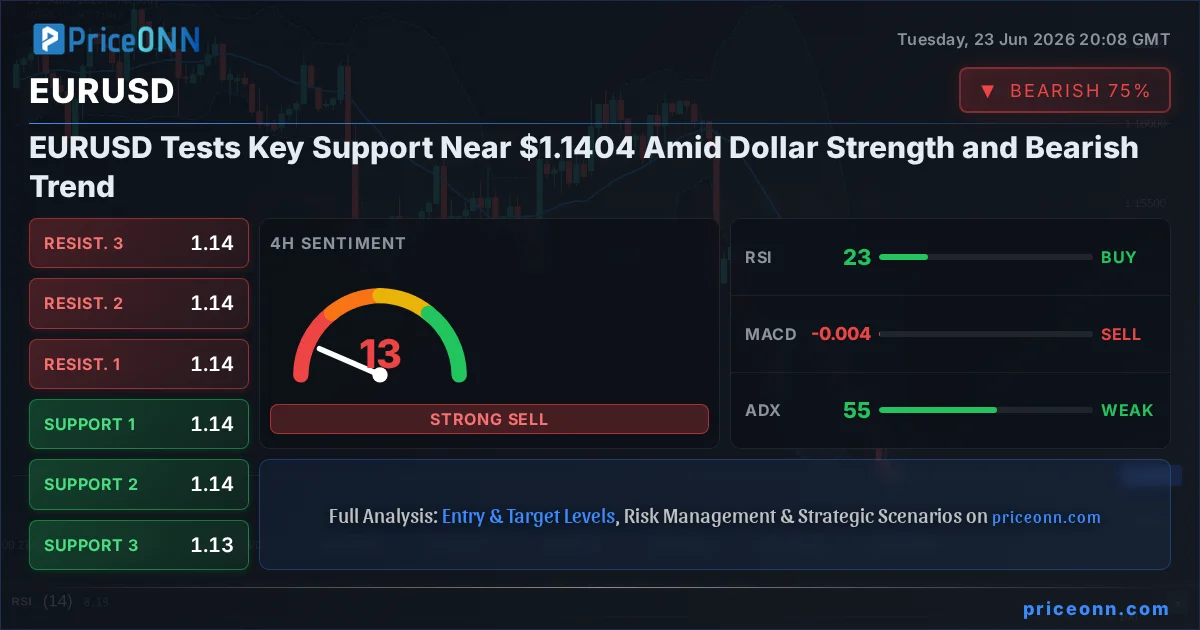
EURUSD is currently navigating a challenging period, trading at $1.13793 as the US Dollar Index (DXY) continues its ascent. This bearish pressure on the Euro, evident across multiple timeframes, sees the pair testing crucial support levels around the $1.1404 mark. The prevailing sentiment, coupled with strong dollar dynamics, paints a cautious picture for the single currency.
- EURUSD RSI(14) is at 23.24 on the 1H chart, indicating oversold conditions, but the strong bearish trend (ADX 46.44) suggests this may not halt the decline without confirmation.
- The critical support level for EURUSD is identified at $1.13756, with further downside targets at $1.13732 and $1.13711. A break below these levels would solidify the bearish outlook.
- The US Dollar Index (DXY) is currently at 101.44, showing strength and putting downward pressure on EURUSD, consistent with its inverse correlation.
- ECB Chief Economist Philip Lane's comments suggest a 'calibrated' response rather than aggressive tightening, which may limit upside potential for the Euro against a strong dollar.
Navigating the Bearish Tide: EURUSD's Current Predicament
The Dollar's Unrelenting Advance
The narrative for EURUSD is currently dominated by the robust performance of the US Dollar. The Dollar Index (DXY) has climbed to 101.44, marking a significant gain of 0.42% on the day. This strength is not merely a fleeting moment; it reflects a broader market sentiment that favors the greenback, likely driven by a combination of risk aversion and the perceived stability of the US economy relative to other major blocs. Historically, a rising DXY acts as a strong headwind for major currency pairs like EURUSD, often leading to price depreciation. The current DXY level of 101.44 is a critical benchmark, and its continued ascent suggests that the downward pressure on EURUSD is likely to persist, at least in the short to medium term. Traders are closely watching the DXY's ability to maintain its upward momentum, as any faltering could provide a much-needed reprieve for the Euro.
This dollar strength is particularly impactful given the current market environment. With global risk appetite showing signs of waning, as indicated by potential weakness in indices like the S&P 500 and Nasdaq, investors tend to flock towards perceived safe-haven assets, with the US dollar often being a primary beneficiary. This dynamic creates a powerful confluence of factors pushing EURUSD lower. The tight correlation between the DXY and EURUSD means that for the Euro to find significant footing, the dollar would likely need to reverse course, a scenario that current technical indicators on the DXY do not immediately suggest.
Technical Breakdown: A Picture of Weakness
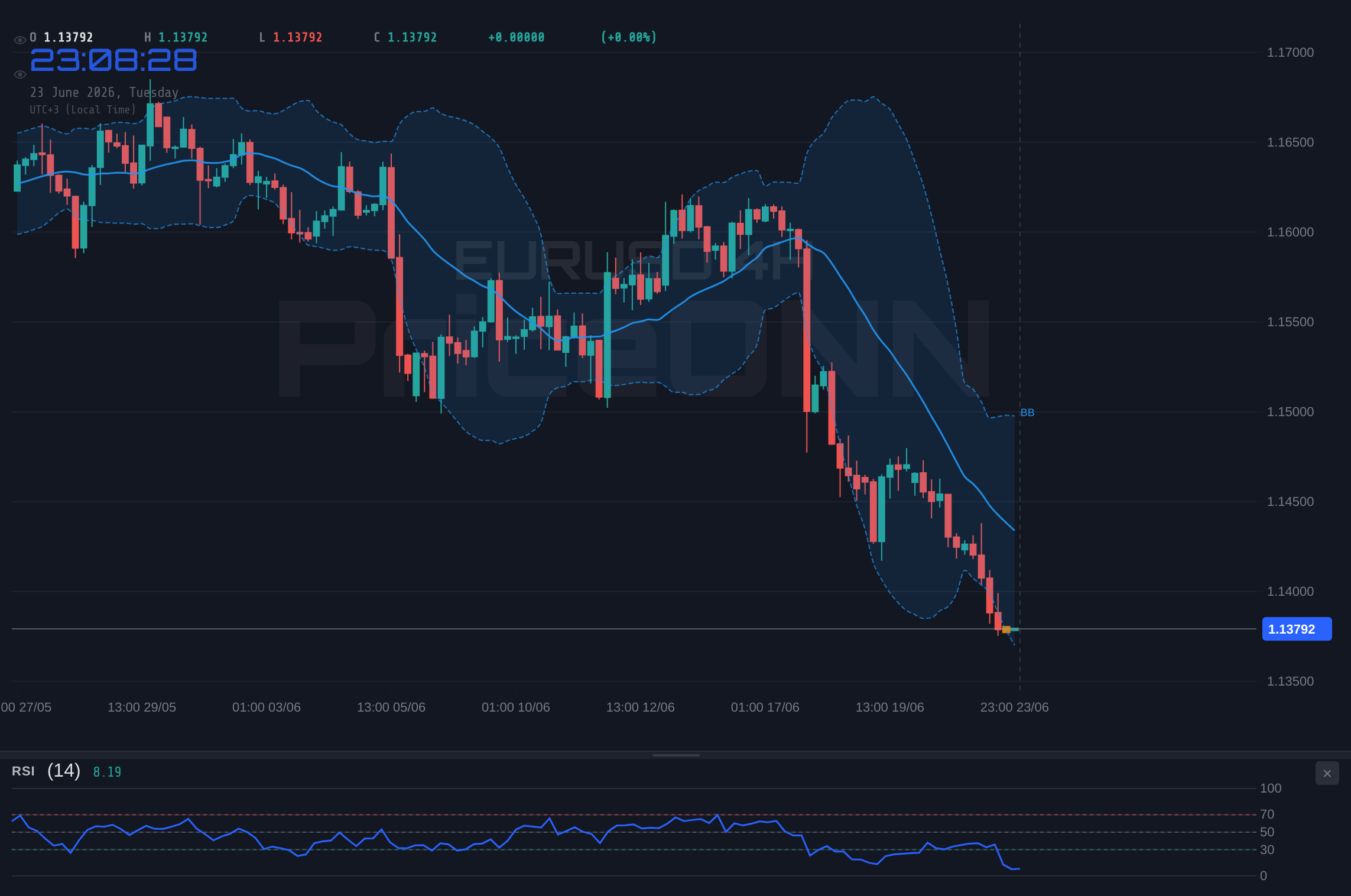
The technical landscape for EURUSD is overwhelmingly bearish across multiple timeframes, painting a grim picture for the single currency. On the 1-hour chart, the trend is decidedly downwards with a formidable 98% strength. The pair is currently hovering precariously close to the immediate support level at $1.13756. Below this, further support lies at $1.13732 and $1.13711. The RSI(14) is sitting at a deeply oversold 23.24, suggesting that sellers may be overextended in the short term. However, the MACD is below its signal line, and the Bollinger Bands are showing the price trading below the lower band, reinforcing the bearish momentum. The Stochastic Oscillator further supports this, with %K at 9.04 and %D at 9.73, indicating a bearish signal in extreme oversold territory. The ADX at 46.44 screams 'strong downtrend', confirming that the bears are firmly in control on this shorter timeframe.
The 4-hour timeframe offers an even starker view. Here, the trend is unequivocally bearish with 100% strength. Support levels are marked at $1.13761, $1.13641, and $1.13462. The RSI(14) at 22.96 is deeply entrenched in oversold territory, again hinting at a potential for a short-term bounce, but the overall trend structure is dominant. The MACD is negative and below its signal line, while the price is trading below the middle Bollinger Band. Stochastic K and D lines are at 5.3 and 11.96 respectively, firmly in oversold conditions and signaling further downside. The ADX at 54.6 is exceptionally high, indicating a very strong downtrend. This suggests that any upward movements are likely to be mere corrections within a larger bearish wave.
Even the daily timeframe, often considered more robust, shows a clear bearish trend with 90% strength. The daily support levels are at $1.14043, $1.13839, and $1.13496. The RSI(14) at 28.38 remains in oversold territory, a recurring theme that highlights the extent of the selling pressure. The MACD is negative, and the price is hugging the lower Bollinger Band. Stochastic K at 10.41 and D at 29.51 continue to signal a downtrend. The ADX at 29.33, while slightly lower than the intraday charts, still points to a strong downtrend. Taken together, the technical indicators across all analyzed timeframes present a unified message: EURUSD is in a significant downtrend, and any deviation from this path requires substantial evidence to the contrary.
The Impact of Central Bank Rhetoric and Economic Data
ECB's Calibrated Approach vs. Fed's Stance
Adding another layer to the EURUSD dynamic is the differing tones from the European Central Bank (ECB) and the Federal Reserve. Comments from ECB Chief Economist Philip Lane suggest that the central bank's recent policy tightening should be viewed as 'calibrated' rather than a 'huge, gigantic' tightening push. This implies that the ECB might be nearing the end of its hiking cycle or is adopting a more cautious approach to further rate hikes compared to the US central bank. This 'calibrated' stance could limit the Euro's upside potential, especially when contrasted with the Federal Reserve's more hawkish leanings, particularly if inflation proves to be persistent, as suggested by Chicago Fed President Austan Goolsbee's concerns about inflation staying at 3-4%.
The market's interpretation of these central bank communications is crucial. If the Fed continues to signal a readiness to maintain higher rates for longer due to stubborn inflation, this would further support the US Dollar, exacerbating the downward pressure on EURUSD. Conversely, any indication from the ECB that it might need to adopt a more aggressive stance to combat inflation could provide some support for the Euro. However, based on Lane's recent remarks, the former scenario appears more probable in the immediate future. The market's pricing of future interest rate expectations, often reflected in Fed Fund Futures and OIS rates, will be a key determinant of currency movements.
Eurozone Economic Resilience
Despite the bearish outlook for EURUSD, there are glimmers of resilience in the Eurozone economy that could provide a floor. The latest Eurozone PMI data showed the Flash Composite PMI Output Index rising from previous levels, suggesting that the economy is stabilizing and managing to stay out of recession, largely thanks to a recovery in the services sector. This indicates that while the manufacturing sector might be struggling, the services sector is showing signs of life, which is a positive sign for overall economic health. This resilience could, in theory, offer some support to the Euro, preventing a complete collapse.
However, the strength of the US dollar and the clear bearish technicals currently seem to be overshadowing these positive economic undertones. For the Eurozone's economic recovery to translate into significant currency strength, the data would likely need to be substantially better than expected, or there would need to be a clear signal from the ECB of more aggressive policy tightening. In the current environment, where the Fed is perceived as more hawkish and the dollar is riding a strong wave, the positive PMI figures might only provide temporary relief rather than a sustained turnaround for EURUSD.
Market Sentiment and Geopolitical Undercurrents
Risk-Off Appetite and Safe-Haven Demand
The prevailing market sentiment appears to be leaning towards risk aversion, a condition that typically benefits the US Dollar. While specific global risk indicators like the S&P 500 and Nasdaq are not provided in detail, the general trend of a strengthening dollar often correlates with a decrease in risk appetite. When investors become nervous about the global economic outlook or geopolitical stability, they tend to move capital away from riskier assets and into perceived safe havens. The US dollar, along with assets like gold and certain government bonds, often benefits from such a shift.
This risk-off sentiment can amplify the downward pressure on EURUSD. As investors shed Euro-denominated assets in favor of dollars, the demand for EUR falls, and the demand for USD rises, creating a dual effect that pushes the exchange rate lower. The ongoing geopolitical tensions, though not detailed in the provided data, are always a background factor that can quickly shift market sentiment. Any escalation in global conflicts or unforeseen political instability could further entrench this risk-off environment, reinforcing the dollar's strength and weighing on the Euro.
Gold's Vulnerability and Oil's Decline
The performance of other key markets provides further context. Gold, often considered a safe-haven asset, has started a fresh decline below the $4,265 support level, with a major bearish trend line forming. This is somewhat counterintuitive if the market were purely in a 'risk-off' mode where gold typically shines. However, the simultaneous strength of the dollar might be negating gold's safe-haven appeal. The news that gold has fallen for three consecutive weeks, starting the week near $4,150, indicates significant selling pressure. This weakness in gold, despite potential risk aversion, suggests that dollar strength is a dominant factor, or perhaps the market anticipates a less inflationary future than previously thought.
Oil prices, both Brent and WTI, are also showing weakness, trading down by 0.87% and 0.84% respectively. The decline in oil prices can be interpreted in several ways. It might suggest weakening global demand, which would align with a risk-off sentiment. Alternatively, it could indicate easing inflationary pressures, which might lead central banks to adopt less aggressive tightening policies. The news regarding the Strait of Hormuz crisis sparking a Middle East pipeline boom suggests that geopolitical supply disruptions might be less of a concern currently, or that alternative routes are being secured. A sustained drop in oil prices can indirectly support currencies of oil-importing nations while hurting those reliant on oil exports, but in the context of EURUSD, it adds to the overall picture of shifting market dynamics where dollar strength is a key driver.
Trading Scenarios and Risk Management
The Bearish Case: Testing the Depths
The most probable scenario, given the overwhelming technical and fundamental evidence, is a continuation of the bearish trend for EURUSD. The trigger for this scenario is the sustained trading below the $1.14043 key support level on the daily chart. If EURUSD fails to reclaim this level and continues to trade below it, the path of least resistance points downwards. The immediate targets would be the 1-hour support levels at $1.13756, followed by $1.13732. A decisive break below these could open the door to the 4-hour support at $1.13641. The invalidation of this bearish thesis would occur if the price decisively closes back above $1.14043, ideally with strong bullish momentum and a break of resistance levels.
The probability of this scenario playing out is high, estimated at around 65%. This is underpinned by the strong downtrend signals across all timeframes, the persistent strength of the DXY, and the potentially less dovish stance of the Fed compared to the ECB. The RSI being in oversold territory on intraday charts might lead to temporary bounces, but these are unlikely to alter the larger trend without significant confirmation, such as a break of key resistance levels or a shift in central bank rhetoric.
The Bullish Counter-Argument: A Potential Rebound?
While the odds are stacked against it, a bullish scenario cannot be entirely dismissed. The primary trigger for a bullish reversal would be a strong daily close above the $1.14043 resistance level. This would need to be accompanied by a shift in market sentiment, perhaps a pullback in the DXY or surprisingly hawkish comments from the ECB. If EURUSD can break above $1.14043 with conviction, the next resistance level to watch would be $1.1459 on the daily chart. A further push could target $1.14933. The invalidation of this bullish scenario would be a failure to hold above $1.14043, leading to a resumption of the downtrend.
The probability for this bullish scenario is currently low, estimated at around 10%. The current technical picture, with multiple indicators in oversold territory on shorter timeframes but still showing strong bearish trends on higher timeframes, suggests that any upside move might be a corrective bounce rather than a sustained trend reversal. Confirmation would be needed in the form of bullish divergence on oscillators, increasing volume on up-moves, and a clear break of key intraday resistance levels like $1.13801 and $1.13846 on the 1-hour chart.
The Neutral Path: Consolidation and Uncertainty
A neutral scenario suggests that EURUSD might enter a period of consolidation, hovering around the current price levels without a clear directional bias. This could occur if market participants await key economic data releases, such as upcoming inflation figures or central bank meeting minutes, which could provide clarity on future monetary policy. The trigger for this scenario would be the price consolidating between the immediate support at $1.13756 and resistance at $1.13801 on the 1-hour chart, or between the daily support of $1.14043 and resistance of $1.1459. The ADX readings, particularly on the daily chart (29.33), suggest a strong trend, making prolonged consolidation less likely, but it remains a possibility.
The probability for a neutral scenario is estimated at 25%. This would likely involve choppy price action, with the pair potentially oscillating between support and resistance levels without establishing a clear direction. Traders might look for short-term opportunities within this range, but the overall trend remains bearish, suggesting that a breakdown from this consolidation phase is more probable than a sustained move higher. The invalidation of the neutral scenario would be a clear break of either the defined support or resistance levels, leading back into the bearish or bullish scenarios respectively.
Navigating the Volatility: A Trader's Perspective
For traders operating on shorter timeframes, the current environment presents opportunities for scalping or short-term trades, particularly around the oversold levels indicated by RSI and Stochastic on the 1-hour and 4-hour charts. However, the extremely high ADX values (above 40 on intraday charts) signal strong trends, meaning that counter-trend trades are risky and require tight stop-losses. The general advice would be to focus on trades that align with the dominant daily trend, which is bearish.
Swing traders and position traders would likely be looking for confirmation of a sustained move. A break below the daily support at $1.13756 could be a signal to enter short positions, targeting lower levels. Conversely, a clear break and hold above the daily resistance at $1.1459 would be needed to consider a bullish position. Given the current ADX strength, patience is key; waiting for clearer signals and confirmation before committing significant capital is paramount. The risk/reward ratio for counter-trend trades is currently unfavorable due to the strong momentum.
The economic calendar provides context for potential volatility. While specific upcoming events were not detailed in the provided data, investors are always attuned to central bank communications and key economic indicators from both the US and the Eurozone. Any surprises in inflation, employment, or GDP figures could trigger significant price movements. For instance, if US inflation remains stubbornly high, it could embolden the Fed to maintain a hawkish stance, further pressuring EURUSD. Conversely, a significant economic downturn in the Eurozone could accelerate the bearish trend.
The Road Ahead: What to Watch
The outlook for EURUSD remains decidedly bearish in the short to medium term. The confluence of a strong US Dollar, a clear downtrend across multiple timeframes, and potentially divergent central bank policies suggests that further downside is probable. Key levels to watch remain the immediate support at $1.13756 and the more significant daily support at $1.14043. A break below these could signal a move towards the $1.13496 level.
On the upside, any sustained move above $1.14043 would be a tentative sign of a potential reversal, but this would require significant catalysts. Traders should remain vigilant for shifts in market sentiment, central bank communication, and key economic data releases. The DXY's trajectory will be a critical indicator to monitor, as its continued strength is a major impediment to any Euro recovery. For now, the bears appear to have the upper hand, and the focus remains on how far this bearish trend will extend.
Frequently Asked Questions: EURUSD Analysis
What happens if EURUSD breaks below the $1.13756 support level?
A break below $1.13756 on the 1-hour chart, especially with strong bearish momentum (high ADX), would likely signal a continuation of the downtrend. The next target would be $1.13732, with further downside potential towards $1.13641 on the 4-hour chart.
Should traders consider buying EURUSD at current levels near $1.13793 given the oversold RSI?
While the RSI(14) is deeply oversold (23.24 on 1H), the strong bearish trend indicated by ADX (46.44) suggests caution. Counter-trend trades are risky; confirmation of a bullish reversal, such as a break above $1.13801 and sustained momentum, would be needed before considering a buy.
Is the RSI at 23.24 a sell signal for EURUSD right now?
An RSI reading of 23.24 is typically considered oversold, suggesting potential for a bounce rather than a sell signal. However, in a strong downtrend (ADX 46.44), oversold conditions can persist. The primary signal remains bearish until confirmed otherwise by price action and other indicators.
How will the Fed's stance on inflation affect EURUSD this week?
If the Fed continues to signal concerns about persistent inflation (3-4%), it could lead to a more hawkish stance, strengthening the dollar. This would likely exacerbate the bearish pressure on EURUSD, potentially pushing it towards lower support levels as the market prices in higher-for-longer interest rates.
Track markets in real-time
AI-powered analysis, technical indicators and real-time price data.
Join Our Telegram Channel
Breaking market news, AI analysis and trading signals instantly.
Join Channel