

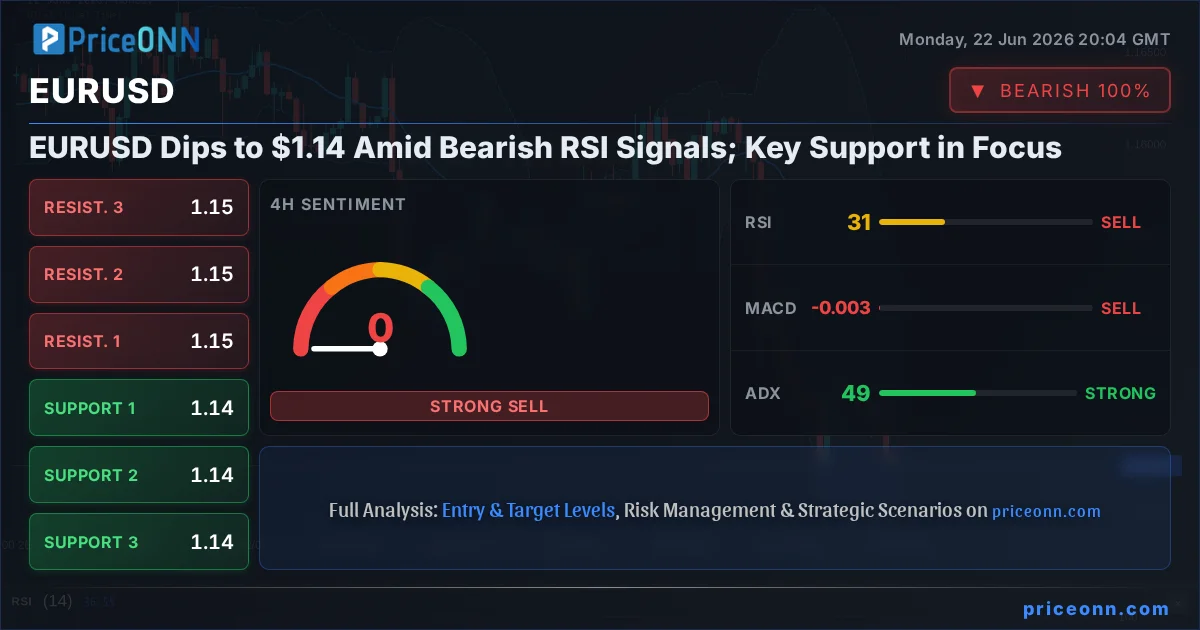
The narrative surrounding EURUSD has taken a decidedly bearish turn as the pair trades precariously close to critical support levels, currently hovering around the $1.14 mark. While broader market sentiment and geopolitical undercurrents often dictate the dance between the Euro and the US Dollar, the technical indicators are currently flashing a clear warning signal, with the Relative Strength Index (RSI) painting a particularly grim picture for the bulls.
- EURUSD is trading at $1.14256, with a bearish RSI of 36.46 on the 1H chart indicating potential downside.
- Key support is being tested at $1.14197, while resistance looms at $1.1429.
- The Dollar Index (DXY) is strengthening, currently at 101.06, adding pressure to EURUSD.
- A close below $1.14197 could trigger a move towards $1.14104, while a sustained rally above $1.14383 is needed for a bullish reversal.
The recent trading session has seen EURUSD struggle, shedding value and inching closer to the $1.14197 support level. This downward pressure isn't occurring in a vacuum; it's happening amidst a strengthening US Dollar, as evidenced by the Dollar Index (DXY) pushing higher to 101.06. This inverse correlation is a well-trodden path in forex markets: a stronger dollar typically means weaker demand for other currency pairs, including the Euro. The question on every trader's mind is whether this current dip represents a temporary pause before a recovery, or the prelude to a more significant decline. The charts, particularly the one-hour and four-hour timeframes, offer some compelling clues, but the daily outlook still presents a complex picture.
Diving deeper into the technicals, the 1-hour chart for EURUSD presents a mixed yet predominantly cautious outlook. The RSI(14) reading of 36.46 firmly places the pair in neutral territory, but more importantly, it shows a clear downward trend. This suggests that momentum is favoring sellers, and any upward movement might be met with resistance. The MACD indicator, also on the 1-hour timeframe, is showing negative momentum, with the MACD line below its signal line, reinforcing the bearish sentiment. However, the Bollinger Bands offer a slight counterpoint, indicating a potential for upward movement as the price is currently trading above the middle band. This creates a bit of a tug-of-war between indicators, suggesting that a decisive move might be pending confirmation.
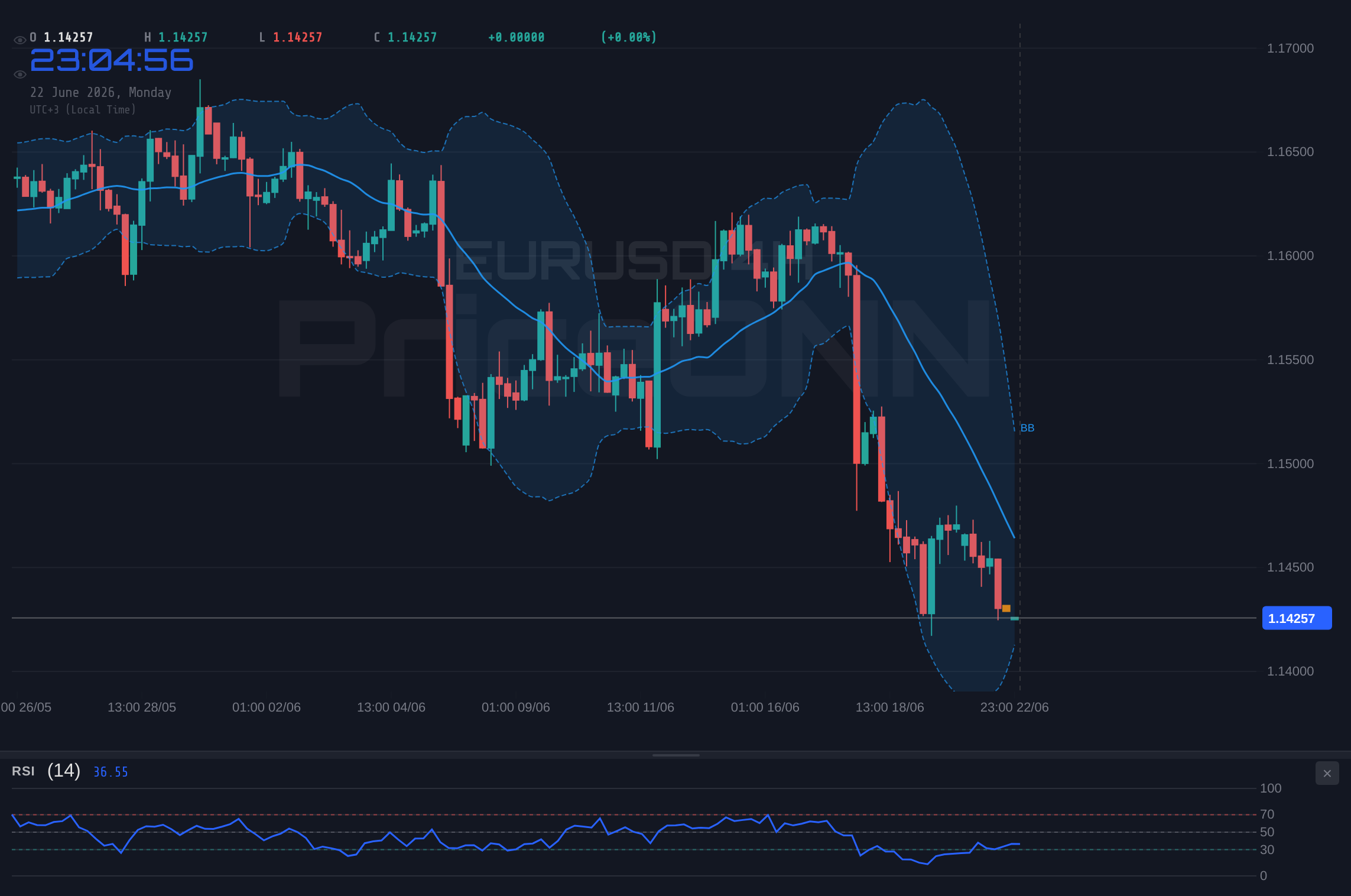
The Stochastic Oscillator on the 1-hour chart is currently reading K=9.44 and D=41.97. This places the pair deep within oversold territory, with the %K line significantly below the %D line. While this can sometimes signal an impending bounce, it also indicates strong selling pressure. The ADX, measuring trend strength, sits at 25.33. This indicates a reasonably strong trend is in play, which, when combined with the bearish RSI and MACD, leans towards the continuation of the downward move rather than a sharp reversal. The overall signal on the 1-hour timeframe is a mixed bag, but the weight of evidence, particularly from the RSI and MACD, leans towards caution and potential further downside.
Shifting our focus to the 4-hour timeframe, the picture for EURUSD becomes more clearly defined, and not in a way that would excite Euro bulls. The trend is neutral, but the underlying strength is leaning towards a decline, according to the ADX at 48.57 – a reading that signifies a strong downward trend. The RSI(14) here is even lower than on the 1-hour chart, sitting at 31.16. This is firmly in oversold territory, suggesting that the sellers might be overextending themselves, but it doesn't negate the bearish momentum. The MACD continues to show negative momentum, and the Bollinger Bands are positioned below the middle band, indicating a bearish bias.
The Stochastic Oscillator on the 4-hour chart presents a slight divergence. With K=44.28 and D=58.88, the %K line is below the %D line, reinforcing the bearish outlook. However, the Stochastic is not in oversold territory, unlike its 1-hour counterpart. This suggests that while there's selling pressure, there's still room for further decline without immediate oversold exhaustion. The confluence of a strong ADX pointing downwards, a low RSI, and negative MACD momentum on the 4-hour chart paints a more cohesive bearish narrative than what we saw on the shorter timeframe. The overall signal for this timeframe is a strong 'SELL', underscoring the prevailing negative sentiment.
When we zoom out to the daily timeframe, the longer-term trend for EURUSD is confirmed as decidedly bearish, with a strength of 84%. The current price of $1.14256 is navigating a landscape defined by significant support at $1.14318 and resistance at $1.14945. The RSI(14) on the daily chart reads 34.9, further cementing the oversold condition that has been building across multiple timeframes. This isn't just a short-term blip; it suggests a sustained period of weakness for the Euro against the dollar. The MACD is still showing negative momentum, and the Bollinger Bands are hugging the lower band, reinforcing the downward pressure.
The Stochastic Oscillator on the daily chart, with K=17.99 and D=37.41, also confirms the oversold conditions and bearish momentum. The ADX at 27.22 indicates a strong downward trend is in place. This daily perspective is crucial because it shows that the short-term bearish signals are not isolated incidents but are part of a larger, more established downtrend. For any potential buyers, this presents a challenging environment. The primary support level to watch on the daily chart is $1.14318. A decisive break below this level would likely confirm further downside, potentially targeting the subsequent support at $1.13931. Conversely, a sustained move above the resistance at $1.14945 would be required to challenge the prevailing bearish narrative.
The strengthening US Dollar Index (DXY) at 101.06 is a significant factor contributing to the pressure on EURUSD. As the DXY climbs, it often signals increased demand for the dollar, driven by factors such as higher US interest rate expectations, global risk aversion, or relative economic strength. Currently, the DXY is showing strong upward momentum across all observed timeframes (1H, 4H, 1D), with the daily ADX at 34.17 indicating a robust uptrend. This persistent dollar strength creates a headwind for the Euro, making it difficult for EURUSD to find sustainable footing and encouraging sellers to press their advantage.
Furthermore, the broader market sentiment, as reflected in the S&P 500 and Nasdaq indices, also plays a role. While the S&P 500 is showing some upward movement on the 1-hour chart, its daily trend is bearish, and the Nasdaq's daily trend is also bullish but showing mixed signals. This mixed risk appetite can create volatility. However, the prevailing strength in the DXY suggests that any 'risk-on' sentiment might be tempered, or that investors are favouring the US dollar as a safe-haven asset despite equity market gains. This dynamic reinforces the bearish outlook for EURUSD, as a strong dollar typically benefits from global uncertainty or a perceived divergence in economic policy.
Considering the confluence of bearish technical signals across multiple timeframes - particularly the oversold RSI, negative MACD momentum, and strong ADX readings - and the supportive backdrop of a strengthening dollar, the immediate outlook for EURUSD appears challenging. The pair is currently consolidating near a critical support zone. The ability of buyers to defend the $1.14197 level will be paramount in determining whether this is a temporary pullback or the start of a more sustained depreciation. The trading range on the 1-hour chart, between support at $1.14197 and resistance at $1.1429, is exceptionally tight, suggesting that a breakout is imminent.
The recent news flow also provides some context, though not always directly actionable for EURUSD's immediate price action. Reports of a 'Hormuz Crisis' and India rethinking its energy strategy highlight ongoing geopolitical tensions that can influence global risk sentiment and, by extension, currency markets. While these events might not directly impact the Euro in isolation, they contribute to the overall environment of uncertainty that often favors the US dollar as a safe-haven currency. Similarly, news regarding oil prices and their potential return to pre-war levels speaks to inflation concerns, which are intrinsically linked to central bank policies and, consequently, currency valuations.
The technical setup on EURUSD, especially the RSI's position and the ADX's strength on the 4-hour and daily charts, presents a clear trade recommendation. The bearish sentiment is strong, and the current price action near support suggests a potential continuation of the downtrend. However, the oversold conditions indicated by the Stochastic oscillator on the 1-hour chart warrant caution regarding immediate entries. A breakdown below the key support level of $1.14197 seems probable, but waiting for confirmation is crucial to avoid a potential 'stop hunt' or a false breakout.
The market is indeed at a critical juncture for EURUSD. The bearish technicals are hard to ignore, especially with the DXY showing robust strength. However, extreme oversold readings on shorter timeframes, coupled with the tight consolidation, suggest that the market could be coiling for a move. Traders will be watching closely to see if sellers can break the $1.14197 support decisively, or if buyers can muster enough strength to initiate a short-covering rally. The next few trading sessions, particularly with upcoming economic data releases, will be crucial in determining the pair's trajectory.
Given the strong bearish signals across multiple timeframes and the supportive DXY environment, the path of least resistance for EURUSD appears to be downwards. The aggressive sell signals from the 4-hour and daily charts, coupled with the RSI's sustained weakness, suggest that further declines are likely. However, the oversold Stochastic on the 1-hour chart and the tight trading range mean that a sharp, immediate drop isn't guaranteed. A clear break below $1.14197 is the primary trigger for a bearish scenario, potentially leading to significant downside. Until then, caution is advised, and risk management remains paramount.
Trade Scenarios for EURUSD
Bearish Scenario: Downside Momentum Continues
65% ProbabilityNeutral Scenario: Consolidation Before Move
25% ProbabilityBullish Scenario: Short-Covering Rally
10% Probability| Indicator | Value | Signal | Interpretation |
|---|---|---|---|
| RSI (14) | 36.46 | Bearish | Oversold pressure building |
| MACD Histogram | -0.00449 | Bearish | Negative momentum confirmed |
| Stochastic (%K) | 9.44 | Bearish | Deep oversold, potential bounce or continuation |
| ADX | 25.33 | Bullish | Strong trend in play (downward bias) |
| Bollinger Bands | Middle Band | Neutral | Price above middle band on 1H, below on 4H/1D |
Frequently Asked Questions: EURUSD Analysis
What happens if EURUSD breaks below the $1.14197 support level?
A decisive break below $1.14197 would likely confirm further downside momentum, potentially targeting the next support at $1.14104. This scenario is supported by the bearish RSI and MACD signals across multiple timeframes.
Should I consider buying EURUSD at current levels around $1.14256 given the oversold Stochastic?
While the 1-hour Stochastic oscillator is in oversold territory, the overall trend on higher timeframes remains bearish. Buying at current levels without a clear bullish reversal signal or a confirmed break of resistance carries significant risk, especially with the DXY strengthening.
Is the RSI at 36.46 a strong sell signal for EURUSD right now?
An RSI of 36.46 on the 1-hour chart indicates bearish momentum but is not yet in extreme oversold territory (typically below 30). Combined with negative MACD and a strong ADX, it supports a bearish outlook, suggesting that further downside is more probable than an immediate reversal.
How is the rising DXY at 101.06 impacting the EURUSD's bearish trend?
The strengthening DXY, currently at 101.06 and showing strong upward trends on daily charts, exerts significant downward pressure on EURUSD due to the typical inverse correlation. This dollar strength often reflects global risk sentiment or differing central bank outlooks, reinforcing the bearish case for the Euro.
Track markets in real-time
AI-powered analysis, technical indicators and real-time price data.
Join Our Telegram Channel
Breaking market news, AI analysis and trading signals instantly.
Join Channel