

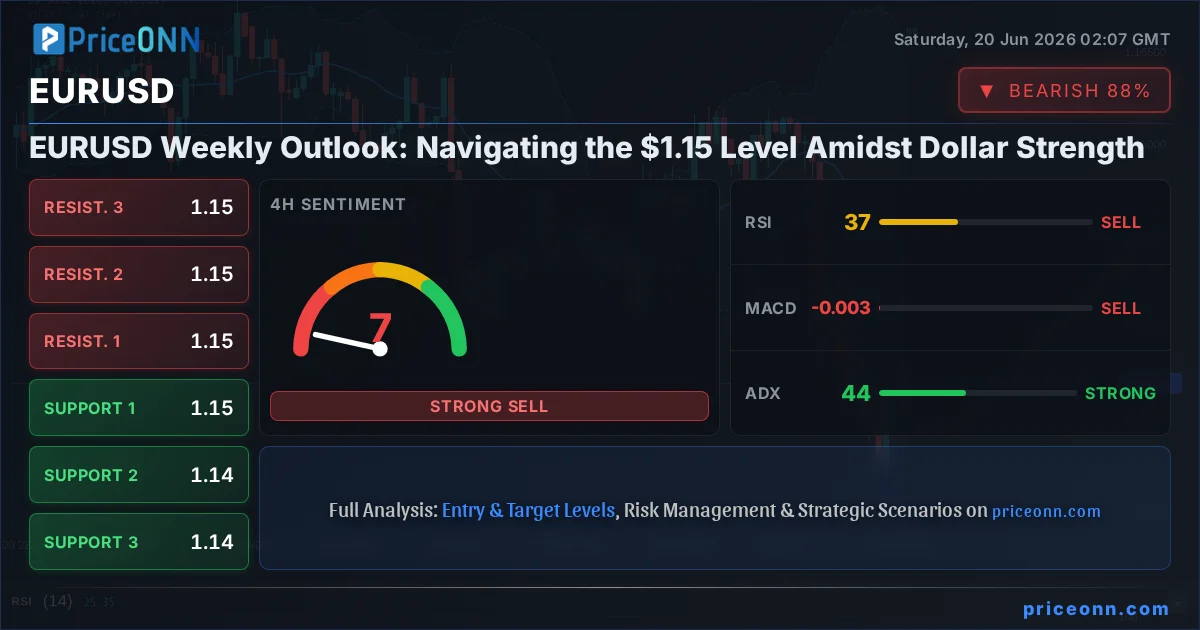
The EURUSD pair is currently navigating a challenging landscape, hovering around the $1.15 mark as the US Dollar Index (DXY) flexes its muscles. Last Friday's close saw the pair at approximately 1.1474, a level that has come under significant pressure. This bearish drift isn't merely a technical blip; it's a reflection of broader market sentiment favoring the dollar, driven by a confluence of factors including anticipated Federal Reserve policy divergence and persistent geopolitical undercurrents. As we step into a new trading week, the question on many traders' minds is whether this downward pressure on the Euro is set to intensify or if a reprieve is on the horizon. Understanding the interplay between the DXY, risk sentiment, and upcoming economic data will be crucial for charting a course through these choppy waters.
- EURUSD trades near $1.1474, showing a bearish drift influenced by a strong DXY at 100.85.
- Key support for EURUSD is identified at $1.14725, with a break below potentially targeting $1.14343.
- Resistance looms around $1.14793, a level that needs to be cleared for any significant bullish reversal.
- The current market sentiment favors the US dollar, impacting EURUSD correlation with the DXY's upward trajectory.
The past week has been a testament to the dollar's resilience, a theme underscored by the latest market data. The DXY, a key barometer of the greenback's strength against a basket of major currencies, finished the week hovering around 100.85. This level, while slightly off its weekly highs, signifies a robust upward trend that has been consistently pressuring riskier assets and, consequently, the Euro. The narrative driving this dollar strength is multifaceted. On one hand, the Federal Reserve's hawkish undertones, even amidst murmurs of a potential pause, continue to anchor demand for dollar-denominated assets. Fed futures are pricing in a certain probability of future rate hikes, a stark contrast to the more dovish stance hinted at by some other major central banks. This policy divergence creates a natural tailwind for the USD, making it an attractive proposition for carry trades and safe-haven seekers alike.
Furthermore, the global economic landscape, while showing pockets of resilience, is still fraught with uncertainties that tend to amplify the dollar's safe-haven appeal. Geopolitical tensions in various hotspots, coupled with lingering supply chain issues and the ongoing energy market volatility, contribute to an environment where investors gravitate towards perceived stability. The recent news flow, including reports of India ordering strategic oil reserve expansion and discussions around critical metals versus electricity bottlenecks for AI, highlights the complex global economic backdrop. While these specific headlines might not directly impact EURUSD in the short term, they contribute to the overall risk-off sentiment that bolsters the dollar. The EURUSD pair, therefore, finds itself caught between the dollar's inherent strength and the Eurozone's own economic challenges, creating a delicate balance that is currently tipping towards the bears.
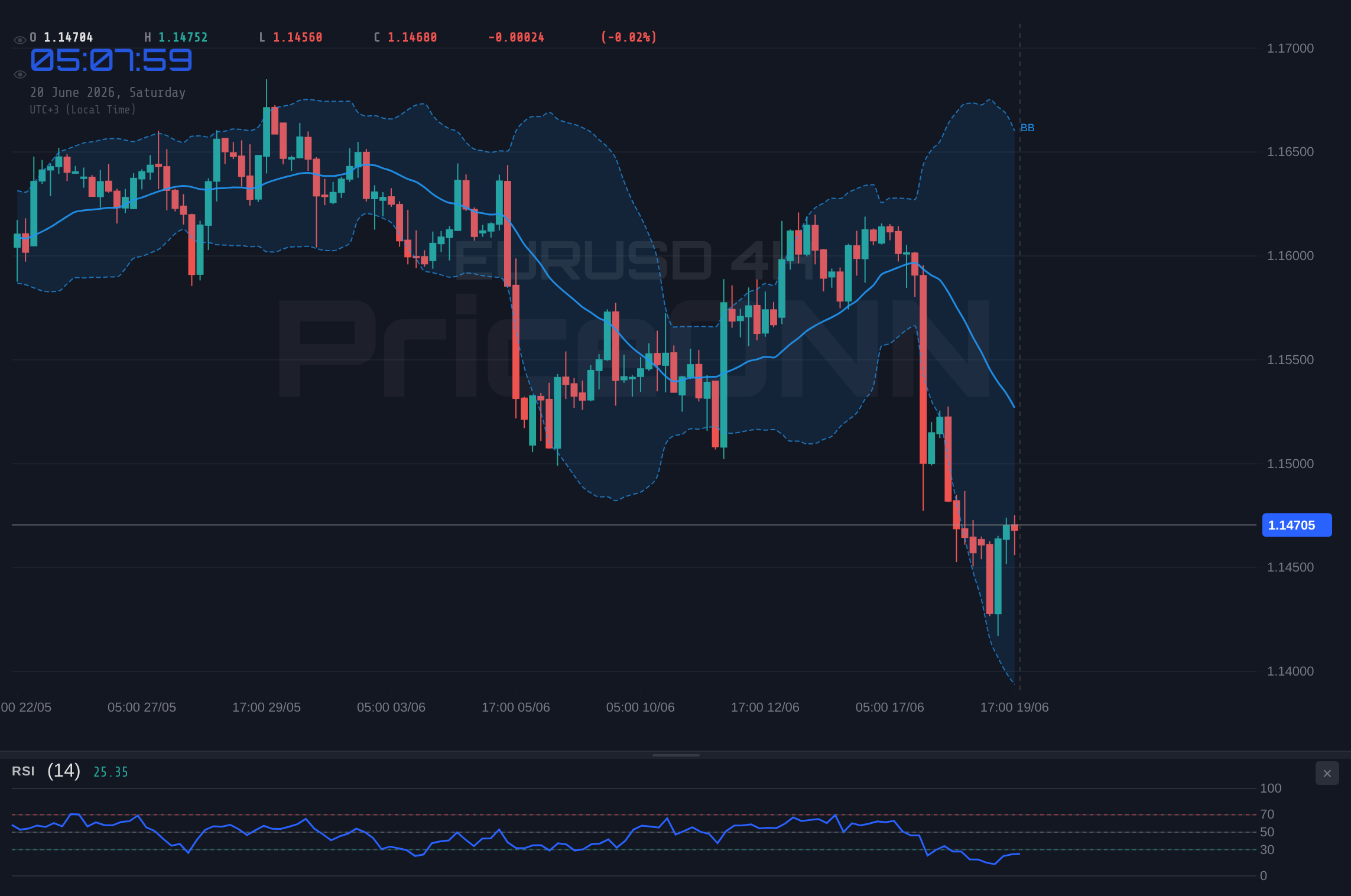
Navigating the Technical Terrain: EURUSD's Short-Term Outlook
On the 1-hour timeframe, EURUSD is exhibiting a neutral trend with a slight leaning towards bearish momentum. The RSI(14) sits at 54.6, indicating a market that is neither overbought nor oversold, but the MACD is showing positive momentum with the MACD line above the signal line. However, the Bollinger Bands are suggesting a bearish inclination as the price action is trading below the middle band. The Stochastic Oscillator is in overbought territory, with K=86.05 and D=81.7, signaling a potential pullback. The ADX at 25.89 indicates a moderately strong uptrend, which seems to contradict some of the other indicators. This mixed picture on the shorter timeframe suggests choppy price action, with potential for short-term fluctuations within a broader bearish trend. The immediate support level to watch is 1.14725, followed by 1.14694. Resistance is seen at 1.14793 and 1.14830.
Shifting to the 4-hour chart, the technical signals become more decidedly bearish. The trend is neutral but the power of the downtrend is growing, as indicated by the ADX at 43.89. The RSI(14) has fallen to 37.35, firmly in the neutral-to-bearish zone and showing a clear downward eğilim. The MACD is displaying negative momentum, with the MACD line below the signal line, reinforcing the bearish sentiment. Bollinger Bands are also below the middle band, pointing towards further downside potential. The Stochastic Oscillator, however, presents a slight divergence, showing a bullish signal with K=45.47 and D=18.29, where %K > %D. This could suggest a temporary bounce or a false signal within a larger downtrend. The general signal for this timeframe leans towards 'SELL', with support levels at 1.14566, 1.1443, and 1.14343, and resistance at 1.14789, 1.14876, and 1.15012.
The daily timeframe paints an even clearer picture of the prevailing bearish trend. With a trend strength of 83% and an ADX reading of 25.41, the downtrend is well-established. The RSI(14) is at 35.32, well within the neutral zone and continuing its downward trajectory, suggesting ample room for further decline before reaching oversold conditions. MACD is firmly in negative territory, below its signal line, confirming the bearish momentum. The Bollinger Bands are hugging the lower band, indicating significant selling pressure and potential for a break below the current price levels. The Stochastic Oscillator, with K=14.61 and D=40.52, presents a strong 'SELL' signal, as %K is significantly below %D and both are in oversold territory, hinting at potential further downside. The overall signal is a strong 'SELL', with key support levels at 1.14292, 1.14014, and 1.13522. Resistance is found at 1.15062, 1.15554, and 1.15832. This confluence of bearish signals across multiple timeframes underscores the prevailing sentiment against the Euro.
Broader Market Correlations: DXY, Equities, and the Euro's Plight
The strength of the US Dollar Index (DXY) is a critical factor influencing the EURUSD pair, and its recent performance has been a major headwind for the Euro. As the DXY hovers around 100.85, it exerts downward pressure not only on EURUSD but also on other major currency pairs and commodities. When the dollar strengthens, it typically implies a 'risk-off' sentiment in the broader market, or at least a preference for dollar-denominated assets as safe havens. This often correlates with a decline in major stock indices like the S&P 500 and Nasdaq. Indeed, the S&P 500 closed the week around 6572.87, showing a significant daily gain of 0.74%, but its 1D trend is categorized as 'Düşüş' (Downtrend) with ADX at 47.51, indicating underlying weakness despite the intraday recovery. The Nasdaq 100, similarly, ended the week around 30329.02 with a daily drop of 0.26%, and its 1D trend is also 'Yükseliş' (Uptrend) with ADX at 24.48, suggesting mixed signals but overall caution in the tech sector.
This dynamic between the dollar and risk assets is crucial for understanding EURUSD. A strengthening DXY, especially when accompanied by weakness in equities or a rise in Treasury yields (though yields are not provided here, they are implicitly linked to Fed policy expectations), typically spells trouble for the Euro. The Eurozone's own economic indicators, while not detailed in the provided data, are often perceived as less robust than those of the United States, particularly in the context of inflation and interest rate differentials. Recent news highlighted Canada's headline inflation potentially edging higher while core remains near target, and the UK's job growth stalling. These global economic snapshots contribute to a narrative where the US economy, despite its own challenges, is seen as a relatively more stable bet, further bolstering the dollar. The PriceONN market news from June 19th, stating 'EUR/USD Loses Ground as Market Sentiment Favours the US Dollar', perfectly encapsulates this intermarket relationship. The pair falling to its lowest level since March 31, 2026, as reported, directly links the price action to dollar favorability.
Gold (XAUUSD) and Silver (XAGUSD) also serve as important benchmarks. Gold, currently trading at $4155.56 and showing a daily decline of 1.27%, is in a strong downtrend (ADX 36.72 on daily). This suggests that the 'risk-off' sentiment, while bolstering the dollar, is not necessarily translating into a surge in safe-haven demand for gold, indicating a complex interplay of factors perhaps including higher interest rate expectations or strong dollar dynamics that negate gold's appeal. Silver, trading at $64.84 and also in a downtrend (ADX 30.31 on daily), mirrors gold's weakness. The fact that both precious metals are declining alongside a strengthening dollar and mixed equity performance suggests that the primary driver is dollar strength, potentially overriding traditional safe-haven flows or indicating that the market is pricing in a scenario where inflation fears are subsiding relative to growth concerns, which is typically USD-positive.
Geopolitical Factors and Economic Calendar: What's Next for EURUSD?
Geopolitical developments continue to cast a long shadow over global markets, and their impact on the EURUSD pair cannot be ignored. While specific new geopolitical catalysts directly impacting the Eurozone haven't been highlighted in the recent news snippets, the general backdrop of global uncertainty indirectly supports the US dollar's safe-haven status. Events such as the ongoing discussions around critical metals and electricity bottlenecks for AI, or India's strategic oil reserve expansion, point towards a global economy grappling with resource management and supply chain considerations. These broader themes contribute to a cautious market environment, where investors are likely to remain biased towards the perceived safety and liquidity of the US dollar. The news from June 16th, mentioning 'EUR/USD and GBP/USD Advance on Reports of a US–Iran Agreement', suggests that any de-escalation of geopolitical tensions can indeed provide temporary relief to riskier currencies, but the overarching trend favoring the dollar seems more persistent.
Looking ahead, the economic calendar will be crucial in shaping the trajectory of EURUSD. While specific upcoming events for the Eurozone aren't detailed in the provided data, recent PriceONN news indicated 'EUR/USD Ahead of the New Week: Expecting High Volatility' (June 15th). This suggests that market participants are anticipating significant price swings, likely driven by upcoming data releases or central bank commentary. The US economic calendar, though not explicitly detailed here, is implicitly driving the Fed's hawkish outlook. Any data that reinforces the US economy's resilience or suggests persistent inflation could further embolden the Federal Reserve, leading to continued dollar strength and pressure on EURUSD. Conversely, signs of significant economic slowdown or a dovish shift from the Fed could offer the Euro a much-needed respite. The Canadian inflation report for May, mentioned in the news, serves as an example of how key economic data from major economies can influence currency markets broadly, impacting pairs like EURUSD through cross-asset correlations and risk sentiment shifts.
The UK jobs market data, showing stalling growth and easing wage pressures, also provides context. While not directly about the Eurozone, it reflects a global trend of labor market adjustments and potential shifts in inflation dynamics. For EURUSD, the key will be how these global economic trends interact with the specific policies and economic health of the Eurozone. If the Eurozone continues to lag behind the US in terms of economic recovery or faces greater inflationary pressures relative to growth, the bearish outlook for EURUSD will likely persist. The tight correlation between EURUSD and DXY, where a rising DXY often leads to a falling EURUSD, is a technical manifestation of these fundamental forces at play. Traders will be closely watching any divergence between the two or significant shifts in central bank rhetoric to gauge potential turning points.
Trade Scenarios and Actionable Insights
Given the prevailing bearish sentiment, the technical indicators, and the broader market correlations, the outlook for EURUSD remains cautiously bearish. The daily chart presents a strong downtrend, reinforced by RSI below 40, negative MACD momentum, and Bollinger Bands indicating downside pressure. The 4-hour chart echoes this with an ADX of 43.89 and bearish signals across most indicators, despite a minor divergence in the Stochastic Oscillator. The 1-hour chart shows more mixed signals, but the overall context suggests that any upside attempts are likely to face significant resistance. The key price levels to monitor are clear: support at 1.14725, 1.14694, and the more significant 1.14292, and resistance at 1.14793, 1.14830, and the crucial 1.15062.
Bearish Scenario: Downward Drift Continues
65% ProbabilityNeutral Scenario: Range-Bound Consolidation
25% ProbabilityBullish Scenario: Unexpected Reversal
10% ProbabilityThe current technical setup strongly favors the bearish scenario. The ADX on the 4-hour chart at 43.89 indicates a strong trend, and the daily ADX at 25.41 confirms a persistent downtrend. While the 1-hour chart shows some conflicting signals, the overwhelming weight of evidence from the higher timeframes points downwards. The key trigger for the bearish scenario would be a sustained break below the 1.14725 support level. If this occurs, the next logical targets would be the 4-hour support at 1.14343 and then the daily support at 1.14014. Conversely, for the bullish scenario to gain traction, EURUSD would need to decisively break above the 1.14793 resistance, ideally on strong fundamental news, perhaps a surprisingly dovish shift from the Fed or a significant weakening of the DXY. Without such catalysts, any upward moves are likely to be met with selling pressure, making the bearish outlook the most probable path.
For traders, this means maintaining a cautious approach. The 1-hour chart's mixed signals suggest that intraday trading might offer opportunities for quick gains or losses, but the overall trend favors shorting rallies. The strong downtrend indicated by the daily and 4-hour ADX values means that once a move lower begins, it could have significant momentum. Therefore, waiting for clear confirmation of a breakdown below key support levels is advisable. The PriceONN market news from June 15th, 'EUR/USD Hits a Wall - Can Bulls Break Through?', highlights this very tension. The fact that bulls are struggling to break through suggests the path of least resistance is currently downwards. Patience will be key; waiting for price to confirm the bearish bias by breaking below immediate support levels will provide a better risk-reward setup than trying to preempt the move.
The Importance of Risk Management in a Dollar-Dominated Market
In an environment where the US dollar is exhibiting such strength, and the EURUSD pair is under pressure, robust risk management becomes paramount. The technical indicators across multiple timeframes, particularly the ADX, RSI, and MACD on the daily and 4-hour charts, are signaling a persistent downtrend. This implies that any counter-trend moves, or 'bullish' scenarios, are likely to be short-lived and potentially lead to further downside. Therefore, traders should be prepared for potential breakdowns and ensure their stop-loss orders are placed judiciously to protect against adverse price movements. The PriceONN news from June 19th, 'EUR/USD Loses Ground as Market Sentiment Favours the US Dollar', serves as a stark reminder of this dynamic. The market sentiment is currently the dominant force, and it is heavily skewed in favor of the dollar.
When analyzing the EURUSD at $1.15, it's crucial to remember the context provided by the DXY at 100.85. This inverse correlation is not a perfect 1:1 relationship, but it's a strong guiding principle. If the DXY continues its ascent, it will be increasingly difficult for EURUSD to mount a sustained recovery. The support levels identified at 1.14725 and 1.14292 are critical. A break below the latter, in particular, could trigger a cascade of stop-loss orders, accelerating the downward move. Conversely, breaking through resistance levels, especially the daily resistance at 1.15062, would require significant fundamental shifts or a major change in market sentiment. Until then, the prudent approach is to favor downside risks, but always with well-defined risk parameters.
The recent news highlighting the stalling UK job growth and the potential for higher Canadian inflation serve as reminders that the global economic picture is complex and evolving. These factors, while not directly dictating EURUSD price action, contribute to the overall risk sentiment that influences dollar strength. A 'risk-off' environment typically benefits the dollar, making it harder for the Euro to find strong footing. Therefore, any trades should be executed with a clear understanding of the prevailing macro-economic backdrop and the potential for unexpected news to cause sharp, albeit potentially temporary, reversals. Managing risk means not only setting stop-losses but also position sizing appropriately, recognizing that in a strong trend, even small pullbacks can be deceptive.
The Path Forward: What to Watch in the Coming Week
As we look towards the upcoming trading week, the EURUSD pair is likely to remain under pressure as long as the US dollar continues its upward trajectory. The key levels to watch will be the immediate support at 1.14725 and the more significant daily support at 1.14292. On the upside, resistance at 1.14793 and the critical 1.15062 will be the levels to break for any potential bullish reversal. The DXY's movement will be a primary indicator to follow; any significant pullback in the dollar index could provide some relief for EURUSD. Similarly, shifts in Federal Reserve policy expectations or major economic data releases from the Eurozone that signal a stronger-than-expected recovery could alter the current bearish narrative.
The interplay between technical signals and fundamental drivers will be crucial. While the daily and 4-hour charts present a clear bearish picture, the 1-hour chart shows some conflicting signals that could lead to short-term volatility. Traders should remain vigilant for confirmation of any trend changes. The PriceONN market news from June 16th, 'EUR/USD and GBP/USD Advance on Reports of a US–Iran Agreement,' suggests that geopolitical de-escalation can indeed offer temporary boosts to riskier currencies. However, the underlying strength of the dollar, driven by monetary policy expectations, appears to be the more dominant theme currently. Therefore, while short-term bounces are possible, the overall trend suggests a continuation of the bearish drift unless significant fundamental shifts occur.
For investors and traders, the current environment calls for a disciplined approach. The bearish outlook for EURUSD, driven by dollar strength and mixed Eurozone economic signals, suggests that opportunities may lie on the short side, provided that risk management is strictly adhered to. Waiting for price to confirm breakdowns below key support levels will offer better risk-reward ratios. The market is dynamic, and while the current trend is down, vigilance for any shifts in sentiment or fundamental drivers is essential. The journey through the $1.15 level and beyond will likely be dictated by the dollar's path and the Federal Reserve's ongoing policy stance, making these the primary factors to monitor in the weeks ahead.
Frequently Asked Questions: EURUSD Analysis
What happens if EURUSD breaks decisively below the $1.14725 support level?
A sustained break below $1.14725 would likely trigger further selling pressure, targeting the next key support at $1.14343 on the 4-hour chart. This would reinforce the bearish trend, especially if the DXY continues to strengthen.
Should I consider buying EURUSD at current levels near $1.1474 given the mixed 1-hour signals?
Buying at current levels carries significant risk due to the stronger bearish signals on the 4-hour and daily charts. A more prudent approach would be to wait for confirmation of a bullish reversal, such as a break above $1.14793 resistance, or to look for shorting opportunities on rallies towards resistance levels.
Is the RSI at 35.32 on the daily chart a buy signal for EURUSD?
An RSI of 35.32 is in the neutral zone and shows a downward trend, not a typical oversold buy signal. While it indicates room for further decline before becoming oversold, it does not, in isolation, suggest a bullish reversal. Confirmation from other indicators and price action is needed.
How will the anticipated Fed policy divergence affect EURUSD in the coming week?
If the Fed maintains a hawkish stance while other central banks signal dovishness, it is likely to continue supporting the US dollar, thereby exerting further downward pressure on EURUSD. Traders should monitor Fed commentary and rate expectations closely for potential shifts.
Track markets in real-time
AI-powered analysis, technical indicators and real-time price data.
Join Our Telegram Channel
Breaking market news, AI analysis and trading signals instantly.
Join Channel