EUR/USD corrects to near 1.1560 as USD gains ground
Dollar Stages Notable Rebound
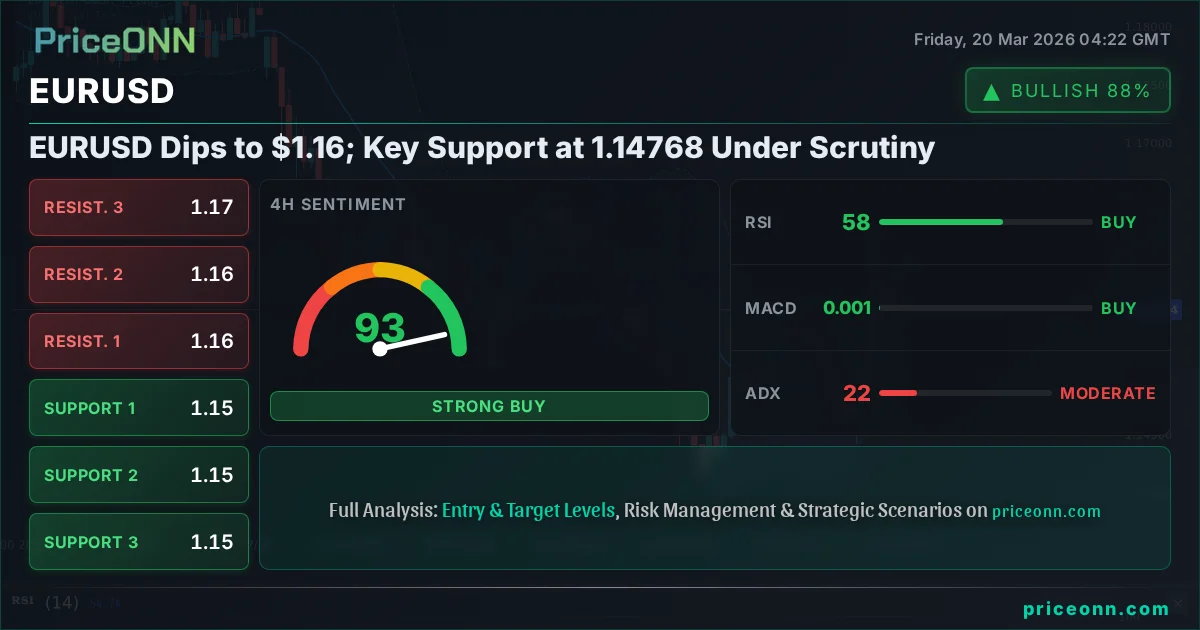
The US Dollar Index, a gauge of the greenback's strength against a basket of major currencies, is showing signs of life after a significant downturn. This renewed upward pressure on the dollar is causing the EUR/USD currency pair to give back some of its recent gains, retreating from Thursday's weekly pinnacle of 1.1616 to hover near 1.1560 in early Asian trading on Friday. The pair is currently down approximately 0.2% as the USD attempts to regain its footing.
Market data shows the dollar was the strongest performer against the Japanese Yen earlier today, underscoring a broader trend of USD recovery. This move appears to be a correction after a sharp sell-off that characterized recent trading sessions, suggesting a potential recalibration of market sentiment.
European Central Bank's Monetary Stance
Understanding the dynamics of the Euro requires a look at the European Central Bank (ECB), the central bank responsible for monetary policy across the Eurozone. Headquartered in Frankfurt, Germany, the ECB's core mission is to maintain price stability, targeting inflation at around 2%. Its primary instrument for achieving this objective is the adjustment of interest rates.
Generally, higher interest rates tend to bolster the Euro's value, while lower rates can exert downward pressure. The ECB's Governing Council, comprising the heads of the Eurozone's national central banks and key executives like President Christine Lagarde, convenes eight times annually to deliberate and decide on monetary policy actions.
In extraordinary economic circumstances, the ECB possesses tools beyond standard rate adjustments. One such powerful, albeit less frequently used, policy is Quantitative Easing (QE). This involves the central bank injecting liquidity into the financial system by purchasing assets, typically government or corporate bonds, from commercial banks. Historically, QE implementations have been associated with a weaker Euro.
QE is generally reserved for situations where reducing interest rates further is deemed insufficient to achieve the inflation target. The ECB has deployed this measure during significant economic shocks, including the aftermath of the 2008 Great Financial Crisis, a period of persistently low inflation in 2015, and most recently, during the COVID-19 pandemic.
Quantitative Tightening and Its Implications
Conversely, Quantitative Tightening (QT) represents the unwinding of QE. This process typically occurs when an economy shows signs of recovery and inflation begins to accelerate. Instead of purchasing assets, the ECB, during QT, ceases the acquisition of new bonds and refrains from reinvesting the principal from maturing bonds it already holds.
This reduction in the central bank's balance sheet is generally viewed as a positive signal for the Euro, potentially leading to a firmer currency.
Reading Between the Lines
The current retracement in EUR/USD, while modest, highlights the ongoing tug-of-war between the Federal Reserve's policy path and the ECB's stance. The dollar's ability to find bids suggests that market participants are reassessing the pace and extent of expected Fed rate hikes relative to the ECB's own monetary normalization trajectory.
While the ECB has signaled a gradual move away from ultra-loose policy, the market remains highly sensitive to any hints of a more aggressive approach to quantitative tightening or interest rate hikes. Conversely, any indication that the Federal Reserve might be nearing the end of its tightening cycle could reignite dollar weakness.
The critical factor to watch will be the economic data flow from both sides of the Atlantic. Inflation prints, employment figures, and manufacturing surveys will provide crucial clues about the underlying economic strength and the potential for central banks to alter their policy paths. The market is currently digesting the narrative that the Fed might be closer to a pause than previously thought, but this dollar rebound suggests that narrative is being tested.
Market Ripple Effects
This dollar strength and subsequent Euro pullback could have broader implications across financial markets. For instance, a stronger dollar typically exerts downward pressure on commodity prices, as many are priced in USD. This could impact gold prices, potentially pushing them lower if the dollar's recovery gains momentum.
Furthermore, the US Treasury yields are a key indicator to monitor. If the dollar's rebound is driven by rising yield expectations, it could signal renewed tightening concerns and influence risk appetite in equity markets, particularly affecting growth-oriented tech stocks.
The Swiss Franc (CHF), often seen as a safe-haven currency, might also experience some headwinds if the broader risk sentiment shifts due to dollar strength. Conversely, emerging market currencies could face increased pressure as capital potentially flows back to the US.
Track markets in real-time
Empower your investment decisions with AI-powered analysis, technical indicators and real-time price data.
Join Our Telegram Channel
Get breaking market news, AI analysis and trading signals delivered instantly to your Telegram.
Join Channel