
Will the Fed Deliver Two Rate Cuts as Inflation Concerns Linger?

The Federal Reserve concluded its March meeting by holding interest rates steady, a decision that aligned with widespread market expectations. Federal Reserve Chair Jerome Powell, while refraining from offering strong forward guidance, indicated a heightened focus on persistent inflation rather than potential slowdowns in economic growth. Despite the median projections for interest rate cuts remaining unchanged, the distribution of forecasts suggests a potential shift towards later reductions.
Market Context
Following the Fed's announcement, the yield on 2-year U.S. Treasury notes saw an increase of approximately 7 basis points, and the EUR/USD currency pair retreated, falling back below the 1.15 level. The central bank's March statement included a new, cautious note regarding the geopolitical tensions in the Middle East, stating, "The implications of developments in the Middle East for the U.S. economy are uncertain." This acknowledgment highlights the sensitivity of monetary policy decisions to external shocks, particularly concerning energy supply disruptions.
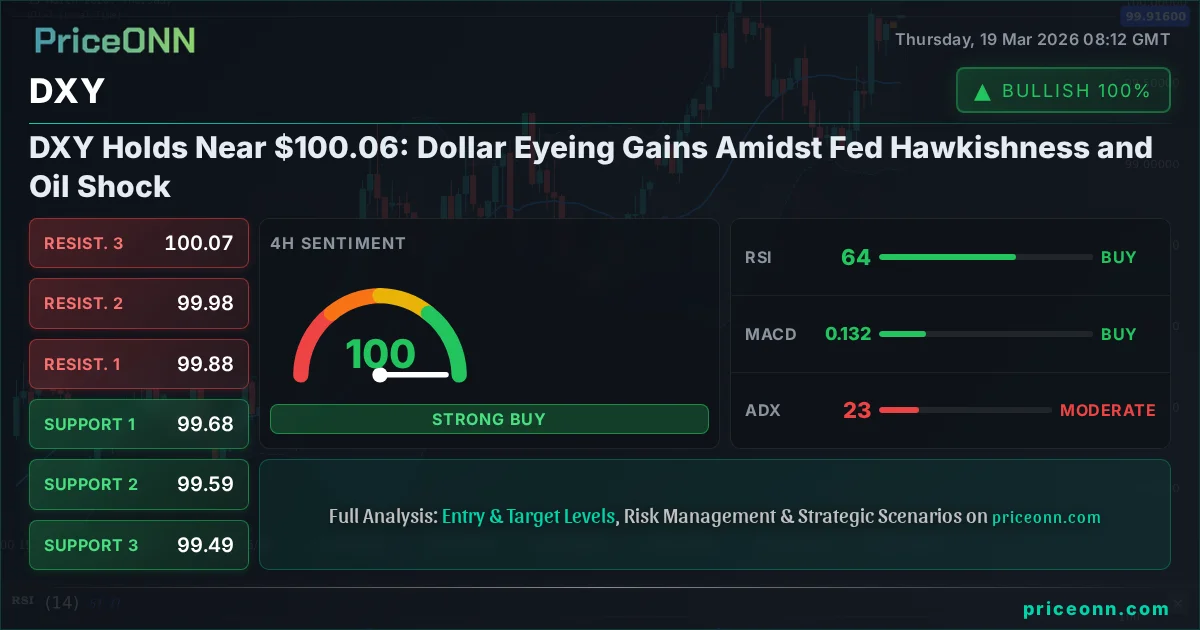
Analysis & Drivers
While the Fed's GDP growth forecast for 2027 was revised upward to 2.3% from 2.0%, and the core PCE inflation forecast was nudged to 2.2% from 2.1%, these adjustments were largely overlooked by the market amidst the uncertainty surrounding geopolitical events. Analysts note that under normal circumstances, such upward revisions might be interpreted as hawkish signals. However, the current environment, dominated by potential energy supply disruptions and broader economic uncertainties, has overshadowed these domestic economic projections. Powell himself alluded to the difficulty in forecasting, even joking about the possibility of not publishing economic projections due to the high sensitivity of the outlook to assumptions about global conflicts. The risk assessment within the Fed's report indicated that risks to GDP growth were tilting back towards the downside, while inflation risks were seen as equally balanced to the upside.
Trader Implications
Traders should closely monitor the upcoming economic data releases, particularly inflation and employment figures, as these will be critical in determining the timing and magnitude of future Fed rate adjustments. The current market sentiment suggests that while two rate cuts might still be on the table, their timing is highly contingent on the resolution of global energy supply issues. The EUR/USD pair has shown sensitivity to shifts in U.S. interest rate expectations, and a sustained move below 1.15 could indicate further downside pressure. Key support levels for EUR/USD are being watched around 1.1450 and 1.1400, while resistance remains near 1.1550. Any significant escalation or de-escalation in Middle Eastern tensions could rapidly alter the risk sentiment and impact currency valuations.
Outlook
The Federal Reserve appears to be navigating a complex economic landscape, balancing inflation concerns with growth uncertainties amplified by geopolitical instability. While the median forecast still points to two rate cuts in the coming year, the path forward is far from clear. Traders should anticipate continued market volatility as investors digest incoming data and assess the Fed's reaction function. The central bank's 'humble' approach to forward guidance suggests a data-dependent strategy, making upcoming inflation reports and geopolitical developments the primary drivers for currency markets in the short to medium term.
Frequently Asked Questions
What was the Federal Reserve's decision on interest rates in March?
The Federal Reserve decided to maintain its monetary policy unchanged in March, keeping interest rates at their current levels as widely expected by market participants.
How did the Fed's meeting affect the EUR/USD pair?
Following the Fed's announcement and Chair Powell's remarks, the EUR/USD pair declined, falling back below the 1.15 mark, indicating a strengthening of the U.S. Dollar against the Euro.
What is the outlook for U.S. interest rate cuts?
While the median projection still indicates two rate cuts, the distribution of forecasts suggests a potential shift towards later implementation. The timing remains highly sensitive to inflation data and global energy supply developments.
Track markets in real-time
Empower your investment decisions with AI-powered analysis, technical indicators and real-time price data.
Join Our Telegram Channel
Get breaking market news, AI analysis and trading signals delivered instantly to your Telegram.
Join Channel



PriceONN