
Is EUR/USD Set for a Decline as Fed Signals Fewer Rate Cuts?

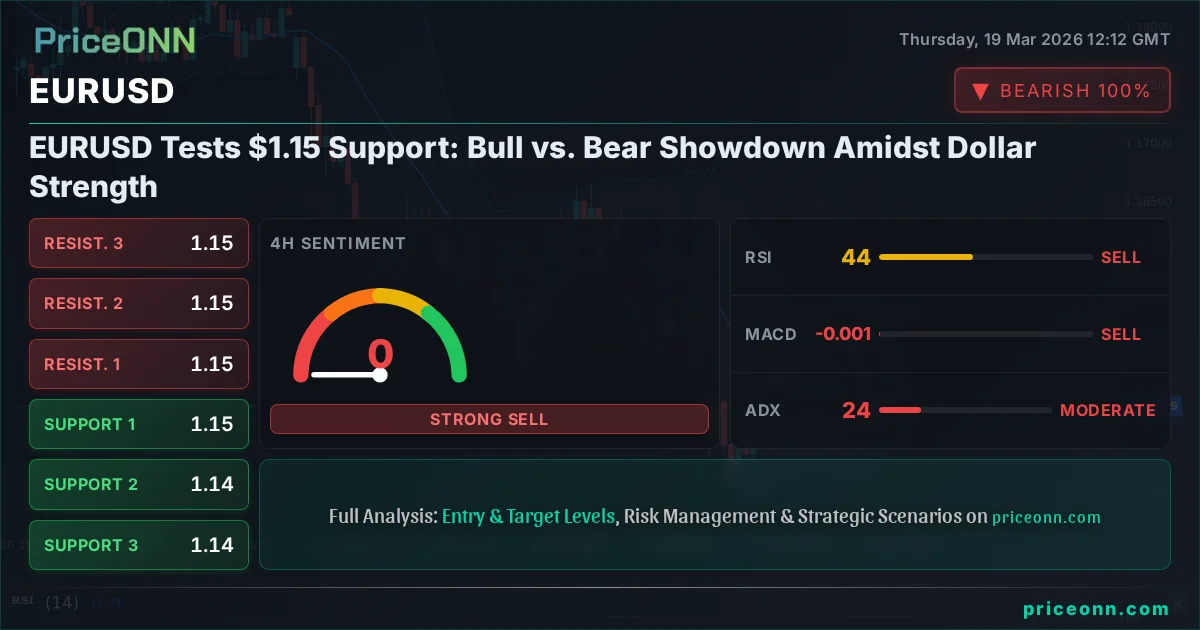
The EUR/USD pair has dipped below the 1.15 handle following the Federal Reserve's March policy meeting. While the decision to hold interest rates steady was widely anticipated, market data indicates a subtle but significant shift in the Fed's outlook, suggesting a potentially slower path for rate cuts than previously expected.
Market Context
In its March meeting, the Federal Reserve opted to keep its benchmark interest rate unchanged, a decision that aligned with broad market expectations. However, Fed Chair Jerome Powell's commentary and the updated economic projections revealed a greater concern for persistent inflation compared to downside growth risks. Although the median projection for rate cuts remained at two 25-basis-point reductions for the year, the distribution of individual forecasts showed a clear shift towards deferring these cuts. This recalibration of expectations contributed to a modest rise in 2-year US Treasury yields, which climbed approximately 7 basis points, and subsequently pressured the Euro against the US Dollar.
Analysis & Drivers
The primary driver behind the market's reaction appears to be the Fed's evolving stance on inflation. Analysts note that Powell emphasized a cautious approach, highlighting that the path forward for monetary policy remains highly sensitive to incoming economic data, particularly concerning inflation trends. The FOMC statement included a new acknowledgement of the geopolitical uncertainties stemming from developments in the Middle East, stating, “The implications of developments in the Middle East for the U.S. economy are uncertain.” This acknowledgment underscores the complex global backdrop influencing Fed decisions. Despite upward revisions to GDP growth forecasts for 2027 (to 2.3% from 2.0%) and core PCE inflation forecasts (to 2.2% from 2.1%), market participants focused more on the subtle hawkish tilt implied by the distribution of rate cut projections. Powell's remarks, while not overtly hawkish, avoided dovish arguments that could have been used to justify more immediate rate reductions, such as the potential negative growth impact from tighter financial conditions.
Trader Implications
The shift in Fed sentiment presents key implications for forex traders. The immediate pressure on EUR/USD below 1.15 suggests that the market is repricing the likelihood and timing of Fed rate cuts. Traders should monitor key support levels for EUR/USD, with 1.1450 now becoming a critical area to watch. A sustained break below this level could signal further downside potential. Conversely, any signs of cooling US inflation data or a more dovish tone from Fed officials in subsequent communications could provide support for the pair. The uncertainty surrounding global energy supply disruptions due to geopolitical events adds another layer of complexity, potentially influencing both inflation and growth trajectories, and thus, Fed policy. Key economic releases from both the US and the Eurozone in the coming weeks will be crucial in shaping short-term price action.
Outlook
Looking ahead, the Federal Reserve's path for interest rates appears more data-dependent and potentially slower than previously priced in by markets. The market will be closely watching upcoming US inflation reports (CPI and PCE) and employment data for clues on whether the Fed's inflation concerns are justified. While the median projection still points to two rate cuts, the increased dispersion in forecasts suggests that the timing and magnitude of any reductions remain highly fluid. For EUR/USD, the immediate outlook is tilted towards caution, with the potential for further downside if US economic resilience and inflation persistence continue to challenge expectations for imminent easing. Traders should remain vigilant for any shifts in central bank rhetoric and geopolitical developments that could impact the global economic outlook.
Frequently Asked Questions
What is the current outlook for Federal Reserve interest rate cuts?
Market data and Fed projections indicate a shift towards later rate cuts in 2027. While the median forecast still suggests two 25-basis-point reductions, a greater number of Fed officials are leaning towards delaying these cuts due to inflation concerns, especially amid geopolitical uncertainties.
How has the Fed's stance impacted EUR/USD?
The Federal Reserve's more cautious tone regarding inflation and potential delays in rate cuts has strengthened the US Dollar, causing the EUR/USD pair to decline below the key 1.15 level. Traders should watch the 1.1450 support level.
What key data should traders monitor for future EUR/USD movement?
Traders should closely monitor upcoming US inflation reports (CPI, PCE) and employment figures, as these will provide critical insights into the US economy's trajectory and the Fed's future policy decisions. Geopolitical developments impacting energy prices also remain a key factor.
Track markets in real-time
Empower your investment decisions with AI-powered analysis, technical indicators and real-time price data.
Join Our Telegram Channel
Get breaking market news, AI analysis and trading signals delivered instantly to your Telegram.
Join Channel


PriceONN