
Is EUR/USD Headed for 1.10 as Fed Holds Rates and Eyes Inflation Amid Geopolitical Uncertainty?
Market Context
The Euro US Dollar (EUR/USD) currency pair experienced a notable decline, trading below the 1.15 level following the U.S. Federal Reserve's March monetary policy announcement. This move came as the Fed kept its benchmark interest rate unchanged, a decision widely anticipated by market participants. However, the accompanying statement and press conference revealed a heightened concern over inflation and considerable uncertainty stemming from geopolitical developments, particularly the ongoing conflict in the Middle East. This has led to a shift in market sentiment, pushing Treasury yields higher and prompting a retreat in riskier assets.
In parallel, the price of gold (XAU/USD) suffered a sharp downturn, plummeting by approximately 3.3% and decisively breaking through the psychologically significant $5,000 support level. This significant price action underscores the market's reaction to the Fed's perceived hawkish undertones and the prevailing economic uncertainty. The confluence of these events suggests a cautious approach from investors, favoring safer assets or awaiting clearer signals from central banks and geopolitical developments.
Analysis & Drivers
The Federal Reserve's decision to maintain its current monetary policy stance was largely expected. However, the nuances within the March FOMC statement and Federal Reserve Chair Jerome Powell's subsequent remarks provided the market with a more complex picture. While the median economic projections, or 'dots', remained unchanged, indicating a potential for two rate cuts this year, the distribution of these projections showed a shift towards later timing. This suggests that a growing number of policymakers are leaning towards holding rates higher for longer.
A key driver for this cautious approach appears to be the persistent inflation outlook. Market data shows the median core PCE inflation forecast for the year-end was revised upwards to 2.2% from 2.1% in December. Furthermore, the Fed acknowledged the significant uncertainty introduced by the conflict in the Middle East, noting that "The implications of developments in the Middle East for the U.S. economy are uncertain." This geopolitical factor, coupled with potential supply disruptions, adds an inflationary risk that monetary policy is ill-equipped to directly combat. Analysts note that this supply shock, while inflationary in the short term, also presents growth-hindering effects, complicating the Fed's balancing act between controlling inflation and supporting economic expansion.
The upward revision in the GDP growth forecast to 2.3% for the year, alongside the unchanged median unemployment rate, paints a picture of an economy that is perceived as resilient but facing upside inflation risks and downside growth risks. The Fed's acknowledgment of higher uncertainty around these estimates, with risks skewed towards higher inflation and unemployment, signals a heightened state of vigilance. This "wait-and-see" mode, influenced by external shocks, is keeping the door open for optionality in future policy adjustments.
Trader Implications
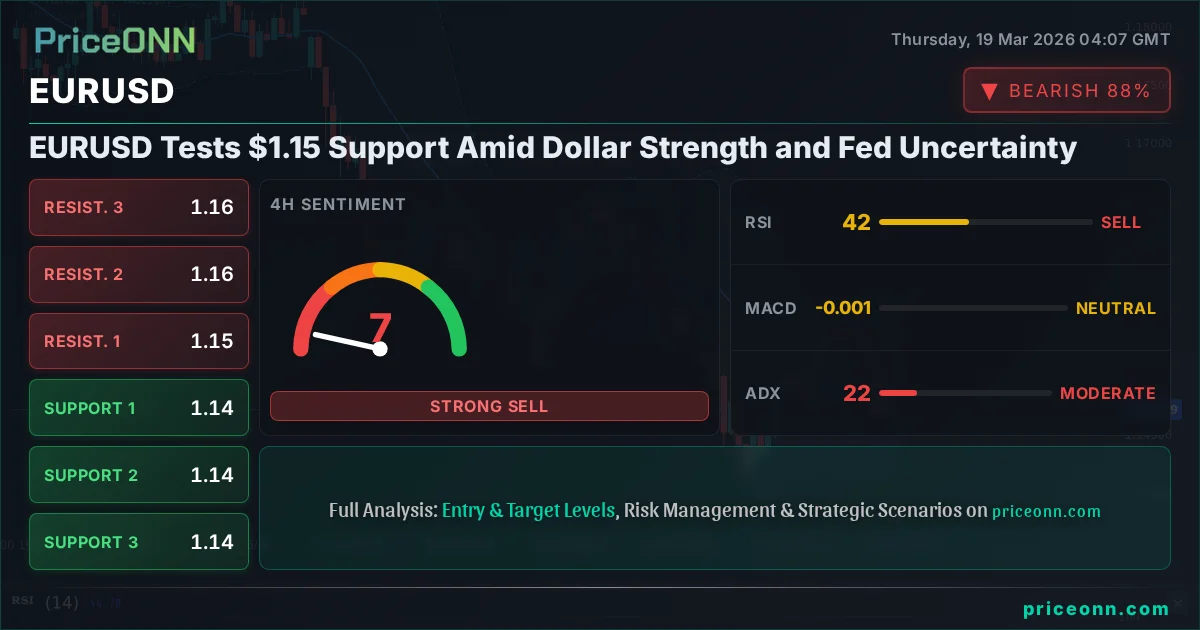
For forex traders, the dip in EUR/USD below 1.15 presents a critical juncture. The immediate downside risk appears to be towards the 1.10 level if the dollar continues to find strength on the back of persistent inflation fears and a cautious Fed. Key levels to watch include the previous support at 1.1500, now acting as resistance, and further down, the 1.1350 mark. A sustained break below 1.1500 could trigger further selling pressure.
Traders should closely monitor upcoming economic data releases, particularly inflation figures and employment reports, as these will heavily influence the Fed's future policy decisions. The market's anticipation of potential rate cuts being pushed back to 2027, as suggested by the shifted distribution of Fed projections, remains a significant factor. Any indication of a more aggressive hawkish stance from the Fed or escalating geopolitical tensions could further strengthen the U.S. Dollar, putting downward pressure on EUR/USD.
The sharp sell-off in gold below $5,000 also presents a significant technical signal. With structural support identified at $4,760.46, traders will be watching to see if this level holds. A break below this could signal a deeper correction. Conversely, any signs of de-escalation in the Middle East or a shift in Fed rhetoric towards a more dovish stance could provide a catalyst for a gold price rebound, making the current price levels a potential discount opportunity for long-term investors.
Outlook
The path forward for EUR/USD appears clouded by the Fed's cautious stance and the ongoing geopolitical uncertainties. While the market is pricing in a possibility of delayed rate cuts, the timing remains highly sensitive to incoming data and global events. Traders should brace for continued volatility as the market digests the Fed's latest communication and the evolving Middle East situation. The near-term outlook suggests a potential for further dollar strength, capping upside for EUR/USD, unless a significant shift in risk appetite or economic data emerges.
Frequently Asked Questions
What is the current outlook for EUR/USD after the Federal Reserve's March meeting?
EUR/USD has fallen below 1.15 following the Fed's decision to hold rates steady and signal concerns about inflation. The immediate outlook suggests potential further downside, with traders watching the 1.10 level if the dollar strengthens. Key resistance is now seen at 1.1500.
Why did gold prices drop significantly ahead of the FOMC meeting?
Gold (XAU/USD) dropped over 3.3% to break below $5,000 as markets anticipated a "hawkish hold" from the Fed, potentially delaying rate cuts to 2027. This expectation reduced gold's appeal as a safe-haven asset amid rising U.S. dollar strength and inflation concerns.
What are the key economic factors influencing the Federal Reserve's monetary policy now?
The Federal Reserve is closely monitoring persistent inflation, with core PCE forecasts revised up to 2.2%. Geopolitical developments in the Middle East are adding significant uncertainty, posing both inflationary risks and potential growth headwinds, leading the Fed to maintain a cautious, "wait-and-see" approach.
Track markets in real-time
Empower your investment decisions with AI-powered analysis, technical indicators and real-time price data.
Join Our Telegram Channel
Get breaking market news, AI analysis and trading signals delivered instantly to your Telegram.
Join Channel



PriceONN