

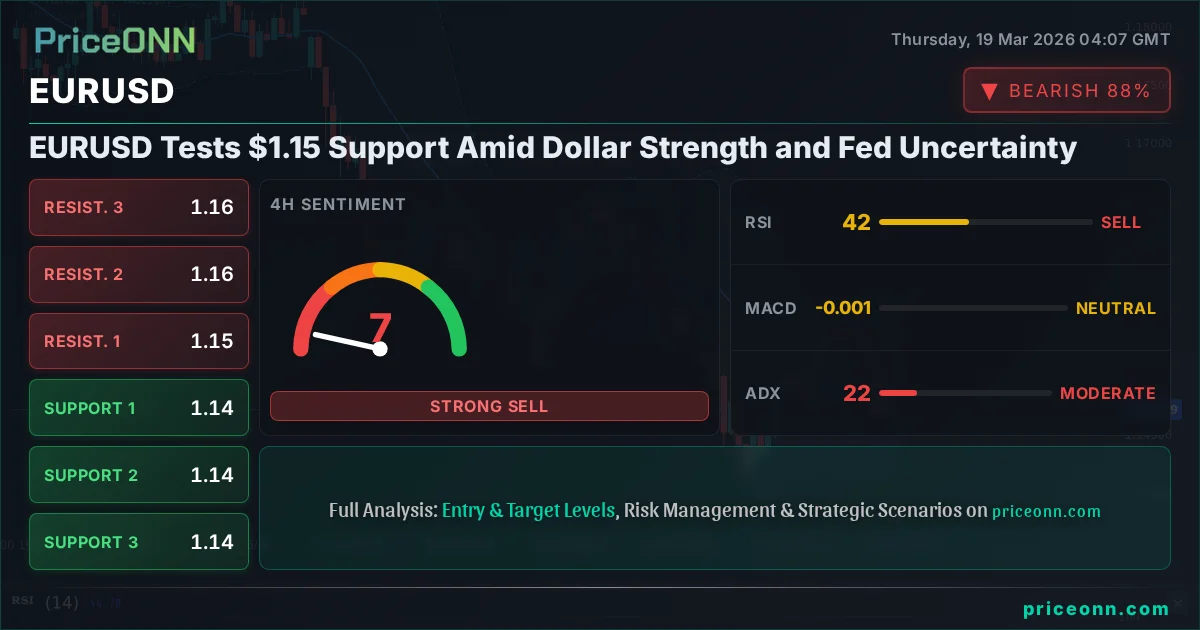
EURUSD today analysis shows the pair grappling with significant headwinds as the US Dollar Index (DXY) shows strength, currently testing the 99.93 mark. At $1.15, the pair is teetering on a critical juncture, with traders closely watching the interplay between Federal Reserve policy expectations and geopolitical tensions that continue to fuel safe-haven demand for the greenback. The recent surge in oil prices and higher-than-expected US PPI data have added layers of complexity, potentially influencing the Fed's upcoming decisions and, consequently, the trajectory of EURUSD.
- RSI at 40.64 signals a neutral but declining momentum for EURUSD, suggesting further downside pressure is possible.
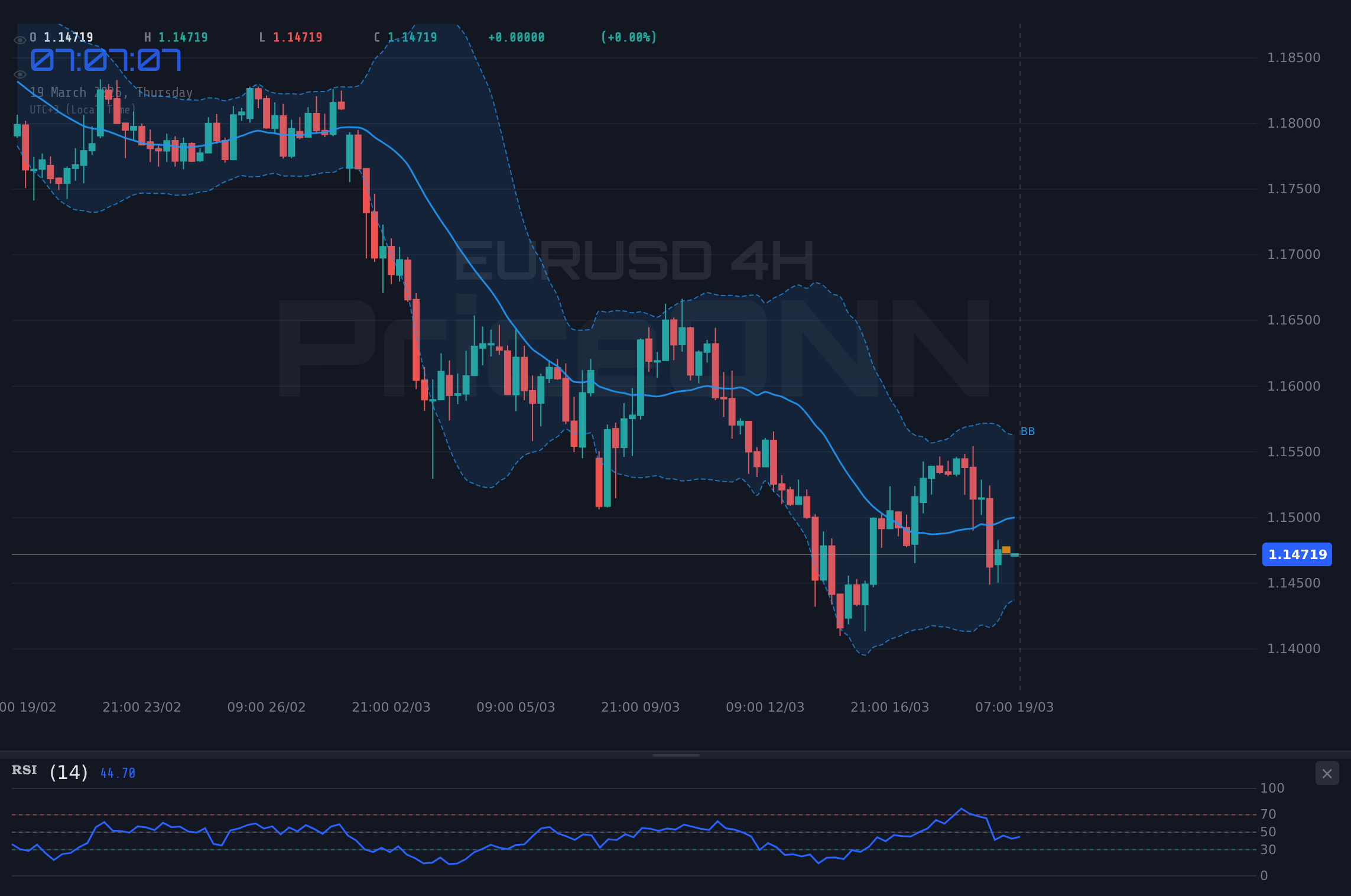
- Critical support sits at $1.14713, tested multiple times this week, with a break below potentially opening the door to $1.14517.
- MACD histogram shows negative momentum, indicating that bearish sentiment is currently prevailing in the short term.
- Fed rate expectations are driving EURUSD correlation with DXY, with hawkish signals from the Fed potentially reinforcing dollar strength.
The market is currently a chessboard of competing forces, and EURUSD finds itself at the center of this strategic battle. On one side, the US Dollar, measured by the DXY, is exhibiting notable strength, currently trading around 99.93. This rise in the dollar is a significant headwind for the Euro, as a stronger dollar typically translates to a weaker EURUSD pair. The DXY's upward momentum, supported by strong technical indicators across multiple timeframes, suggests that dollar bulls are in control, at least in the short to medium term. The 1-hour chart shows ADX at 25.7, indicating a strong downtrend, while the 4-hour chart shows ADX at 22.45, suggesting a moderate trend. The daily chart also points to a strong downtrend with ADX at 38.79. This broad dollar strength is a critical factor to consider for any outlook on EURUSD.
Adding to the complexity is the Federal Reserve's stance. Recent signals have leaned hawkish, with market participants pricing in fewer rate cuts than previously anticipated. This hawkish bias from the Fed naturally supports the US dollar, as higher interest rates or the prospect thereof tend to attract capital. The recent US Producer Price Index (PPI) data, which came in hotter than expected, further fuels this narrative. Higher inflation figures can put pressure on central banks to maintain a tighter monetary policy, which is generally dollar-positive. This macroeconomic backdrop is crucial for understanding why EURUSD is finding itself under pressure.
Navigating the Cross-Currents: Technical Signals and Key Levels
Looking at the technicals for EURUSD, the picture is one of caution. On the 1-hour chart, the RSI(14) is at 40.64, residing in neutral territory but showing a downward inclination. This suggests that while the pair isn't oversold, the momentum is currently leaning towards sellers. The MACD is also displaying negative momentum, with the MACD line below the signal line, reinforcing the bearish sentiment in the short term. The Stochastic oscillator, however, offers a glimmer of hope for the bulls, with K at 45.99 and D at 25.56, indicating a potential upward signal as %K crosses above %D. Yet, the ADX at 25.7 on this timeframe points to a strong downtrend, which often overrides short-term oscillator signals.
The 4-hour timeframe paints a more consistently bearish picture. The RSI(14) sits at 42.11, still in neutral territory but continuing the downward trend. The MACD's momentum is balancing, but the overall trend strength, as indicated by ADX at 22.45, suggests a moderate downtrend is in play. The Stochastic oscillator shows K at 31.15 and D at 66.22, providing a clear bearish signal with %K below %D. The Bollinger Bands are also below the middle band, indicating a bearish inclination. This confluence of bearish signals on the 4-hour chart suggests that short-term rallies might be met with selling pressure.
On the daily chart, the downtrend narrative continues, albeit with some nuances. The RSI(14) at 35.1 indicates a move towards oversold conditions, which could offer some support. However, the MACD is still in negative momentum territory, and the ADX at 38.79 confirms a strong downtrend. The Stochastic oscillator, with K at 31.32 and D at 22.59, presents a bullish signal as %K crosses above %D, hinting at a potential reversal or at least a pause in the downward move. This divergence between the daily Stochastic and the longer-term downtrend indicators highlights the current indecision in the market. The key support level to watch on the daily chart is $1.14226. A decisive break below this level would solidify the bearish outlook, potentially targeting $1.13830 and then $1.13170. On the resistance side, a move above $1.15282 would be the first sign of a potential bullish shift, with subsequent resistance at $1.15942 and $1.16338.
The Impact of Geopolitics and Commodities
The recent surge in oil prices, with Brent crude climbing past $108.40 while WTI lagged, adds another layer of complexity. This rise in energy costs has significant implications for inflation, a key concern for central banks. Higher inflation can lead to sustained hawkish monetary policy, which, as mentioned, supports the US dollar. The geopolitical tensions in the Middle East, cited as a driver for the oil surge, also contribute to a general 'risk-off' sentiment in the markets. When investors become risk-averse, they tend to flock to perceived safe-haven assets, such as the US dollar and gold, which can further pressure currency pairs like EURUSD.
The correlation between EURUSD and the DXY is particularly important to monitor. Currently, the DXY is showing strength, which is a direct drag on EURUSD. If this dollar strength persists, driven by hawkish Fed expectations or escalating geopolitical risks, EURUSD will likely continue its downward trajectory. Conversely, any signs of de-escalation in geopolitical tensions or a shift in Fed rhetoric towards a more dovish stance could provide relief for EURUSD. The relationship is not always perfect, but in the current environment, it's a primary driver.
The performance of major equity indices like the SP500 and Nasdaq also provides context for risk sentiment. Currently, both indices are showing signs of weakness on the 1-hour and 4-hour charts, with strong downtrend signals from ADX. The SP500's ADX is 45.56 on the 1H and 16.86 on the 4H, while Nasdaq's ADX is 45.49 on the 1H and 15.46 on the 4H. This suggests a general risk-off sentiment, which typically favors the US dollar and can weigh on currency pairs like EURUSD. A sustained decline in these indices would likely reinforce the bearish case for EURUSD.
Trade Scenarios and Outlook
Given the current technical and fundamental landscape, a cautious approach to EURUSD is warranted. The prevailing downtrend, supported by dollar strength and hawkish Fed undertones, suggests that bearish scenarios hold a higher probability. However, the divergence in signals across different timeframes and the proximity to key support levels mean that a sharp reversal cannot be entirely ruled out.
Bearish Scenario: Dollar Dominance Continues
65% ProbabilityNeutral Scenario: Consolidation Around $1.15
25% ProbabilityBullish Scenario: Reversal on Fed Uncertainty
10% ProbabilityThe current ADX readings across timeframes (1H: 25.7, 4H: 22.45, 1D: 38.79) suggest that while a downtrend is present, its strength varies. The daily ADX at 38.79 indicates a strong trend, which favors the bearish scenario. However, the Stochastic signals on the daily chart (K=31.32, D=22.59) are turning upwards, hinting at potential divergence. This conflict underscores the need for patience and confirmation. A break below $1.14226 would be a strong bearish confirmation, while a sustained move above $1.15282, especially on dovish Fed news, could signal a bullish reversal.
The Road Ahead: What to Watch
The upcoming Federal Reserve decision will be a pivotal moment for EURUSD. If the Fed maintains its hawkish stance or signals fewer rate cuts, the dollar could strengthen further, pushing EURUSD lower. Conversely, any hint of a more dovish outlook, perhaps due to moderating inflation expectations or growing concerns about economic slowdown, could provide a much-needed boost to the Euro. Traders should also keep a close eye on upcoming economic data from both the US and the Eurozone, particularly inflation figures and employment reports, as these will shape central bank policies.
Geopolitical developments remain a wild card. Any escalation of tensions in the Middle East or other major global flashpoints could trigger a flight to safety, benefiting the dollar and pressuring EURUSD. The correlation with oil prices is also key; sustained high energy costs could keep inflation concerns elevated, indirectly supporting the dollar.
Frequently Asked Questions: EURUSD Analysis
What happens if EURUSD breaks below the $1.14226 support level?
A break below the $1.14226 daily support level would likely confirm the prevailing downtrend, invalidating the bullish divergence seen on the daily Stochastic. This scenario would open the door for further downside, with the next key targets identified at $1.13830 and potentially $1.13170.
Should I consider buying EURUSD at current levels around $1.15 given the daily Stochastic signal?
Buying at current levels is a high-risk proposition given the strong downtrend signals on hourly and 4-hour charts, and the significant dollar strength. While the daily Stochastic shows an upward turn, it needs confirmation from price action and a break above key resistance levels like $1.15282. A more prudent approach might be to wait for a confirmed bullish reversal or a clear test and hold of lower support levels like $1.14226.
Is the RSI at 40.64 a sell signal for EURUSD right now?
An RSI of 40.64 is not an extreme signal in itself, but its downward inclination on the 1-hour chart suggests waning momentum for buyers. Combined with other bearish indicators like the MACD histogram and strong ADX trend strength, it contributes to the overall cautious to bearish outlook. It indicates a lack of strong buying pressure rather than an outright sell signal.
How will the upcoming Fed decision and US PPI data affect EURUSD this week?
Hawkish signals from the Fed or continued high US PPI data would likely reinforce dollar strength, putting further downward pressure on EURUSD. If the Fed signals fewer rate cuts than expected, the pair could fall towards $1.14226 or lower. Conversely, any dovish surprise from the Fed, or a significant cooling in US inflation, could trigger a short-covering rally, potentially pushing EURUSD towards the $1.15282 resistance.
The market is a dynamic environment, and while current indicators point towards continued dollar strength and potential downside for EURUSD, agility is key. Watching for confirmations, managing risk diligently, and staying attuned to macroeconomic shifts will be paramount for navigating these choppy waters. Patience remains a virtue; waiting for clear signals and respecting key levels will be crucial for successful trading decisions in the coming days.
Track markets in real-time
AI-powered analysis, technical indicators and real-time price data.
Join Our Telegram Channel
Breaking market news, AI analysis and trading signals instantly.
Join Channel