
Is the USD Poised for a Rally as NZ GDP Falters and Fed Holds Steady?

The US Dollar may find renewed strength as contrasting economic signals emerge from the global stage. New Zealand's Gross Domestic Product (GDP) for the December quarter of 2025 registered a disappointing 0.2% growth, falling considerably short of market expectations. This slowdown, occurring as global uncertainties mount, contrasts sharply with the US Federal Reserve's steady hand, which maintained its policy outlook, suggesting underlying resilience in the American economy.
Market Context: Divergent Economic Fortunes
New Zealand's economic performance in the final quarter of 2025 proved to be a significant disappointment. The 0.2% quarterly GDP expansion was well below the 0.4% anticipated by analysts at Westpac and the broader market consensus of 0.5%. The Reserve Bank of New Zealand (RBNZ) had also projected a more optimistic 0.5% growth. This sluggishness suggests that the economy's momentum was weaker than previously thought, even before recent global oil price shocks began to impact broader economic conditions. Revisions to previous quarters also painted a less robust historical picture, with the September quarter's growth revised down from 0.9% to 0.9% and the June quarter adjusted from -1.0% to -0.9%. On an annual basis, New Zealand's economy grew by 1.3%, also trailing the 1.6% forecast.
In stark contrast, market data indicates the US Federal Open Market Committee (FOMC) adopted a cautious but confident tone at its March meeting. Recognizing increased global uncertainty, the committee reaffirmed its focus on the domestic economy. Projections for US GDP growth were revised upwards, with expectations now set at 2.4% for 2026 (up from 2.3%) and 2.3% for 2027 (up from 2.0%). The longer-run neutral rate was estimated at 3.1%. While acknowledging constrained labor supply, the FOMC anticipates job gains will remain modest, with the unemployment rate edging down to 4.2% by end-2028. This outlook is underpinned by expected productivity gains and consumer willingness to spend.
Analysis & Drivers: Policy Divergence and Inflation Outlook
The divergence in economic performance and central bank outlooks presents a compelling narrative for currency markets. The weaker-than-expected New Zealand GDP data could weigh on the New Zealand Dollar (NZD), especially if it signals a more prolonged period of economic stagnation. This weakness might be exacerbated by the upcoming impact of global oil price volatility, a factor not fully captured in the Q4 2025 figures.
On the other hand, the US Federal Reserve's upward revision to GDP forecasts and its steady policy stance suggest a degree of confidence in the American economic trajectory. While the FOMC acknowledged global uncertainties, their primary concern remains domestic growth and inflation. Notably, the Fed's view on inflation differs significantly from some other central banks, such as the RBA. The FOMC sees the inflationary effects of tariffs and Middle East conflicts as temporary, revising annual inflation up to 2.7% for 2026 but only slightly to 2.2% for 2027. This suggests the Fed is less inclined to deviate from its planned policy path due to these transient factors, potentially maintaining a higher interest rate differential compared to economies facing more persistent inflationary pressures or weaker growth.
Trader Implications: Watching Key Levels and Risk Factors
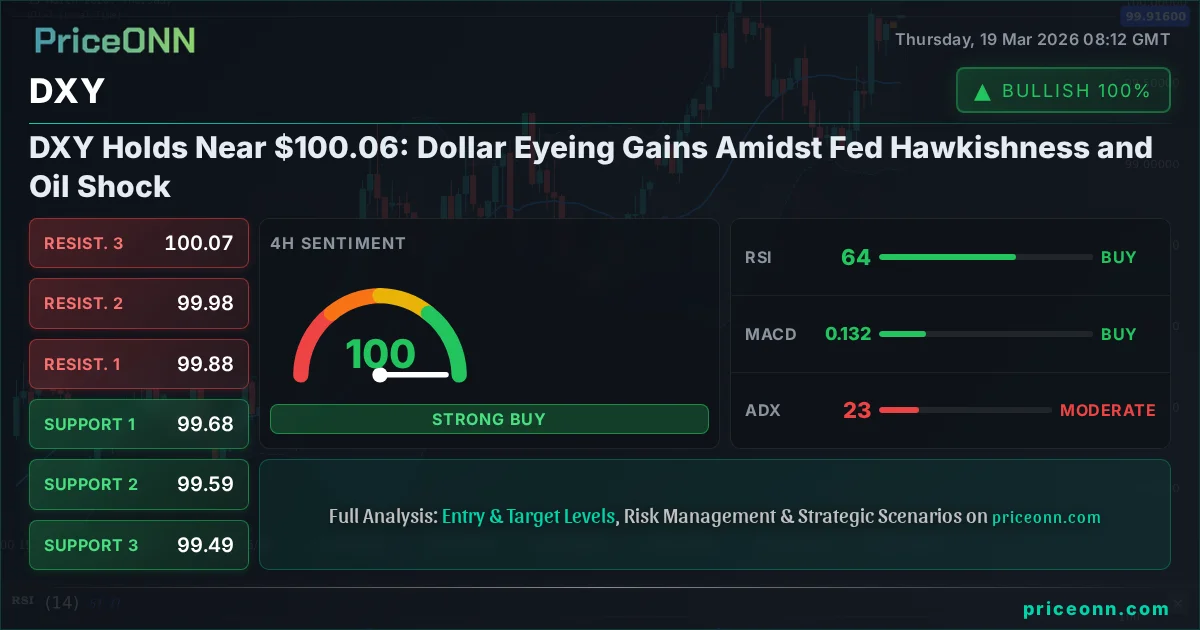
Forex traders should closely monitor the reaction of the NZD/USD pair to these diverging economic narratives. Key support for NZD/USD may be tested if the market prices in a more sustained period of weakness for the Kiwi. Conversely, the US Dollar Index (DXY) could see upward pressure if the Fed's outlook continues to support higher-for-longer interest rate expectations relative to other major economies.
Traders should watch for any further deterioration in New Zealand's economic data, which could trigger significant downside for the NZD. On the US side, attention will be on any signals from Fed officials regarding the timing and pace of potential rate cuts, though the current projections suggest a measured approach. Geopolitical developments, particularly concerning oil supply and prices, remain a significant wildcard that could influence both inflation expectations and growth prospects globally, potentially overriding domestic economic data in the short term.
Outlook
The immediate outlook suggests a potential for US Dollar strength against the New Zealand Dollar, driven by the contrasting economic fundamentals and central bank policies. While the Fed maintains a steady course, the NZD faces headwinds from softer-than-expected growth. Upcoming economic releases from New Zealand will be critical for assessing the extent of the slowdown, while any shifts in the Fed's tone or US inflation data could alter the DXY's trajectory. Traders should remain vigilant for opportunities arising from this divergence, with a focus on key technical levels and risk management.
Frequently Asked Questions
What was the New Zealand GDP growth rate for Q4 2025?
New Zealand's GDP grew by 0.2% in the December quarter of 2025. This figure was below forecasts, indicating a slower pace of economic recovery than anticipated.
What is the US Federal Reserve's outlook on GDP growth?
The FOMC revised its US GDP growth forecast upwards, expecting 2.4% for 2026 and 2.3% for 2027. This reflects confidence in the domestic economy's resilience, driven by productivity gains and consumer spending.
How might the diverging economic data affect the NZD/USD pair?
The weaker New Zealand GDP and the Fed's steady policy stance could lead to US Dollar strength against the New Zealand Dollar. Traders should watch for potential testing of key support levels around 0.6000 for NZD/USD.
Track markets in real-time
Empower your investment decisions with AI-powered analysis, technical indicators and real-time price data.
Join Our Telegram Channel
Get breaking market news, AI analysis and trading signals delivered instantly to your Telegram.
Join Channel



PriceONN