
EUR/USD and GBP/USD Hover Near Support as Traders Await Crucial US Inflation Data


The Euro and the British Pound are currently exhibiting a notable lack of directional conviction, trading within familiar price boundaries. This period of consolidation follows a tumultuous recent stretch that saw significant price swings. Last week, both the EUR/USD and GBP/USD experienced declines before partially recovering lost ground. However, the currencies are now back at critical support levels, struggling to establish a clear upward or downward trend.
Market participants are exercising caution, a sentiment amplified by the current absence of fresh geopolitical flashpoints. The primary focus has sharply shifted towards upcoming macroeconomic data from the United States. These figures are widely expected to shape Federal Reserve monetary policy expectations and, consequently, the future path of the US dollar. Investor attention is particularly fixed on the release of the US core Personal Consumption Expenditures (PCE) price index, Gross Domestic Product (GDP) figures, and new orders for durable goods. The implications of these releases are substantial, potentially triggering significant shifts in currency markets.
Market Context
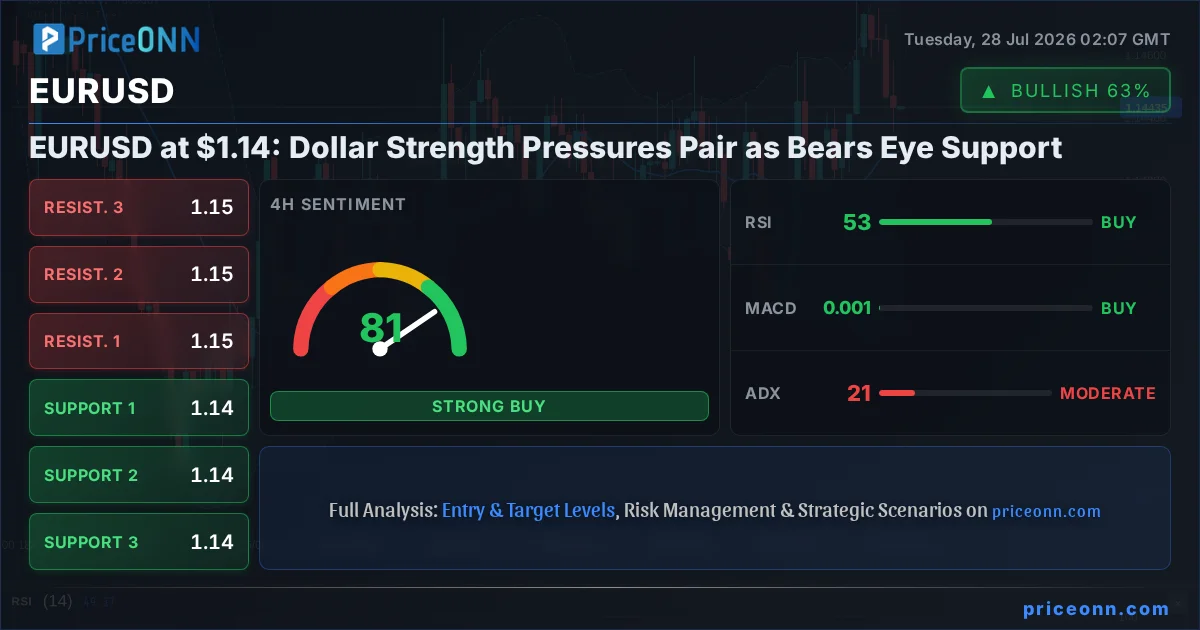
For the EUR/USD pair, trading has settled into a tight channel between 1.1600 and 1.1660. Technical indicators suggest that a failure to hold the 1.1600 level could see the pair retest last week's low, approaching 1.1570. A sustained advance, conversely, would likely require a decisive break and establishment of trading above the 1.1660 ceiling.
The GBP/USD pair has faced renewed selling pressure after a brief upward correction. The pair's recent low, situated near 1.3300, is currently holding, which lends credence to the possibility of a near-term bounce. However, without a clear directional catalyst, further downside risks remain if key support falters.
Analysis & Drivers
The current range-bound behavior in both EUR/USD and GBP/USD is a classic sign of market indecision ahead of major economic event risk. The absence of significant geopolitical developments has removed external drivers, placing all eyes on domestic US economic indicators. The core PCE price index is particularly crucial as it is the Federal Reserve's preferred measure of inflation. A higher-than-expected reading would likely bolster expectations for continued hawkish monetary policy, supporting the US dollar. Conversely, a softer print could lead to a reassessment of Fed rate hike probabilities, potentially weakening the dollar and offering relief to the Euro and Sterling.
Recent price action indicates that while these pairs have dipped, there hasn't been enough conviction from sellers to break key support levels decisively. This suggests underlying demand at these lower price points or simply a lack of committed direction. Traders are likely taking a cautious approach, reducing exposure until the economic data provides a clearer picture of the inflationary environment and the Fed's likely response.
Trader Implications
Traders should remain vigilant as the upcoming US data releases have the potential to trigger significant volatility. Key levels to watch for EUR/USD are the support at 1.1600 and resistance at 1.1660. A break below 1.1600 could open the door to 1.1570, while a sustained move above 1.1660 might target higher levels. For GBP/USD, the 1.3300 level represents immediate support. A failure to hold this level could lead to a test of lower grounds, while a firm reclaim of 1.3350 or higher could signal a short-term reversal.
The core PCE data, due later today, is the primary event. Any deviation from consensus estimates could lead to rapid price discovery. For those looking to trade the event, risk management is paramount. Options strategies or scaled-in entries after initial volatility might be considered, but the risk of whipsaws remains high until a clear trend emerges. The overarching sentiment remains cautious, with a bias towards dollar strength if inflation data proves persistent.
Outlook
The immediate future for EUR/USD and GBP/USD will likely be dictated by the US core PCE price index and other accompanying data. If inflation remains elevated, the US dollar could see a renewed surge, pushing these currency pairs lower. Conversely, signs of cooling inflation might allow for a modest recovery in the Euro and Sterling. Until then, expect continued choppiness with potential for sharp, short-lived moves around the data releases. Traders should prepare for increased volatility and be ready to adjust positions based on the incoming economic signals.
Frequently Asked Questions
What is the key US data to watch for EUR/USD and GBP/USD?
The most critical data point is the US core Personal Consumption Expenditures (PCE) price index, which is the Federal Reserve's preferred inflation gauge. Traders will also monitor Gross Domestic Product (GDP) and durable goods orders for a broader economic picture.
What are the current trading levels for EUR/USD?
EUR/USD is currently trading within a range between 1.1600 and 1.1660. Support is seen at 1.1600, with a break below potentially leading to a test of 1.1570. Resistance lies at 1.1660.
How might the US data impact GBP/USD?
If US inflation data comes in hotter than expected, it could strengthen the US dollar, potentially pushing GBP/USD below its current support level near 1.3300. Conversely, cooler inflation might allow GBP/USD to rebound from these levels.
Track markets in real-time
Empower your investment decisions with AI-powered analysis, technical indicators and real-time price data.
Join Our Telegram Channel
Get breaking market news, AI analysis and trading signals delivered instantly to your Telegram.
Join Channel PriceONN News
EUR/USD enters the final week of July at 1.1369. Friday’s modest decline in energy prices reduced expectations that the Federal Reserve could raise rates as early as its upcoming meeting, scheduled for Tuesday and Wednesday. At the same time, the main currency pair remains very close to the monthly low recorded in late June. Markets […] The post EUR/USD Ahead of a Key Week: Holding Near Lows appeared first on ActionForex.
PriceONN News
Gold fell to 4,047 USD per ounce on Tuesday, erasing gains from the previous session. Pressure on the metal is mounting amid fears that the Federal Reserve may raise rates as early as this week. Markets currently estimate the probability of such a move on Wednesday at over 33% – an unusually high level of […] The post Gold Declines, Focus on Fed and Falling Oil Prices appeared first on ActionForex.
PriceONN News
The ceasefire in the Middle East has disrupted the greenback’s plans. Strong PMI data and falling oil prices are helping the euro. The US dollar faced a downward gap at the start of the week as the Middle East de-escalation of the conflict came as an unwelcome surprise to speculators who had built up net […] The post De-Escalation Undermines the Greenback appeared first on ActionForex.
PriceONN News
The dollar heads into a pivotal week trading near 101.80, just off a 15-month high, with the Fed’s July 29 meeting standing as the clear focal point. Markets currently price roughly a 65% chance of a hold, though renewed Middle East escalation has kept a hike back on the table for later this year. Energy […] The post US Dollar Index: a Defining Week for the King of the Markets appeared first on ActionForex.
PriceONN News
On 21 July, Stats NZ reported an acceleration in inflation: the Consumer Price Index rose 1.5% in the second quarter, while the annual inflation rate climbed to 4.1%, its highest level in more than two years and slightly above analysts’ consensus forecast of 4.0%. The increase was driven primarily by higher fuel prices amid tensions […] The post NZD/USD: Inflation Surge Meets Strong US Dollar Pressure appeared first on ActionForex.
PriceONN News
I am already riding two EURUSD sell entries. Another possible sell opportunity could be forming for traders that are not in yet. EURUSD Possible Bearish Scenario Watch for price to tap 4 Hour FVG (Purple) first. Watch for a bearish shift and bearish reversal signs in the FVG zone. Wait for all above to play […] The post Riding EURUSD Sellside appeared first on ActionForex.
PriceONN News
(RTTNews) - Gold prices traded higher on Monday as oil prices tumbled amid eased Middle East tensions, helping ease inflation and interest-rate concerns ahead of crucial Fed, BoE and BoJ central bank meetings due this week.
PriceONN News
European Central Bank Governing Council member Peter Kazimir from Slovak reinforced the hawkish bias on Monday, arguing that policymakers will likely need to raise interest rates at least once more and warning that a worsening energy shock could ultimately require even more tightening than markets currently anticipate. His remarks come just days after the ECB […] The post ECB’s Kazimir Sees At Least One More Rate Hike, Warns Oil Shock Could Require More appeared first on ActionForex.
PriceONN News
US business activity accelerated at the start of the third quarter, with S&P Global’s Flash Composite PMI Output Index rising from 51.9 to 53.6 in July, its highest level in eight months. The improvement was driven by the services sector, where the Business Activity Index climbed from 51.2 to 53.6, also an eight-month high. Manufacturing, […] The post US PMI Hits Eight-Month High,Yet Rising Costs and Supply Delays Raise Caution appeared first on ActionForex.
PriceONN News
Market Overview The crypto market trended lower at the end of Monday, mirroring the US equity market, as it fell from a peak of $2.23T to $2.16T before returning to recent local lows of $2.18T by Tuesday morning. This marks yet another test of the 50-day moving average (MA) as support, which sellers have been […] The post Bitcoin Has Failed to Break Away from Its Long-Term Trend appeared first on ActionForex.
PriceONN News
The de-escalation of the conflict in the Middle East has sent Brent prices tumbling. The oil market could return to a surplus as early as the end of 2026. The US dollar and oil have lost their correlation. Brent recorded its worst daily fall in three months after reports of a ceasefire in the Middle […] The post Oil: A Surplus on the Horizon appeared first on ActionForex.
PriceONN News
The Trump administration is weighing whether to extend access to some Chinese rare earth materials beyond the January 1, 2027 cutoff after U.S. producers acknowledged they cannot build sufficient domestic processing and magnet capacity before the deadline, Reuters reported on Monday. Industry executives and Pentagon suppliers told Reuters that U.S. processing and magnet manufacturing capacity remains insufficient to meet despite billions of dollars in federal support for new mines, separation...