

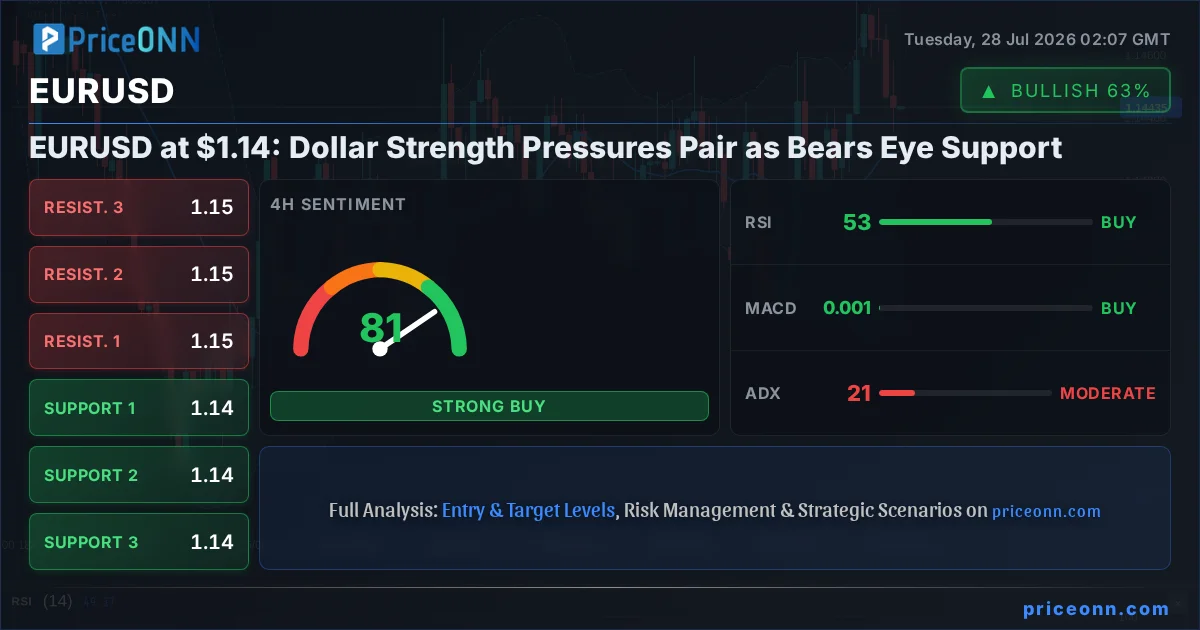
This is precisely where the market tension lies: EURUSD is locked in a fierce battleground around the $1.14 mark, with the Dollar Index (DXY) showing renewed strength and pushing against the Euro. Traders are scrutinizing every tick, trying to decipher whether this is a temporary pause before a resumption of the bullish trend, or if the mounting pressure from a strengthening dollar will finally break the pair's resolve and send it lower. The narrative is split, with bulls pointing to potential consolidation and bears highlighting the persistent headwinds. This week's economic calendar, particularly key inflation and central bank policy indicators, will be crucial in determining the next significant move.
- The RSI for EURUSD is currently at 43.67 on the 1H chart, indicating bearish momentum is building.
- Critical support for EURUSD is identified at $1.14383, with a break below potentially targeting $1.14251.
- The Dollar Index (DXY) is trading at 100.7, reflecting underlying strength that weighs on EURUSD.
- Upcoming ECB and Fed policy signals will be pivotal in shaping the EURUSD outlook for the coming week.
The Bull Case: A Temporary Reprieve at Key Levels?
Despite the bearish undertones from the 1-hour technicals and the overarching dollar strength, the bulls are not yet ready to concede. They point to the 4-hour and daily charts, where EURUSD shows resilience, hovering above significant support levels. The 4-hour chart, for instance, shows an RSI of 53.17, indicating a neutral-to-bullish bias, and MACD is positive with the histogram above the signal line. This suggests that while the short-term might be choppy, the medium-term picture offers some hope for a reversal or at least a consolidation. The daily chart reinforces this, with an RSI of 47.95, still holding within the neutral zone, and Bollinger Bands trading above the middle band, hinting at underlying upward momentum that has been temporarily stalled rather than reversed. The key argument here is that the current price action around $1.14 is a critical juncture, not a definitive turning point. If the pair can hold above the $1.14383 support, bulls might see an opportunity to re-enter, especially if upcoming economic data from the Eurozone surprises to the upside or if US data disappoints. The narrative for the bulls is one of patience: wait for confirmation, manage risk, and be ready for a potential bounce from these levels. They argue that the market has already priced in much of the Fed's hawkish expectations, leaving limited room for further dollar appreciation against a Eurozone that, while facing challenges, is not in outright crisis. The current price, $1.14, is seen not as a ceiling, but as a level where buyers might step in to defend their positions, anticipating a reversion to the mean or a broader risk-on sentiment shift.
Furthermore, the bulls are looking at the broader economic context. While US inflation remains a concern, the narrative around the Fed's next moves is becoming increasingly nuanced. Any hint of a pause or a slower pace of tightening could significantly shift the balance of power away from the dollar. Conversely, if the Eurozone can demonstrate robust economic activity, perhaps through better-than-expected PMI or employment figures, it could provide the necessary fundamental catalyst for a EURUSD rally. The fact that the pair has not decisively broken below $1.14, despite the DXY’s ascent to 100.7, suggests a degree of underlying Euro strength or at least a lack of strong selling conviction below this psychological level. They are waiting for a clear signal, perhaps a daily close above $1.14500, to confirm their thesis. Until then, the strategy is defensive: protect capital and look for opportunities to join a confirmed uptrend, rather than trying to catch a falling knife. The historical performance of EURUSD around these price points often shows periods of consolidation before major moves, and bulls believe this is simply another such phase.
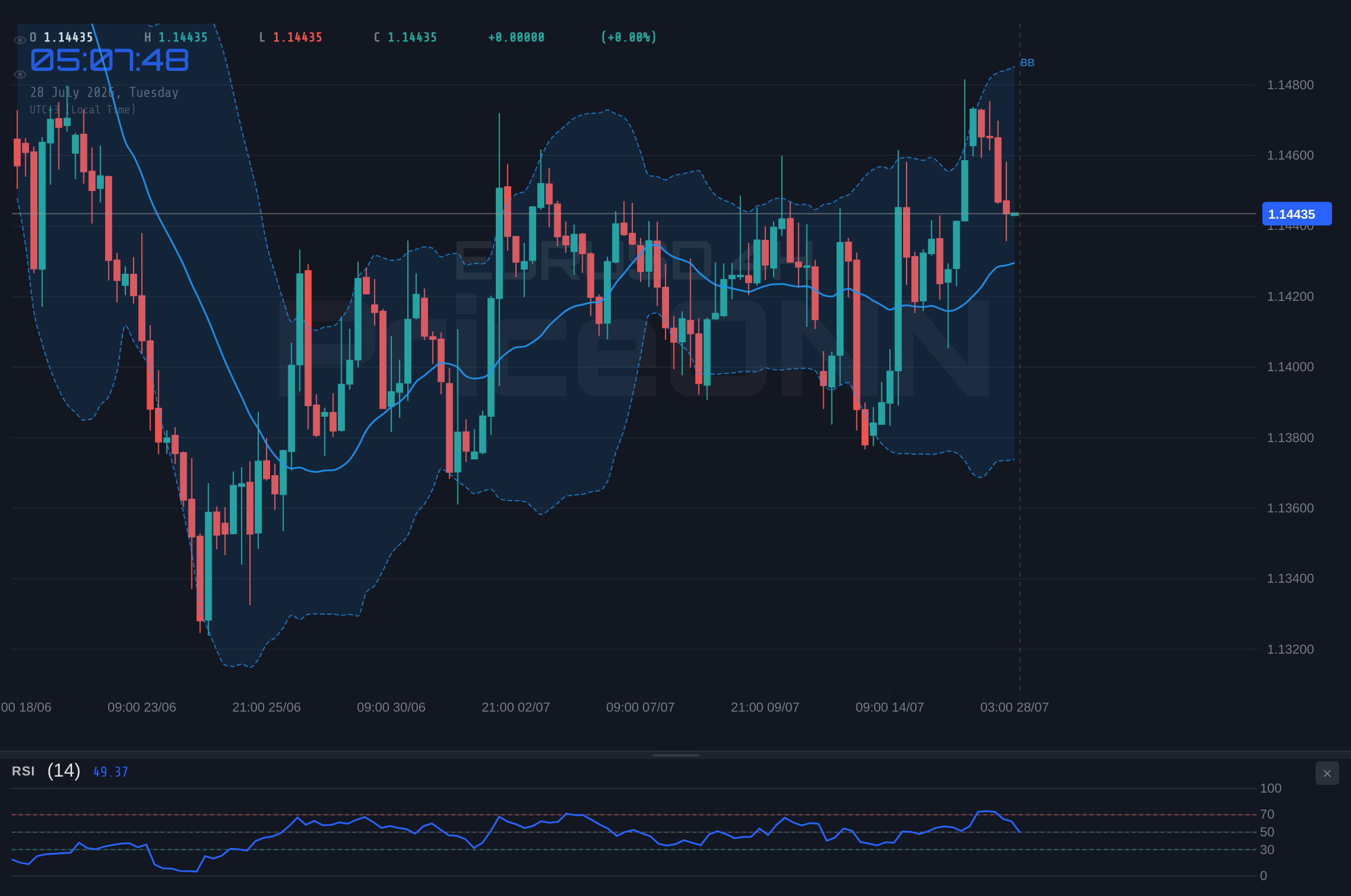
From a technical perspective, the bulls are watching the confluence of support levels between $1.14383 and $1.14251. A failure to hold these levels would invalidate the immediate bullish outlook, but a successful defense could pave the way for a move back towards the $1.14500 resistance. They also note that Stochastic on the 1-hour chart is showing a crossover (%K > %D), a nascent bullish signal, even though RSI is trending down. This divergence, if confirmed by subsequent price action and other indicators like MACD histogram moving back into positive territory, could signal a short-term bottom. The overall sentiment, while cautious, is not entirely bearish. The market is grappling with competing forces: the Fed's potentially restrictive policy versus the Eurozone's own economic challenges and the ECB's stance. This uncertainty, bulls argue, creates opportunities for counter-trend trades if key support levels hold firm.
The Bear Case: Dollar Dominance and Macro Headwinds
On the other side of the coin, the bears see a clear path lower for EURUSD, driven by a potent combination of dollar strength and Eurozone vulnerabilities. The 1-hour technical signals are particularly concerning for bulls, with RSI at 43.67 trending downwards, MACD showing negative momentum below the signal line, and Stochastic confirming a bearish crossover (%K
The bears also point to the recent breaking news: the ECB's Kazimir reinforcing a hawkish bias with hints of further rate hikes, but this is seen as a double-edged sword. While higher rates might eventually support the Euro, the immediate impact could be a slowdown in economic activity, a narrative that the bears are happy to amplify. Furthermore, the recent surge in oil prices, while easing slightly due to geopolitical developments, still poses an inflation risk that could force the ECB's hand into more aggressive tightening, potentially choking off growth. The bears are looking for confirmation of downside momentum, such as a daily close below $1.14300, which would solidify their view. They are not betting on a collapse but rather a steady grind lower as the market prices in continued dollar strength and Eurozone economic fragility. The correlation with the DXY is key here; as the dollar index shows strength, EURUSD is expected to fall, and the current setup on the DXY, despite some mixed signals across different timeframes, leans towards continued upward pressure. The bears believe the market is underestimating the Fed's resolve and overestimating the Eurozone's resilience.
Technically, the bears are drawing a line in the sand at the $1.14515 resistance level on the 1-hour chart. A failure to push above this level, especially after a test of lower support, would be a strong bearish signal. They are also watching the ADX on the 4-hour chart, which, despite showing a weaker trend (15.79), is coming off higher daily ADX readings (39.16 on daily), suggesting that the underlying trend, though perhaps consolidating, is still present and could reassert itself. The Stochastic indicator on the 4-hour chart is also in bearish territory (%K
Weighing the Evidence: Technicals, Fundamentals, and the Dollar's Grip
The EURUSD's current predicament at $1.14 is a classic tug-of-war between opposing forces. On one side, the US Dollar Index (DXY) shows resilience, currently trading at 100.7. This strength, driven by the market's anticipation of continued Fed hawkishness and a relatively stable US economic outlook compared to some peers, puts consistent pressure on the Euro. The DXY's upward momentum, even if showing some mixed signals across different timeframes (bullish 1H, bearish 4H, neutral 1D), suggests that the dollar is not ready to significantly weaken, acting as a persistent headwind for EURUSD. The correlation is undeniable: as the DXY pushes higher, EURUSD tends to slide, and the immediate technicals on the 1-hour chart support this narrative with bearish RSI, MACD, and Stochastic readings.
However, the Eurozone is not without its own drivers. While inflation remains a concern, the European Central Bank (ECB) is also navigating a complex path. Recent comments from ECB's Kazimir suggest a continued hawkish bias, hinting at further rate hikes. While this could potentially bolster the Euro in the long run, the immediate market reaction is often focused on the potential economic slowdown that aggressive tightening might entail. This creates a nuanced fundamental picture where the Euro's fate is intertwined with both its own economic performance and the Fed's policy trajectory. The market is essentially waiting for clarity: will the Fed pivot or remain steadfast? Will the Eurozone weather the inflationary storm without a significant growth shock? The current price action around $1.14 reflects this uncertainty, with the pair oscillating between support and resistance.
Looking at the technical indicators across multiple timeframes provides a slightly clearer, albeit still mixed, picture. The 1-hour chart screams caution with bearish signals across RSI, MACD, and Stochastic, coupled with a strong ADX suggesting a downtrend. This supports the bear case for an immediate move lower. However, the 4-hour and daily charts offer a different perspective. The 4-hour chart displays a neutral trend with a bullish bias on MACD and Bollinger Bands trading above the middle band, while the daily chart also shows a neutral trend with bullish leanings on MACD and Bollinger Bands. This suggests that while short-term weakness is possible, the longer-term structure might still favor buyers if key support levels at $1.14383 and $1.14251 hold. The divergence in signals between the short-term and longer-term timeframes is the crux of the current market indecision around $1.14.
The Verdict: Cautious Bearish Stance Favored
Given the current market data and the prevailing sentiment, a cautious bearish stance appears to be the more prudent approach for EURUSD traders in the short to medium term. The immediate technicals on the 1-hour chart are overwhelmingly bearish, with RSI at 43.67 trending down, MACD exhibiting negative momentum, and Stochastic confirming a bearish crossover. This suggests that the path of least resistance is currently to the downside. The Dollar Index trading at 100.7 further bolsters this view, indicating that the greenback has underlying strength that is likely to continue weighing on the Euro.
While the 4-hour and daily charts offer some hope for bulls with their neutral-to-bullish leanings, these longer-term trends are currently being overshadowed by the immediate bearish pressure. For the bears, the critical levels to watch are the support at $1.14383, followed by $1.14304, and the more significant $1.14251. A break below this cluster would likely accelerate the decline. The bears would invalidate their short position if the price decisively closes above the $1.14515 resistance on the 1-hour chart, or more broadly, above the $1.14916 resistance on the daily chart.
The fundamental backdrop, while complex, currently leans towards supporting the dollar. The Fed's stance, coupled with US economic data that, while showing some signs of cooling, remains relatively robust compared to the Eurozone's challenges, provides a solid foundation for dollar strength. Until there is a clear shift in either US monetary policy expectations or a significant improvement in the Eurozone's economic outlook, the risks for EURUSD appear tilted to the downside. Therefore, the favored scenario is a move towards the lower support levels, with traders advised to manage risk tightly and wait for clear confirmation before considering any significant long positions.
Bearish Scenario: Dollar's Grip Tightens
65% ProbabilityNeutral Scenario: Consolidation Around $1.14
25% ProbabilityBullish Scenario: Support Holds, Dollar Weakens
10% ProbabilityFrequently Asked Questions: EURUSD Analysis
What happens if EURUSD breaks below the $1.14383 support level?
A break below $1.14383 on the 1-hour chart would strengthen the bearish case, potentially targeting the $1.14251 support. This would signal that the dollar's upward pressure is overcoming the Euro's resilience around the $1.14 mark.
Should I consider buying EURUSD at current levels near $1.14 given the mixed signals?
Buying at current levels requires extreme caution. While the 4H and daily charts show some bullish potential, the immediate 1H bearish signals and DXY strength suggest a higher probability of further downside. A confirmed hold above $1.14383 with strong volume would be a more prudent buy trigger.
What does the RSI at 43.67 on the 1H chart indicate for EURUSD?
An RSI of 43.67 on the 1-hour chart indicates bearish momentum is building, but it is not yet in oversold territory. This reading supports the view that sellers are currently in control on shorter timeframes, suggesting potential for further downward movement.
How will upcoming ECB and Fed policy expectations impact EURUSD this week?
Upcoming central bank communications are critical. If the Fed signals continued hawkishness, it could push EURUSD lower towards $1.13722. Conversely, any dovish hints from the Fed or a surprisingly hawkish stance from the ECB could support a move back towards $1.14916.
Volatility creates opportunity - those prepared will be rewarded. While the immediate outlook for EURUSD appears cautiously bearish, the market is dynamic. The interplay between Federal Reserve policy expectations and Eurozone economic data will be key drivers. Traders should maintain disciplined risk management, focusing on the critical support levels around $1.14383 and $1.14251. A clear break or hold of these levels will provide the necessary confirmation for the next directional move. Patience and a data-driven approach will be crucial in navigating these choppy waters.
Track markets in real-time
AI-powered analysis, technical indicators and real-time price data.
Join Our Telegram Channel
Breaking market news, AI analysis and trading signals instantly.
Join Channel