

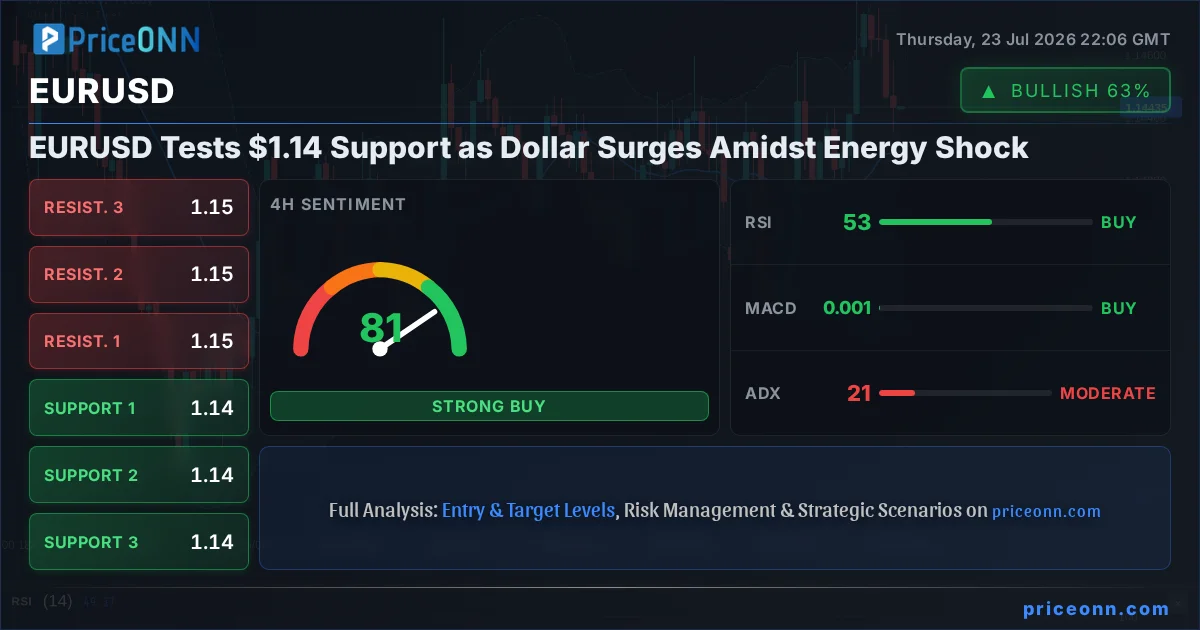
The narrative in the forex market is increasingly dominated by the dual forces of a strengthening US dollar and the persistent specter of energy-driven inflation. For EURUSD, this means navigating a treacherous landscape where the $1.14 level has become a crucial battleground. As the dollar index (DXY) pushes higher, currently trading at 100.7, the euro faces mounting pressure. This dynamic is not occurring in a vacuum; it's deeply intertwined with global macroeconomic shifts, including the European Central Bank's recent policy stance and the volatile trajectory of oil prices, which are nearing $83.79 for Brent crude.
- RSI at 43.67 on the 1H chart signals bearish momentum, with a close below $1.1415 increasing downside risk.
- Critical support sits at $1.1415 (S1), tested multiple times this week; a break below could target $1.1372 (S2).
- MACD histogram shows negative momentum on the 1H and 4H, while the 1D chart presents a bullish divergence, creating a complex picture.
- The correlation with DXY, currently at 100.7, remains a key driver, with dollar strength typically weighing on EURUSD.
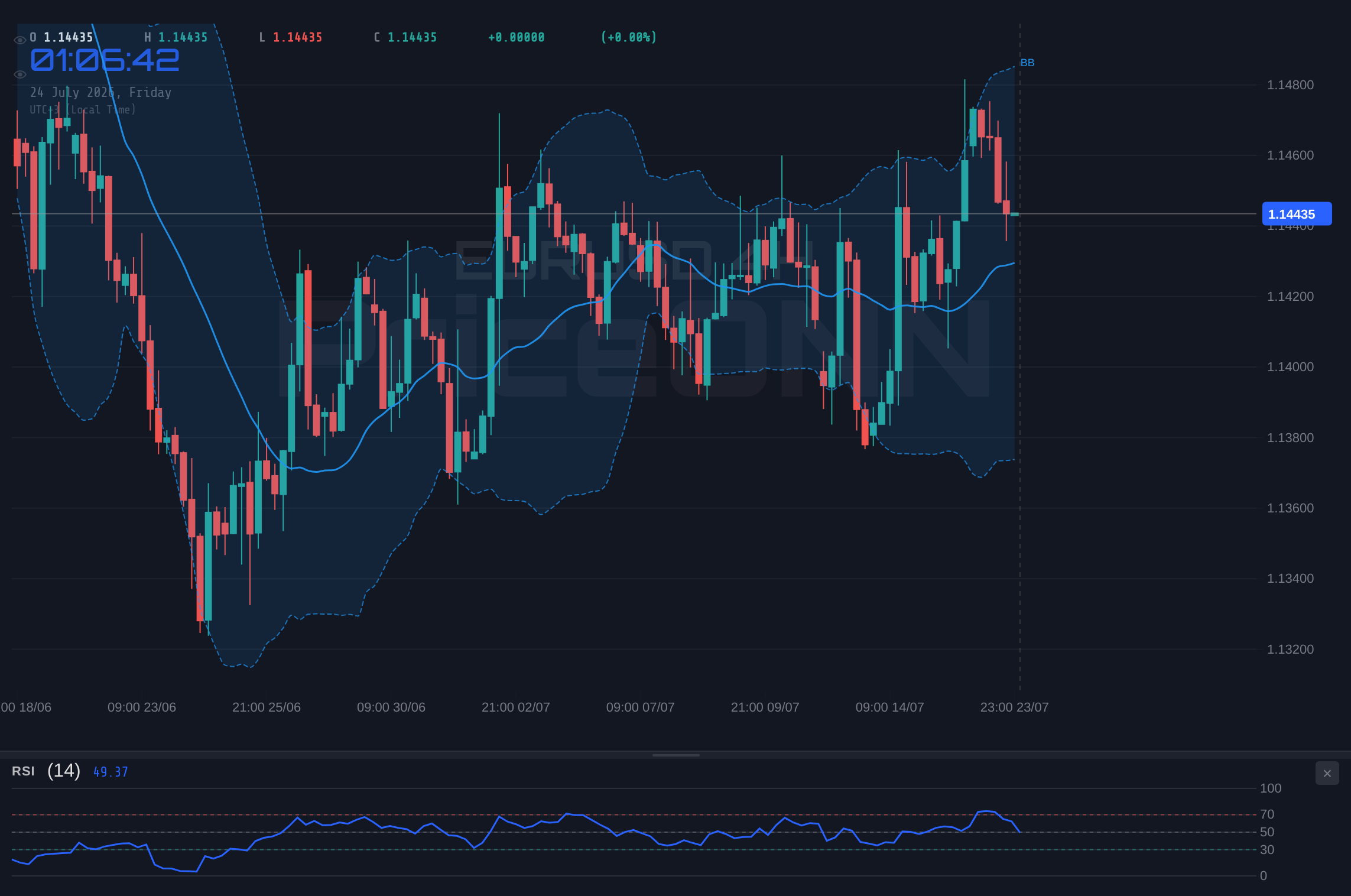
The recent price action for EURUSD, currently hovering around $1.14436, paints a picture of cautious decline. While the 1-hour chart suggests a neutral trend with a slight bearish bias, the 4-hour timeframe indicates a more entrenched neutral stance with mixed signals. However, the daily chart, despite showing positive momentum on the MACD, leans towards a cautious outlook with RSI at 47.95. This intricate dance between timeframes highlights the need for a nuanced approach. The dollar's resurgence, evident in the DXY's climb to 100.7, is a significant factor, often acting as a headwind for the single currency. The market is clearly watching how these forces interact, with traders seeking clarity on the next directional move.
Navigating the Dollar's Resurgence and ECB's Stance
The US dollar's recent strength, reflected in the DXY's push towards 100.7, is a critical element influencing EURUSD. Historically, a stronger dollar tends to put downward pressure on major currency pairs like EURUSD, as it makes dollar-denominated assets more attractive and increases the cost of holding other currencies. This is particularly relevant given the current market environment. The DXY's movement is often a bellwether for risk appetite, and its current upward trajectory suggests a cautious sentiment prevailing in broader markets. This aligns with the broader move seen in indices like the S&P 500, which, despite a recent uptick to 6572.87, faces technical headwinds on the daily chart, hinting at potential underlying weakness.
Adding another layer to this complex picture is the European Central Bank's (ECB) recent monetary policy decision. While the bank held rates steady as widely expected, its commentary on inflation and the economic outlook is paramount. News reports indicate that the ECB is closely watching the impact of energy shocks and potential inflation spillovers. This suggests a cautious, data-dependent approach rather than an immediate pivot towards aggressive tightening or easing. The market's reaction to such pronouncements can be swift, often leading to volatility in the euro. If the ECB's rhetoric leans hawkish, even with rates on hold, it could provide some support to the euro. Conversely, any hint of concern about economic slowdown could amplify the dollar's strength and push EURUSD lower. The current price action for EURUSD, sitting precariously near the $1.14 mark, suggests that the market is still digesting these central bank signals amidst broader market pressures.
The interplay between the dollar's strength and the ECB's policy is crucial for EURUSD. As the DXY moves higher, it creates a challenging environment for the euro. The 1-hour chart for EURUSD shows RSI at 43.67, indicating bearish momentum, and the MACD histogram is in negative territory, reinforcing this view. However, the daily chart presents a more complex picture with positive MACD momentum and Stochastic signaling a potential upward move, even as RSI remains in neutral territory. This divergence across timeframes underscores the current uncertainty. Traders are keenly observing whether the dollar's upward trend will be sustained or if the ECB's cautious stance, combined with potential global risk aversion, might offer some respite for the euro.
Technical Analysis: Decoding EURUSD's Chart Patterns
Delving into the technicals for EURUSD reveals a market at a critical juncture, with the $1.14 level acting as a significant psychological and technical support. On the 1-hour chart, the pair is trading below the middle Bollinger Band, and the RSI at 43.67 suggests room for further downside before reaching oversold territory. The MACD histogram is negative, reinforcing the bearish sentiment on this shorter timeframe. However, the Stochastic indicator on the 1H chart, with K at 40.52 and D at 37.27, is showing a slight upward cross, hinting at potential short-term bounces, though the ADX at 20.26 indicates a neutral trend strength. The overall signal on this timeframe leans towards 'SELL', with 7 sell signals against 2 buy signals.
The 4-hour timeframe offers a slightly different perspective, though still predominantly bearish. EURUSD is trading below the middle Bollinger Band, with RSI at 40.59, continuing the theme of bearish momentum. The MACD remains negative, and Stochastic is firmly in oversold territory with K at 18.51 and D at 31.25, signaling a potential reversal or consolidation. The ADX at 15.79 suggests a weak trend, indicating that the current downward move might lack strong conviction. Despite this, the overwhelming signal on this timeframe is 'SELL', with 8 sell signals and no buy signals. This confluence of bearish indicators across shorter timeframes suggests that the immediate pressure remains on the downside, making the $1.14 support level a key focus.
On the daily chart, the picture becomes more nuanced. EURUSD is trading below the middle Bollinger Band, with RSI at 38.86, still indicating bearish leanings but with more room to move. Crucially, the MACD is showing positive momentum and is above its signal line, a sign that could indicate a potential shift or at least a slowing of the bearish trend. The Stochastic indicator on the daily chart, with K at 26.18 and D at 44.73, signals a potential move upwards, crossing below the D line. However, the ADX at 39.16 indicates a strong trend, which, given the other indicators, is likely still a bearish trend. The daily signal is mixed, with 1 'BUY', 7 'SELL', and 0 'NEUTRAL' signals, reflecting the conflicting signals across different indicators and timeframes. This divergence is precisely what makes the $1.14 level so critical; a break below it could confirm the bearish trend, while a hold and subsequent bounce might signal a shift.
Correlations and Broader Market Context
The movement of EURUSD cannot be analyzed in isolation. Its correlation with other major markets provides vital context. The US Dollar Index (DXY), currently at 100.7, is a primary driver. As observed, the DXY's rise typically exerts downward pressure on EURUSD. This relationship is not always linear, but in the current environment, the dollar's strength is a dominant theme. Furthermore, the performance of global equity markets, such as the S&P 500 (6572.87) and Nasdaq (29164.86), offers clues about risk sentiment. A decline in these indices often leads to a flight to safety, benefiting the dollar and potentially putting pressure on riskier currencies or assets. Conversely, a strong rally in equities might signal increased risk appetite, which could weaken the dollar and support EURUSD.
Energy prices, particularly Brent crude at $83.79, play a significant role. Rising oil prices can reignite inflation concerns, prompting central banks to adopt a more hawkish stance. This can strengthen the currency of the country heavily reliant on oil imports or exports. For the Eurozone, higher energy costs can exacerbate inflationary pressures, potentially forcing the ECB's hand. The current uptrend in oil prices, despite a slight pullback, keeps inflation risks on the table, adding another layer of complexity to the ECB's policy considerations and, consequently, to EURUSD's outlook. The price action in WTI crude oil, currently at $79.59, also echoes this trend, suggesting a broader energy market upswing.
The relationship between EURUSD and gold (XAUUSD) is also worth noting. Gold, currently trading at $4001.21, is often seen as a safe-haven asset. When market uncertainty rises or inflation fears grow, gold can attract capital. If gold prices are rising while EURUSD is falling, it could indicate a broader shift towards safe-haven assets, reinforcing the dollar's strength and euro's weakness. Conversely, if gold is falling despite dollar strength, it might suggest that the market is not pricing in significant inflation risks or that the dollar's strength is driven by factors other than pure risk aversion, such as interest rate differentials.
Trade Scenarios for EURUSD
Given the mixed signals across different timeframes and the interplay of fundamental and technical factors, several scenarios are plausible for EURUSD. The current price action around $1.14 is critical, and the market will likely be driven by how key levels hold or break.
Bearish Scenario: Dollar Dominance Continues
65% ProbabilityNeutral Scenario: Consolidation Around $1.14
25% ProbabilityBullish Scenario: ECB Support and Dollar Weakness
10% ProbabilityWhat Traders Should Watch Next
Looking ahead, traders will be closely monitoring several key factors that could influence EURUSD's trajectory. The immediate focus remains on the $1.1415 support level. A decisive break below this could trigger further selling, aligning with the bearish scenario. Key indicators like the RSI at 43.67 on the 1H chart and the negative MACD momentum on both the 1H and 4H charts support this view. However, the conflicting signals from the daily chart, particularly the positive MACD momentum and Stochastic's upward bias, suggest that a bounce is not entirely out of the question, especially if the dollar falters or the ECB's commentary is interpreted favorably for the euro.
The US dollar's performance, closely tied to the DXY at 100.7, will be paramount. Any sign of weakness in the dollar, perhaps due to shifting interest rate expectations or a change in global risk sentiment, could provide relief for EURUSD. Conversely, continued dollar strength, potentially fueled by further gains in oil prices (Brent near $83.79) and rising Treasury yields, would likely exacerbate the downside pressure on the pair. Traders should also be mindful of upcoming economic data releases, particularly any inflation figures or central bank speeches that could sway interest rate expectations. The current technical setup around $1.14 presents a clear risk-reward scenario; a break of support offers a bearish trade setup, while a hold and reversal could signal a tactical opportunity for the bulls, albeit with lower probability based on current technicals.
The divergence in signals across different timeframes for EURUSD is a classic sign of a market in transition or consolidation. The short-term charts lean bearish, while the longer-term daily chart shows signs of potential stabilization or even a bullish divergence. This makes decisive action around the $1.1415 support level crucial. A break below it, confirmed by volume and sustained price action, would likely invalidate any near-term bullish hopes and open the door for further declines towards $1.1372 and $1.1339. Conversely, a strong rejection of lower prices and a move back above $1.1465 could signal a short-covering rally, targeting higher resistance levels. For now, the path of least resistance appears to be to the downside, but the market is ripe for volatility as these conflicting forces battle for control.
Frequently Asked Questions: EURUSD Analysis
What happens if EURUSD breaks below the $1.1415 support level?
A break below $1.1415 on the EURUSD pair would invalidate the current neutral stance and likely trigger a bearish move. The MACD and RSI on shorter timeframes already suggest downside pressure, and a confirmed break below this key support could target the next level at $1.1372 (S2).
Should I consider buying EURUSD at current levels around $1.14436 given the mixed daily signals?
Buying EURUSD at current levels carries significant risk due to the bearish momentum on 1H and 4H charts and the strong dollar (DXY at 100.7). While the daily chart shows some bullish divergence, it's a low-probability scenario (10%) and would require a clear trigger like a hawkish ECB surprise or dollar weakness.
Is the RSI at 43.67 on the 1H chart a sell signal for EURUSD?
An RSI reading of 43.67 on the 1-hour chart indicates bearish momentum, but it is not yet in oversold territory. Combined with negative MACD momentum, it supports the bearish outlook for the short term. However, traders should look for confirmation from price action, such as a break below $1.1415, before initiating a short position.
How will continued strength in Brent crude near $83.79 affect EURUSD?
Continued strength in Brent crude prices, currently near $83.79, can reignite inflation concerns in the Eurozone. This could pressure the ECB to maintain a cautious or hawkish stance, which might offer some euro support. However, if the dollar continues to strengthen alongside oil due to global risk aversion, it could still lead to further downside for EURUSD.
Volatility creates opportunity - those prepared will be rewarded. The market is cyclical; every downturn plants seeds for the next rally. With disciplined risk management, these choppy waters can be navigated safely. Patient investors always find opportunities - the key is waiting for the right moment.
Track markets in real-time
AI-powered analysis, technical indicators and real-time price data.
Join Our Telegram Channel
Breaking market news, AI analysis and trading signals instantly.
Join Channel