

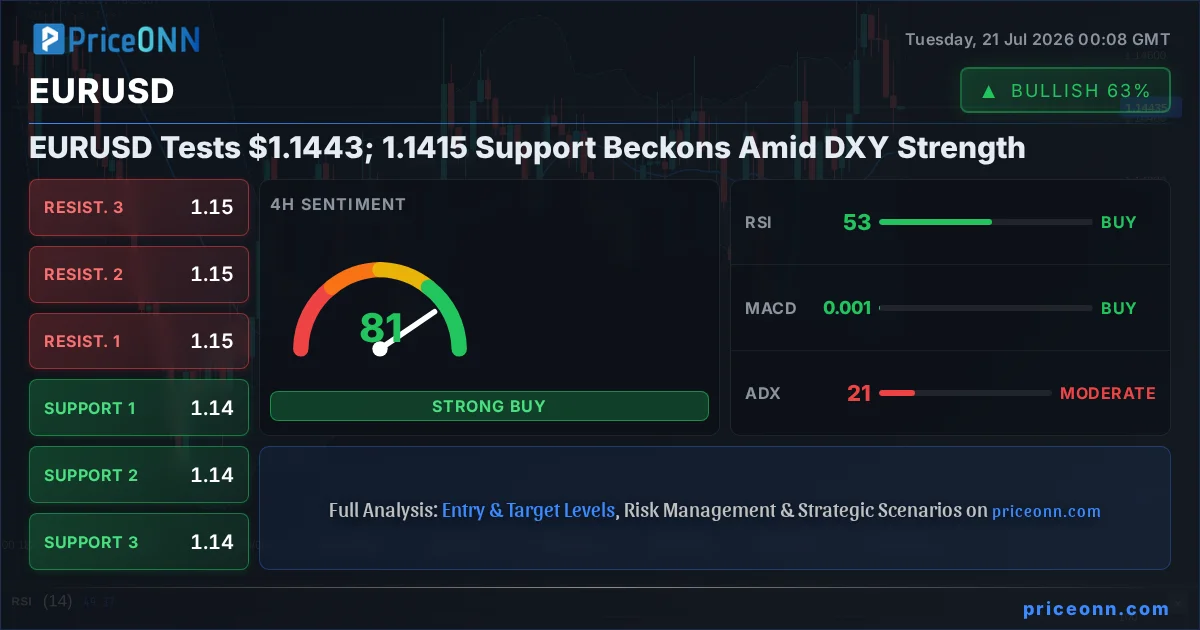
The EURUSD currency pair is currently navigating a critical juncture, trading precariously close to the $1.1443 mark. This level, while seemingly minor, represents a significant psychological and technical threshold. As traders eye the next move, the specter of renewed dollar strength, driven by a robust DXY, looms large, casting a shadow over the Euro's immediate prospects. The question on many minds is not just where the price is heading, but *why* it's poised at this delicate balance point. A closer examination of the underlying fundamental drivers and nuanced technical signals is paramount for anyone looking to understand the forces shaping this pivotal pair.
- EURUSD is trading at $1.1443, with the 1-hour RSI at 43.67 suggesting further downside pressure.
- Key support is identified at $1.1415, with a break below this level potentially targeting $1.1372.
- The US Dollar Index (DXY) is trading at 100.7, showing strength that typically weighs on EURUSD.
- Mixed signals across timeframes necessitate a cautious approach, with the 4-hour chart showing some bullish momentum.
The market sentiment surrounding EURUSD is decidedly mixed, a common theme when a currency pair hovers near a significant support level. On the 1-hour chart, the picture is leaning bearish, with the Relative Strength Index (RSI) at 43.67. This indicator, while not yet in oversold territory, clearly signals a downward bias, suggesting that sellers have the upper hand in the short term. The Moving Average Convergence Divergence (MACD) further reinforces this sentiment, showing negative momentum with the MACD line firmly below its signal line. The Bollinger Bands are also positioned below the middle band, indicating a bearish trend on this timeframe. However, the Stochastic Oscillator presents a conflicting signal, with the %K line (40.52) above the %D line (37.27), hinting at a potential short-term bounce or a pause in the selling pressure. This divergence between the momentum indicators and the price action is precisely what creates uncertainty and requires careful navigation.
Navigating the Dollar's Dominance: The DXY Factor
The overarching narrative for EURUSD cannot be discussed without acknowledging the formidable strength of the US Dollar Index (DXY). Currently trading at 100.7, the DXY's upward trajectory is a significant headwind for the Euro. A rising DXY typically correlates with a weakening EURUSD, as it signifies increased demand for the greenback relative to a basket of major currencies, including the Euro. On the 1-hour timeframe, the DXY shows a bullish trend with an ADX of 27.71, indicating a solid upward momentum. The Stochastic Oscillator is in the overbought region at 86.15, suggesting potential for consolidation or a minor pullback in the dollar, but the overall trend remains bullish. On the 4-hour chart, however, the DXY shows a neutral trend with a weaker ADX of 25.26, and the RSI at 46.15 suggests room for further downside before hitting oversold territory. This mixed picture for the DXY itself adds another layer of complexity, implying that while dollar strength is a dominant theme, its immediate trajectory might see some fluctuations.
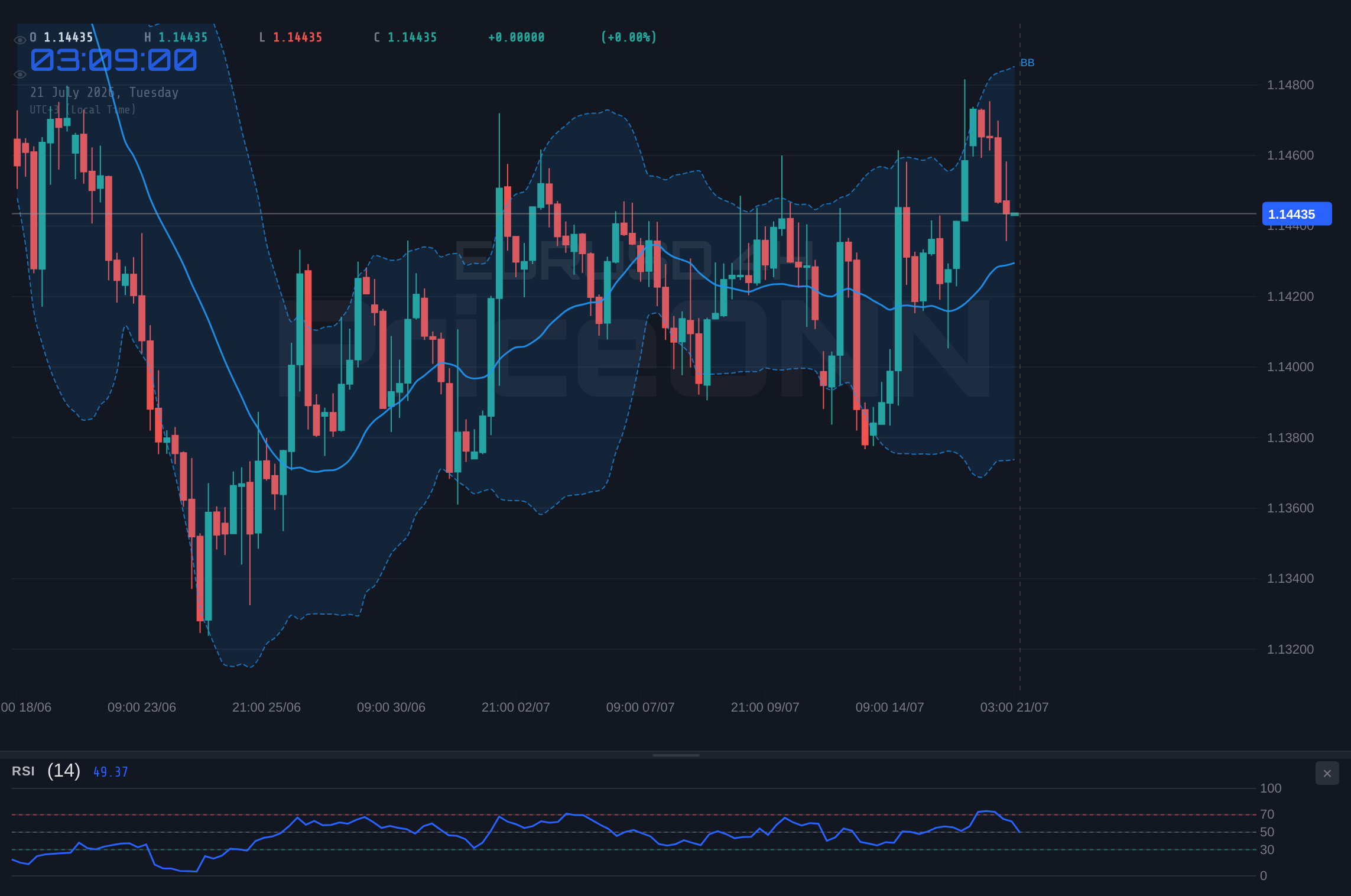
The implications of this DXY strength are profound for EURUSD. When the dollar index rises, it often reflects a 'risk-off' sentiment in the broader markets, where investors flock to the perceived safety of US assets. This can be driven by various factors, including geopolitical tensions, concerns about global economic growth, or expectations of tighter monetary policy from the Federal Reserve. Although the provided market data doesn't explicitly detail Fed rate hike probabilities, the general trend of dollar strength often aligns with a hawkish monetary policy stance or a perception of economic resilience in the US compared to other major economies. For EURUSD, this means that any attempt by the Euro to rally will likely face strong resistance as long as the DXY remains firm. The current price action around $1.1443 suggests that the market is weighing these competing forces: the Euro's intrinsic value and potential support levels against the relentless pull of dollar strength.
The correlation between DXY and EURUSD is not always 1:1, but a sustained move in the DXY, especially above key technical levels like 100.7, usually dictates the short-to-medium term direction for the pair. Traders should monitor the DXY's reaction to its own resistance levels around 100.73 and 100.79.
Technical Crossroads: Support at $1.1415 and Resistance at $1.1464
Examining the EURUSD's technical landscape reveals a battleground of support and resistance levels that are critical for defining its near-term path. On the 1-hour chart, the immediate support is pegged at $1.14383, followed by a more significant level at $1.1415, and then $1.1400. These levels represent areas where buying pressure has historically emerged, potentially halting or reversing downward price movements. Conversely, resistance stands at $1.14515, $1.14568, and a more substantial barrier at $1.14647. A decisive break above this resistance zone could signal a shift in momentum, while a failure to hold the support levels could accelerate selling towards the daily support at $1.1372.
The daily chart provides a broader perspective, painting a picture of consolidation rather than a clear trend. Support is noted at $1.14153, $1.13722, and $1.1339. Resistance is observed at $1.14916, $1.15248, and $1.15679. The RSI on the daily timeframe stands at 47.95, hovering in neutral territory and indicating a lack of strong directional conviction. The MACD, however, shows positive momentum with the MACD line above its signal line, suggesting that longer-term bullish forces might be at play, albeit currently overshadowed by short-term selling. The Bollinger Bands on the daily chart are above the middle band, which typically supports a bullish bias, but the Stochastic Oscillator's %K line (62.39) crossing below its %D line (49.35) presents a bearish signal, indicating a potential pullback from current levels.
This confluence of signals across different timeframes is crucial. The 1-hour chart leans bearish, the 4-hour chart shows some bullish signs with an RSI at 53.17 and MACD in positive territory, while the daily chart presents a neutral outlook with conflicting indicator signals. The ADX values also present a complex picture: a strong 26.93 on the 1-hour suggests a defined downtrend, while the 20.84 on the 4-hour and 26.52 on the daily indicate a trend that is present but not overwhelmingly dominant. This ambiguity means that price action around the key levels of $1.1415 and $1.1464 will be paramount. A confirmed break of either will likely trigger a more decisive move, as the market seeks to resolve this indecision.
The conflicting signals from indicators across different timeframes highlight the potential for whipsaws. Traders should exercise extreme caution and wait for clear confirmation before committing to a position. A close below $1.1415 on the hourly chart could be a strong bearish signal, while a sustained move above $1.1465 would be a bullish confirmation.
Fundamental Undercurrents: Economic Data and Policy Watch
While the immediate price action is dictated by technical levels and dollar strength, the underlying fundamental drivers are crucial for the medium to long-term outlook of EURUSD. Recent economic data releases provide context for the current market dynamics. For instance, the news regarding German PPI falling in June, as reported by ForexLive, suggests some inflationary pressures may be easing in the Eurozone's largest economy. This could influence the European Central Bank's (ECB) monetary policy decisions, potentially tempering expectations for aggressive rate hikes or even signaling a pause sooner rather than later. Lower inflation, if sustained, can reduce a currency's attractiveness to yield-seeking investors.
On the other side of the Atlantic, the US economic picture, while not detailed in the provided market data, is often inferred through the DXY's strength. News about softer US inflation dampening Fed rate hike bets, as mentioned in the provided context, presents a slightly contradictory narrative. If US inflation is indeed cooling, it might reduce the urgency for the Federal Reserve to hike rates further, which could theoretically weaken the dollar. However, the DXY's current strength at 100.7 suggests that either the market is discounting this inflation data, or other factors like geopolitical risks or relative economic growth prospects are currently overriding the inflation narrative. The market's reaction to upcoming US economic data, such as employment figures or consumer confidence reports, will be critical in clarifying the Fed's path and, consequently, the direction of EURUSD.
The interplay between the ECB and the Federal Reserve's monetary policies remains a central theme. If the ECB signals a more dovish stance due to easing inflation or growth concerns, while the Fed maintains a relatively hawkish bias (even if pausing rate hikes, the 'higher for longer' narrative can be dollar-supportive), EURUSD could face further downside pressure. Conversely, if US inflation proves more persistent than expected, forcing the Fed to consider further tightening, the dollar could strengthen across the board, exacerbating any weakness in EURUSD. The upcoming economic calendar will be closely watched for any data that could shift these expectations. For example, significant deviations in upcoming Eurozone GDP or PMI figures, or US Non-Farm Payrolls (NFP) data, could act as catalysts to break the current stalemate.
"The market is always digesting a thousand different pieces of information. Right now, the dollar's strength is the loudest voice, but watch for any shifts in central bank communication or economic data surprises that could change the tune."
Market Sentiment and Trader Positioning
Understanding market sentiment is key to interpreting price action, especially in a market that exhibits conflicting signals. The overall trading signals for EURUSD are mixed, with the 1-hour chart favoring a 'SELL' (2 Buy, 6 Sell, 0 Neutral) and the 4-hour chart leaning towards 'BUY' (5 Buy, 3 Sell, 0 Neutral). The daily chart is perfectly neutral (4 Buy, 4 Sell, 0 Neutral). This split suggests a lack of consensus among algorithmic trading systems and potentially among institutional players. Such a scenario often leads to increased volatility as opposing forces battle for control.
The prevailing 'risk-off' sentiment, often inferred from a stronger DXY and potentially weaker equity markets like the Nasdaq 100 (currently showing a bearish trend on the 1H and 4H charts), generally favors the US dollar. If this risk-off sentiment intensifies, we could see EURUSD continue its downward trend towards the support levels identified. Conversely, any sign of improving risk appetite, perhaps driven by positive geopolitical developments or encouraging economic data from the Eurozone, could provide a much-needed boost to the Euro. However, the current technical setup doesn't strongly advocate for a significant risk-on rally in EURUSD without a clear catalyst to shift the broader market sentiment or fundamentally alter the interest rate differential expectations.
The fact that the 1-hour chart shows a strong 'SELL' signal while the 4-hour chart shows a 'BUY' signal highlights the importance of timeframes in trading. Shorter-term traders might be focused on the immediate bearish momentum, while longer-term players might be looking at the slightly more constructive picture on the 4-hour chart or the longer-term supports on the daily. This divergence in signals can lead to choppy price action, where trends are difficult to establish and reversals can be sharp. For retail traders, this environment calls for patience and discipline, waiting for a clearer signal or a confirmed break of a key level before entering positions.
The current indecision in EURUSD means that breakout strategies might be more attractive than range-bound trading. A clear move above $1.1465 or a decisive drop below $1.1415 could offer more defined entry points with clearer risk management parameters.
Scenario Analysis: Potential Paths Forward
Given the current technical and fundamental crosscurrents, several scenarios could unfold for EURUSD. The most probable scenario, based on the immediate bearish lean of the 1-hour chart and the strong DXY, is a continuation of the downward pressure towards the key support at $1.1415. If this level fails to hold, the next significant support lies at $1.13722 on the daily chart. This bearish outlook is supported by the overall negative momentum seen in short-term indicators and the persistent strength of the US dollar. A trigger for this scenario would be a sustained break below $1.14383 on the 1-hour chart, with confirmation coming from a close below $1.1415.
Bearish Scenario: Dollar Strength Prevails
65% ProbabilityConversely, a bullish scenario would require a significant shift in market sentiment or a clear signal of dollar weakness. This could be triggered by dovish comments from Fed officials, surprisingly weak US economic data, or a sudden improvement in geopolitical stability. In such a case, EURUSD could reclaim the $1.1450 region and target the resistance at $1.14647 and potentially higher levels towards $1.14916 on the daily chart. The 4-hour chart, with its slightly more positive RSI and MACD signals, could provide the initial impetus for such a move, but it would need to be confirmed by a broader risk-on sentiment and a pullback in the DXY.
Bullish Scenario: Euro Rebound
20% ProbabilityA neutral or consolidation scenario is also highly plausible, especially if key economic data releases provide no clear direction or if the conflicting signals within the indicators persist. In this case, EURUSD might continue to trade within a range, likely between the $1.1415 support and the $1.1465 resistance. This would be characterized by choppy price action, limited trending moves, and a general lack of conviction. Such a scenario would be favored if the DXY consolidates around its current levels without a clear directional bias, and if upcoming economic data from both the US and Eurozone comes in largely as expected, offering no new catalysts for significant moves.
Neutral Scenario: Range-Bound Consolidation
15% ProbabilityThe Path Ahead: What Traders Should Watch
Looking forward, the EURUSD pair remains at a critical juncture, heavily influenced by the strength of the US dollar and the conflicting signals emerging from technical indicators. The immediate focus will be on the $1.1415 support level. A decisive break below this point, especially on the 1-hour chart, would likely trigger further selling pressure, aligning with the bearish sentiment seen in short-term momentum indicators and the robust DXY. Traders should be particularly attentive to the volume accompanying any move below $1.1415; high volume would lend more credibility to the breakdown.
Conversely, a failure of the dollar to maintain its strength, perhaps due to softer-than-expected US economic data or a shift in Fed rhetoric, could allow EURUSD to reclaim higher ground. The $1.1465 resistance level on the 1-hour chart and the $1.14916 level on the daily chart would be the next key hurdles. A sustained move above these levels, particularly above $1.14916, would suggest a potential shift towards a more bullish outlook, although this would likely require a broader change in market risk appetite.
Key economic releases in the coming days will be crucial. Pay close attention to any US inflation data or Fed speeches that could impact interest rate expectations. Similarly, Eurozone PMI and inflation figures will provide vital clues about the ECB's stance and the Euro's fundamental appeal. Geopolitical developments also remain a wildcard that could quickly shift market sentiment and impact the DXY and, by extension, EURUSD.
Frequently Asked Questions: EURUSD Analysis
What happens if EURUSD breaks below the $1.1415 support level?
A break below $1.1415 on the 1-hour chart would likely signal further downside, with the next key target being the daily support at $1.1372. This scenario is favored if the DXY remains strong, indicating continued dollar demand.
Should I buy EURUSD at current levels around $1.1443, given the mixed signals?
Given the conflicting signals and the bearish lean on the 1-hour chart, buying at current levels carries significant risk. A more prudent approach would be to wait for a clear break of resistance at $1.1465 or a confirmed bounce from $1.1415 support.
Is the RSI at 43.67 a sell signal for EURUSD right now?
An RSI of 43.67 on the 1-hour chart leans towards bearish momentum, suggesting sellers are in control in the short term. While not definitively oversold, it indicates caution for any immediate bullish plays and supports the potential for further downside towards key support levels.
How will upcoming US inflation data affect EURUSD this week?
Softer US inflation data could dampen Fed rate hike bets, potentially weakening the dollar and supporting a EURUSD rally towards $1.1491. Conversely, hotter-than-expected inflation could strengthen the DXY and push EURUSD lower towards $1.1372.
The market presents a complex puzzle for EURUSD traders. While the immediate technicals suggest a bias towards the downside, the longer-term outlook and potential for dollar weakness due to cooling US inflation cannot be ignored. Patience and disciplined risk management will be paramount. Waiting for a clear directional signal, such as a confirmed break of the $1.1415 support or the $1.1465 resistance, will be crucial for navigating this uncertain terrain. The interplay between monetary policy expectations, economic data releases, and geopolitical risks will continue to shape the pair's trajectory in the coming sessions.
Track markets in real-time
AI-powered analysis, technical indicators and real-time price data.
Join Our Telegram Channel
Breaking market news, AI analysis and trading signals instantly.
Join Channel