

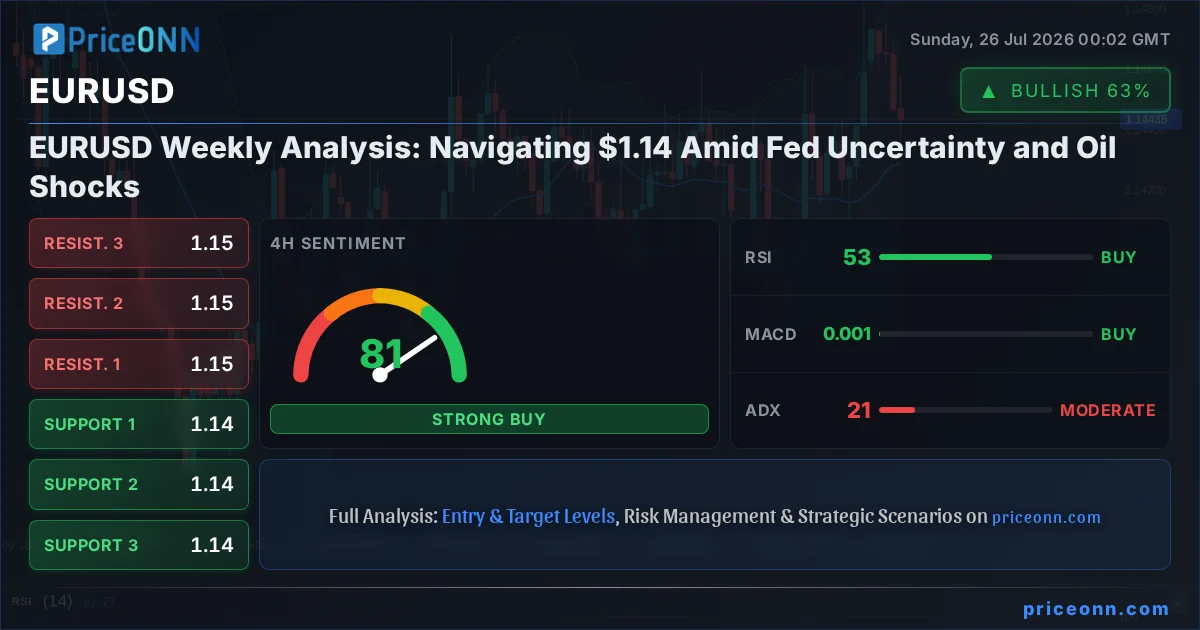
Last week saw EURUSD clinging to the $1.14 handle, a tight range that reflected the market's cautious stance ahead of crucial central bank decisions and ongoing geopolitical anxieties. As traders eye the upcoming Federal Reserve meeting, the euro's trajectory remains delicately poised, caught between potential shifts in monetary policy and the persistent influence of global commodity markets, particularly oil. This analysis delves into the intricate technical landscape of EURUSD, examining indicator signals, key support and resistance levels, and the broader market correlations that will likely shape its path in the coming week.
- EURUSD is currently trading around $1.1444, reflecting a week of consolidation.
- The 4-hour chart shows mixed signals: RSI at 53.17 suggests neutral momentum, while MACD and Bollinger Bands hint at potential upside.
- Key resistance is identified at $1.14916, with support found at $1.14153.
- The upcoming Fed meeting is the primary focus, with market sentiment heavily influenced by interest rate hike expectations and the persistent oil price rally fueling inflation concerns.
The past week for EURUSD was characterized by a distinct lack of decisive direction, a common theme across many major currency pairs as the market grappled with a complex web of economic data and geopolitical undercurrents. The pair largely traded within the confines of $1.14357 to $1.14754, failing to muster a significant breakout in either direction. This sideways action on the daily chart, with an RSI(14) hovering at 47.95, indicates a market in a holding pattern, neither fully bullish nor bearish, but certainly sensitive to any catalysts that could break the stalemate. The price's position above the middle Bollinger Band on the daily chart offers a sliver of hope for buyers, but the overall picture is one of indecision, a sentiment echoed across financial markets as traders await clearer policy signals.
Digging deeper into the technicals, the 1-hour timeframe paints a slightly more bearish picture for EURUSD. The RSI(14) sits at 43.67, indicating a slight bearish lean, while the MACD remains in negative momentum territory, with the MACD line below its signal line. The Stochastic Oscillator, with K=18.84 and D=21.42, also presents a bearish signal, suggesting that the pair might be heading towards oversold conditions or a potential short-term dip. The ADX at 26.93 confirms a strong downtrend on this shorter timeframe, implying that any upward movements might be met with selling pressure. This divergence between the daily and hourly timeframes underscores the current market's internal conflict – a battle between longer-term consolidation and short-term bearish momentum, leaving traders to carefully weigh which timeframe's signals hold more weight.
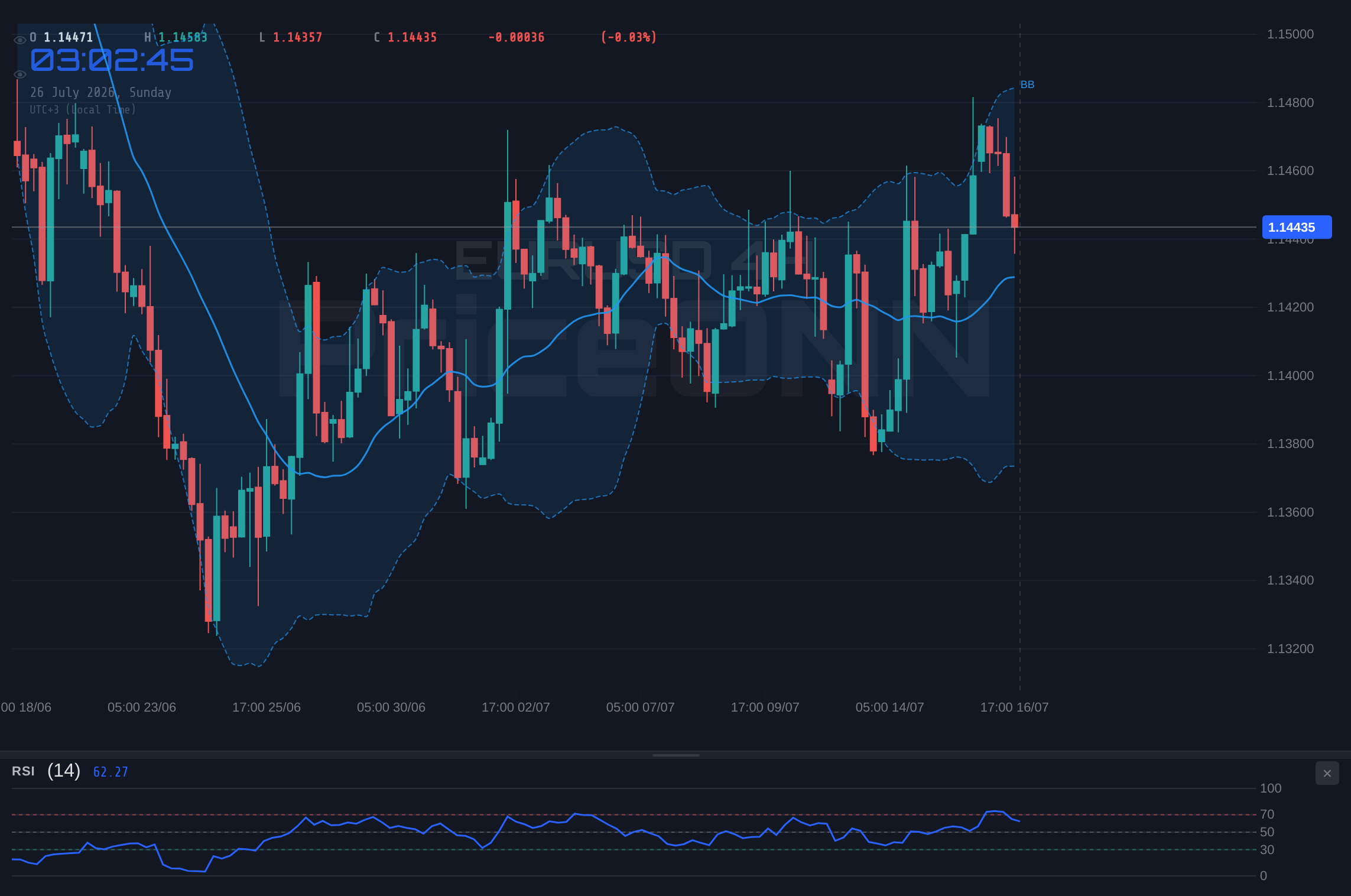
However, the 4-hour chart offers a counterpoint, suggesting that the bulls haven't entirely surrendered. Here, the RSI(14) stands at a more neutral 53.17, indicating a balanced market sentiment. More encouragingly, the MACD is in positive momentum, with the MACD line above its signal line, and the price is trading above the middle Bollinger Band, signaling a potential upward bias. The Stochastic Oscillator, though showing a bearish cross with K=60.94 and D=73.69, is still in the upper half of its range. The ADX at 20.84 suggests a moderate uptrend on this timeframe. This multi-timeframe analysis highlights a critical juncture for EURUSD. While the hourly chart leans bearish and the daily shows consolidation, the 4-hour timeframe hints at underlying strength. The key will be how price action develops around the immediate support and resistance levels in the next trading sessions.
Navigating the $1.14 Landscape: Key Levels and Price Action
The $1.14 region has become a pivotal battleground for EURUSD. On the daily chart, immediate support is identified at $1.14153. A decisive break below this level could open the door to further downside, potentially targeting the secondary support at $1.13722 and then the more significant tertiary support at $1.1339. These levels represent areas where buying interest has historically emerged, and their defense will be crucial for any bullish recovery. Conversely, resistance looms at $1.14916. A sustained move above this mark would be a significant bullish signal, potentially paving the way for a test of the $1.15248 resistance, followed by a more ambitious target at $1.15679. The price's current positioning, wedged between these levels, emphasizes the neutral stance observed on the daily chart and the need for a clear breakout to establish a new trend.
The 1-hour chart offers a more granular view of the immediate price action. Support is currently seen at $1.14383, followed by $1.14304 and $1.14251. A failure to hold these levels could initiate a move towards the lower end of the daily range. On the upside, resistance is encountered at $1.14515, $1.14568, and $1.14647. A breach of these immediate hurdles would be the first step for any intraday bullish sentiment to gain traction. The ADX on the 1-hour chart, at 26.93, indicates a strong downtrend on this very short timeframe, suggesting that any rallies might be capped quickly. This reinforces the idea that while the broader picture might be consolidating, short-term traders should remain wary of potential downward pressure.
The 4-hour chart, however, presents a different tactical outlook. Support levels here are found at $1.14388, $1.14307, and $1.14152. The fact that these are relatively close to the current price means that any significant move lower could quickly test these boundaries. Resistance is marked at $1.14624, $1.14779, and $1.1486. The proximity of these resistance levels to the current price suggests that a push higher might face stiff opposition. The ADX on this timeframe, at 20.84, indicates a moderate uptrend, which, when combined with the bullish MACD and price above the middle Bollinger Band, suggests that the path of least resistance might be slightly to the upside on this timeframe, despite the bearish signals on the hourly chart.
The Fed's Shadow: Monetary Policy and Market Expectations
The dominant narrative shaping the forex market, and particularly EURUSD, continues to be the divergence in monetary policy expectations between the Federal Reserve and the European Central Bank (ECB). While the ECB has signaled a more cautious approach to rate cuts, the Federal Reserve remains under pressure to manage inflation, which, according to recent reports, has proven 'stubborn'. The recent rally in oil prices, pushing Brent crude above $100 and WTI near $80, adds another layer of complexity. This commodity surge directly impacts inflation expectations, potentially forcing the Fed's hand. Markets are increasingly pricing in a higher probability of more aggressive rate hikes from the Fed, a scenario that typically strengthens the US dollar against major currencies like the Euro.
The 'Dollar: Oil Leaves the Fed with No Choice' headline from recent market commentary perfectly encapsulates this dilemma. The rising cost of energy inherently fuels inflationary pressures, making the Fed's mandate to control price stability more challenging. While the ECB might find itself in a position to ease policy, the Fed may be forced to maintain a hawkish stance or even consider further tightening, despite potential economic headwinds. This divergence is a powerful driver for EURUSD. A stronger dollar, fueled by higher US interest rates or a perception of greater economic resilience, directly weighs on the EURUSD pair, pushing it lower. Conversely, any indication that the Fed is nearing the end of its tightening cycle, or that inflation is cooling faster than expected, could provide a much-needed reprieve for the Euro.
Looking ahead to the Fed's upcoming meeting, the market will be dissecting every word for clues about future policy direction. While a rate hold is widely expected, the accompanying statement and press conference will be scrutinized for any hints about the timing and pace of future rate changes. The CME FedWatch tool, if updated with relevant probabilities, would offer a quantitative view of market expectations. However, even without explicit probabilities, the consensus is that the Fed's path is less about immediate cuts and more about holding rates steady for an extended period to ensure inflation is firmly on a downward trajectory. This environment generally favors a stronger dollar, implying continued pressure on EURUSD unless the ECB signals a more hawkish stance than currently anticipated.
Geopolitical Tensions and Commodity Crosscurrents
Beyond monetary policy, the specter of geopolitical tensions continues to cast a long shadow over global markets. Recent news highlighted that 'Markets Brace for Weekend Shock as Oil and Tariffs Threaten Global Recovery'. This suggests a heightened sense of caution, with traders reluctant to commit to large directional positions ahead of the weekend. The interplay between oil prices and geopolitical risks is particularly potent. The ongoing Middle East tensions and potential actions related to Iran, as mentioned in relation to gold and silver's recent tumble, can lead to supply disruptions and price spikes in crude oil. Such spikes not only fuel inflation but also increase global economic uncertainty, often driving demand for safe-haven assets and potentially weakening riskier currencies like the Euro.
The correlation between oil prices and inflation is well-established. As oil prices rise, transportation costs increase, affecting a wide range of goods and services. This can create a ripple effect throughout the economy, making it harder for central banks to achieve their inflation targets. For the ECB, a sustained oil price rally could complicate its efforts to manage inflation within the Eurozone, potentially forcing it to adopt a more cautious tone regarding monetary easing. For the Fed, as discussed, it adds pressure to keep interest rates higher for longer. This complex relationship means that oil price movements are not just about energy markets; they have significant implications for currency valuations, including EURUSD.
Furthermore, the mention of 'tariffs' in the context of global recovery threats cannot be ignored. Trade disputes and the imposition of tariffs can disrupt supply chains, increase costs for businesses, and dampen global trade volumes. This adds another layer of uncertainty to the global economic outlook. If these trade tensions escalate, they could further dampen risk appetite, benefiting safe-haven currencies and potentially putting additional downward pressure on EURUSD. The delicate balance between economic growth, inflation, and geopolitical stability remains a key theme, and any shifts in these factors will undoubtedly be reflected in the price action of major currency pairs.
Technical Outlook Scenarios for EURUSD
Given the mixed signals across different timeframes and the overarching uncertainty surrounding monetary policy and geopolitical events, a scenario-based approach is prudent for EURUSD. The current technical setup suggests a period of potential consolidation or a controlled move, rather than a sharp, decisive trend. The probabilities assigned to each scenario reflect the current balance of technical indicators and the prevailing market sentiment.
Bearish Scenario: Testing Lower Support
65% ProbabilityNeutral Scenario: Consolidation Around $1.14
25% ProbabilityBullish Scenario: Breakout Above Resistance
10% ProbabilityThe Week Ahead: Key Events and Levels to Watch
As we look towards the upcoming trading week, the EURUSD pair remains at a critical juncture. The primary driver will undoubtedly be the Federal Reserve's policy decision and accompanying statements. Any deviation from market expectations regarding interest rates or future policy guidance could trigger significant volatility. Traders will be closely monitoring the Fed's commentary for insights into their inflation outlook and their tolerance for sustained high energy prices. The persistent strength in oil, coupled with ongoing geopolitical uncertainties, creates a challenging environment for central bankers and, by extension, for currency markets.
From a technical standpoint, the levels around $1.14153 (support) and $1.14916 (resistance) will be paramount. A clear break and hold above resistance could signal a shift towards the bullish targets of $1.15248 and $1.15679. Conversely, a decisive drop below support at $1.14153 would likely see the pair test lower levels, with $1.13722 and $1.1339 becoming the next points of interest. The ADX readings across timeframes – 26.93 (1H, strong downtrend), 20.84 (4H, moderate uptrend), and 26.52 (1D, strong downtrend) – highlight the conflicting trend strengths and the potential for choppy price action until a clear catalyst emerges. This suggests that while breakouts are possible, especially on a significant news event, the current environment might favor range-bound trading with potential for sharp, short-lived moves.
The correlation with the US Dollar Index (DXY) will also be a critical factor to monitor. With the DXY currently trading around 100.7, its upward momentum could continue to exert pressure on EURUSD. If the Fed adopts a more hawkish tone than anticipated, it could further bolster the dollar, pushing EURUSD lower. Conversely, if the market perceives that the Fed has priced in most of its tightening cycle, or if geopolitical risks escalate in a way that favors a broader risk-off sentiment, the dollar could weaken, offering support to the Euro. The interplay between these macroeconomic factors and the technical levels will dictate the price action in the coming days. Traders should remain vigilant, manage risk tightly, and wait for clear signals before committing to significant positions.
Frequently Asked Questions: EURUSD Analysis
What happens if EURUSD breaks below the $1.14153 support level this week?
A break below the daily support at $1.14153 would likely trigger further selling pressure, potentially targeting the next key level at $1.13722. This scenario is more probable if the Federal Reserve adopts a hawkish stance, strengthening the US dollar.
Should I consider buying EURUSD at current levels around $1.1444 given the mixed technical signals?
Buying at current levels carries risk due to mixed signals and the looming Fed decision. A more prudent approach might be to wait for a confirmed break above resistance at $1.14916, or a clear rejection and bounce from support at $1.14153, for a higher probability setup.
Is the RSI at 53.17 on the 4-hour chart a buy signal for EURUSD?
An RSI of 53.17 on the 4-hour chart is in neutral territory, suggesting balanced momentum rather than an immediate buy signal. While it doesn't signal outright selling, it indicates that the bullish trend isn't overwhelmingly strong and requires confirmation from other indicators and price action.
How will the upcoming Fed meeting impact EURUSD if they signal no further rate hikes?
If the Fed signals no further rate hikes, it could weaken the US dollar, potentially providing a bullish catalyst for EURUSD. This would make a sustained move above the $1.14916 resistance level more likely, with targets around $1.15248.
Track markets in real-time
AI-powered analysis, technical indicators and real-time price data.
Join Our Telegram Channel
Breaking market news, AI analysis and trading signals instantly.
Join Channel