
Is EUR/USD Poised for Further Declines Below 1.15 Amid Risk-Off Sentiment?


The Euro (EUR) has experienced a significant downturn against the US Dollar (USD), breaking below the 1.1550 level and a key bullish trend line on the 4-hour chart. This decline suggests that the pair may be poised for another leg lower, especially as global market sentiment shifts towards risk aversion.
Market Context
EUR/USD commenced a fresh downward trajectory, trading below the 1.1550 support level. Crucially, it has fallen below a previously established bullish trend line, which now acts as resistance, with immediate support noted around 1.1520. This technical breakdown follows a failure by the Euro to sustain gains above the 1.1620 resistance level. The pair is currently consolidating near the 61.8% Fibonacci retracement level of the move from the 1.1410 swing low to the 1.1639 high, indicating a potential pause before further price discovery.
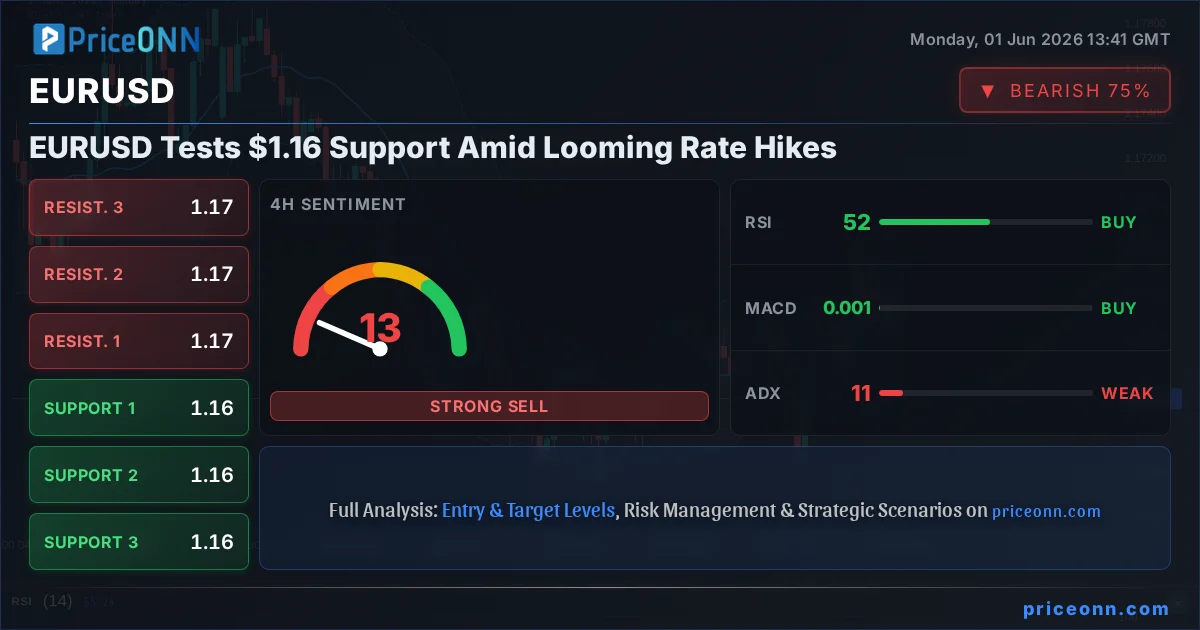
The broader market narrative is also contributing to the pressure on the Euro. Reports suggest a growing risk-off mood, potentially driven by geopolitical developments, which typically favors the US Dollar as a safe-haven asset. This sentiment has also impacted other major currencies, with Sterling (GBP) extending its losses against the USD, trading below 1.3320. Even gold prices are showing weakness, dipping below the $4,550 mark, which often occurs when market participants are moving away from riskier assets and seeking the perceived safety of the dollar.
Analysis & Drivers
Several factors appear to be driving the current weakness in EUR/USD. Technically, the breach of the bullish trend line and key moving averages (100 and 200 SMA on the 4-hour chart) is a strong bearish signal. The failure to settle above 1.1620 highlights the strength of resistance in that zone.
On the fundamental side, market data indicates that the US Dollar is benefiting from a global shift towards risk aversion. While specific catalysts for this shift are not detailed in recent reports, such sentiment often arises from heightened geopolitical tensions or significant economic uncertainty. The US Dollar, being the world's primary reserve currency and the most heavily traded, typically strengthens during such periods as investors seek its perceived stability. The Federal Reserve's monetary policy, while not explicitly mentioned as a direct driver in this immediate move, remains a foundational element influencing the dollar's value. Historically, the Fed's actions on interest rates and liquidity injections (like Quantitative Easing) have a profound impact on the USD's strength.
Upcoming economic data from Germany could provide some short-term volatility. Preliminary readings for the German Consumer Price Index (CPI) for March 2026 are expected. The forecast is for an increase to +2.1% year-on-year and +0.9% month-on-month, a slight acceleration from previous figures. While these numbers could offer a temporary boost to the Euro if they exceed expectations, the prevailing risk-off sentiment and the technical breakdown in EUR/USD might limit any significant upward reaction.
Trader Implications
Traders should be closely monitoring the 1.1500 level, which represents immediate support for EUR/USD. A decisive close below this psychological mark could pave the way for a steeper decline towards the 1.1440 support. A break below 1.1440 would be a significant bearish signal, potentially opening the door for a revisit of the 1.1400 area in the coming days.
On the upside, resistance is now observed near 1.1550 and the 100 SMA. A sustained move above 1.1600 would be required to alleviate the immediate bearish pressure, with further targets at 1.1640. However, given the current market sentiment and technical setup, a sustained break above 1.1600 appears less probable in the short term.
Key risk factors for traders include:
- Geopolitical Developments: Escalations in global tensions could further bolster the USD and weigh on EUR/USD.
- Economic Data: Stronger-than-expected German inflation data could offer temporary Euro support, but its impact may be capped.
- Technical Levels: Closely watch breaks of 1.1500 and 1.1440 for potential downside acceleration.
Traders looking to act on this information should consider short positions on EUR/USD with a target towards 1.1440, placing stop-losses above the 1.1580 resistance. Alternatively, waiting for a confirmed break below 1.1500 before entering short positions could offer a better risk-reward ratio.
Outlook
The outlook for EUR/USD remains bearish in the near term, contingent on the continuation of risk-off sentiment and the US Dollar's strength. Unless the pair can reclaim the 1.1600 level and sustain momentum, further downside appears likely. Upcoming economic data releases will be important, but the overarching market mood seems to favor the Greenback. Traders should remain vigilant for any shifts in sentiment or unexpected economic news that could alter this trajectory.
Frequently Asked Questions
What is the immediate support level for EUR/USD?
The immediate support for EUR/USD is currently seen near the 1.1500 level. A break below this psychological barrier could accelerate losses towards the 1.1440 support zone.
What are the key resistance levels to watch for EUR/USD?
Key resistance levels for EUR/USD are forming around 1.1550, coinciding with the 100-period moving average on the 4-hour chart. A more significant hurdle lies at 1.1580, with a decisive move above 1.1600 needed to challenge higher levels.
What is the outlook for EUR/USD if risk-off sentiment persists?
If risk-off sentiment continues, the US Dollar is likely to remain strong, putting further pressure on EUR/USD. This scenario could lead to a decline towards the 1.1440 or even the 1.1400 level in the short to medium term.
Track markets in real-time
Empower your investment decisions with AI-powered analysis, technical indicators and real-time price data.
Join Our Telegram Channel
Get breaking market news, AI analysis and trading signals delivered instantly to your Telegram.
Join Channel PriceONN News
EUR/USD stalled below 1.1660 as the US Dollar defied expectations, refusing to weaken despite reports of a US-Iran ceasefire extension. Market participants remain cautious, awaiting concrete confirmation and assessing lingering inflationary pressures.
PriceONN News
EUR/USD closed at 1.1640, showing resilience amid mixed signals. Easing US-Iran tensions initially pressured the dollar, but persistent inflation concerns and political ratification hurdles are keeping the greenback surprisingly steady.
PriceONN News
The EUR/USD faces headwinds as core US PCE inflation unexpectedly rose to 3.3% year-over-year, reinforcing a 'higher for longer' interest rate narrative. Meanwhile, a US-Iran ceasefire extension boosted global risk appetite, potentially drawing capital away from safe-haven currencies.
PriceONN News
EUR/USD stabilized around 1.1640 as reports of a US-Iran ceasefire extension and potential Strait of Hormuz reopening eased inflation fears. However, the US Dollar's resilience suggests lingering caution among forex traders.
PriceONN News
USDJPY has returned to the area of previous interventions. The ECB is moving towards a rate hike in June. The US dollar retreated on Friday amid new record highs for stock indices and rumours of amendments to the US-Iran agreement. However, tit-for-tat exchanges between the adversaries pushed the dollar index back into the support zone […] The post Yen Braces for a New Storm appeared first on ActionForex.
PriceONN News
Markets are pricing in a potential de-escalation in the US-Iran conflict, leading to a significant drop in crude oil prices and a weakening US Dollar as diplomatic efforts appear to be gaining traction.
PriceONN News
USD/CAD faces pressure as Canada's economy shows signs of stalling, with Q1 GDP contracting 0.1% and domestic demand weakening. This comes as trade negotiations and geopolitical shifts add layers of uncertainty.
PriceONN News
AUD/USD’s late break of 0.7183 resistance suggests that pullback from 0.7277 has already completed at 0.7076, after defending 55 D EMA. Initial bias is back on the upside this week for retesting 0.7277 high first. Firm break there will resume larger up trend. For now, risk will stay on the upside as long as 0.7076 […] The post AUD/USD Weekly Report appeared first on ActionForex.
PriceONN News
USD/CAD is showing signs of potential upward movement as Canada's economy grapples with a significant slowdown, marked by weak domestic demand and stalled investment, while trade negotiations loom large.
PriceONN News
Canada's economy showed signs of weakness in early 2026, but upcoming May jobs data is expected to reveal a moderate uplift. Analysts anticipate job growth of around 25,000 positions and a potential dip in the unemployment rate to 6.8%.
PriceONN News
The USD/JPY pair is flirting with the 160 level as stalled US-Iran negotiations and hawkish Federal Reserve rhetoric fuel inflation concerns. Traders are closely watching upcoming US Non-Farm Payrolls and Eurozone CPI data.
PriceONN News
The USD/JPY pair is showing signs of upside exhaustion, struggling to overcome the 159.65 resistance level and trading below a key bullish trend line. This technical setup raises concerns about a potential pullback in the near term.