EUR/USD rises to near 1.1500 ahead of German Retail Sales, Eurozone HICP

Euro's Global Standing Under Scrutiny
The Euro, the unified currency for 20 European Union member states, commands a significant presence in global finance. It stands as the second most actively traded currency worldwide, trailing only the U.S. Dollar. In 2022, its share of foreign exchange transactions reached an impressive 31%, with daily turnover averaging over $2.2 trillion. This dominance is particularly evident in the EUR/USD pairing, which represents the lion's share of all currency trades, dwarfing other Euro crosses like EUR/JPY, EUR/GBP, and EUR/AUD.
Overseeing the monetary policy for this vital currency bloc is the European Central Bank (ECB), headquartered in Frankfurt. The ECB's core mission revolves around maintaining price stability, a delicate balancing act between controlling inflation and fostering economic expansion. Its primary instrument for achieving this equilibrium is the adjustment of interest rates. Consequently, a trend of rising interest rates, or even the anticipation of such increases, typically bolsters the Euro's value. Conversely, a reduction in rates or expectations of lower borrowing costs tends to weaken the single currency.
Economic Barometers Driving Euro Sentiment
The ECB Governing Council convenes eight times annually to deliberate on monetary strategy. These critical decisions are shaped by the collective input of national central bank governors from across the Eurozone, alongside six executive board members, including ECB President Christine Lagarde. Among the most closely watched economic indicators influencing the Euro is the Harmonized Index of Consumer Prices (HICP), the Eurozone's measure of inflation. A surprise uptick in HICP, particularly if it breaches the ECB's 2% target, creates considerable pressure for the central bank to tighten monetary policy by raising interest rates to curb price pressures.
Higher interest rates in the Eurozone relative to other major economies naturally enhance the region's appeal to international investors seeking yield. This influx of capital can significantly support the Euro. Beyond inflation, a broad spectrum of economic data releases provides crucial insights into the health of the Eurozone economy, thereby impacting the single currency. Key metrics such as Gross Domestic Product (GDP) figures, Purchasing Managers' Indexes (PMIs) for manufacturing and services sectors, employment statistics, and consumer confidence surveys are all vital inputs for market participants assessing the Euro's trajectory.
A robust economic environment is fundamentally positive for the Euro. It not only attracts foreign direct investment but also increases the likelihood of the ECB implementing tighter monetary policy. Conversely, a string of weak economic reports can exert downward pressure on the Euro. Economic performance in the four largest Eurozone economies-Germany, France, Italy, and Spain-carries disproportionate weight, collectively representing about 75% of the bloc's economic output. Additionally, the Trade Balance, which contrasts a nation's exports against its imports, serves as another significant data point. A consistent surplus, indicating strong export demand, typically strengthens a currency as foreign buyers increase their need for it to acquire domestic goods.
Reading Between the Lines
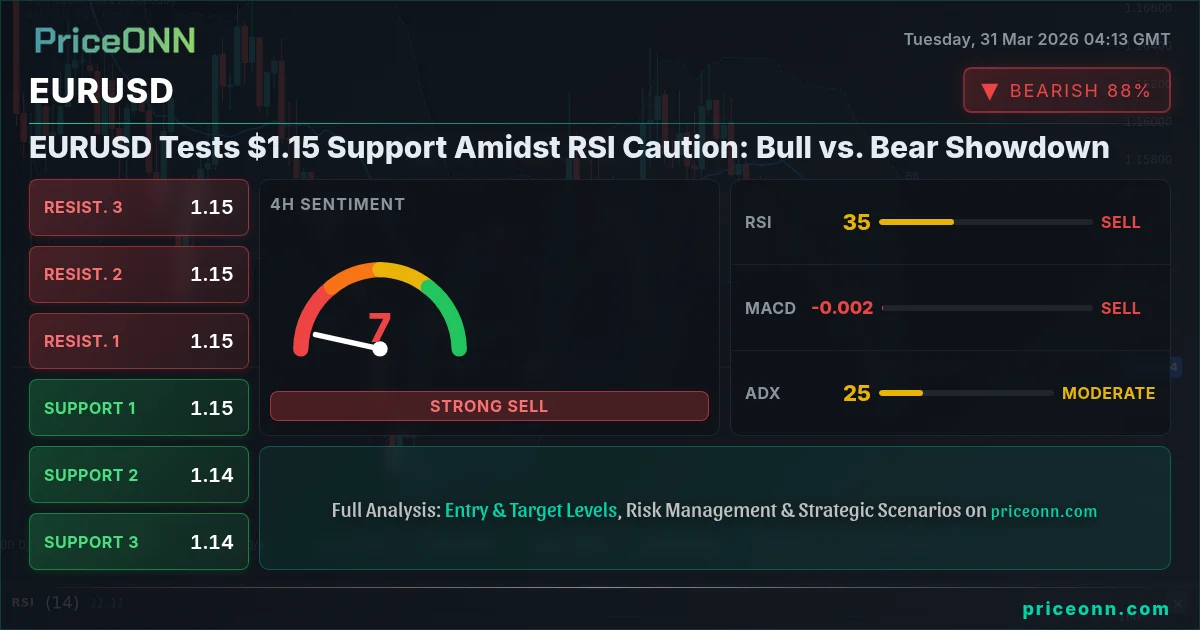
The current uptick in EUR/USD, while modest, signals a temporary pause in the recent bearish sentiment that gripped the pair. Traders are cautiously optimistic, awaiting confirmation from upcoming data releases. German Retail Sales figures and the Eurozone's HICP inflation rate are the immediate focal points. Stronger-than-expected retail sales in Europe's largest economy could suggest underlying consumer resilience, potentially boosting the Euro. Simultaneously, a higher HICP reading, especially if it surpasses forecasts, would reinforce expectations of further ECB tightening, providing a clear tailwind for EUR/USD.
Conversely, disappointing sales numbers or a cooler inflation print could quickly reverse the pair's fortunes. This highlights the sensitivity of EUR/USD to economic surprises and the ongoing tug-of-war between inflation concerns and growth outlooks. Market participants will be dissecting these figures not just for their headline impact but also for their implications on future ECB policy. The divergence in monetary policy paths between the ECB and the U.S. Federal Reserve remains a critical driver, and any data that shifts this perception could trigger significant price action.
The immediate challenge for EUR/USD lies in overcoming the 1.1500 psychological level. A sustained move above this resistance could open the door for further gains, but failure to do so might see the pair retest recent lows. Traders should also keep a close eye on broader market sentiment and the performance of the U.S. Dollar Index (DXY). A strengthening dollar on the back of hawkish Fed signals could cap any Euro rallies, irrespective of positive Eurozone data. Key assets to monitor include German Bund yields for interest rate expectations, European equity indices for risk appetite, and USD/CAD given its sensitivity to global commodity and interest rate differentials.
Track markets in real-time
Empower your investment decisions with AI-powered analysis, technical indicators and real-time price data.
Join Our Telegram Channel
Get breaking market news, AI analysis and trading signals delivered instantly to your Telegram.
Join Channel