
Is the Euro Set for Volatility Ahead of Crucial German Inflation Data Amidst Geopolitical Jitters?

The Euro is bracing for a potentially volatile session as key economic indicators from the Eurozone are set to be released, including crucial German inflation data. Analysts are closely watching these figures, particularly in light of rising energy prices and the simmering geopolitical tensions in the Middle East, which could further complicate the European Central Bank's (ECB) monetary policy decisions.
Market Context
Focus in the Eurozone today is firmly on the German flash inflation print for March. Expectations are for a significant uptick, with forecasts suggesting a rise to 2.7% year-over-year, a notable increase from the previous 1.9%. This projected surge is attributed primarily to escalating energy costs. However, market participants acknowledge that these figures may not fully capture the recent impact of unfolding geopolitical events. Consequently, the European Commission's survey on seller price expectations, a metric closely monitored by ECB President Lagarde, will also be a critical gauge of underlying inflationary pressures.
Adding to the currency's potential vulnerability, ECB official Stournaras is scheduled to deliver a speech today. Traders will be sifting through his remarks for any hints regarding the central bank's stance on monetary policy and inflation outlook. Meanwhile, in Sweden, February retail sales figures are anticipated, though their significance might be diminished by the broader geopolitical developments. Recent trends have shown a divergence between retail sales and consumer confidence, with January retail sales rising 4.1% year-over-year despite weak consumer sentiment.
Analysis & Drivers
The primary driver for potential Euro weakness stems from the anticipated spike in German inflation. A higher-than-expected inflation reading could pressure the ECB to maintain a hawkish stance or even signal a delay in anticipated interest rate cuts, although the central bank is likely to weigh the immediate impact of energy shocks against broader economic growth concerns. The ECB has been grappling with balancing inflation control with supporting economic activity, and this data will provide a clearer picture of the challenges ahead.
Furthermore, the escalating tensions in the Middle East, particularly concerning Iran's oil hub, inject a significant layer of uncertainty into the global economic landscape. Such geopolitical risks typically lead to increased demand for safe-haven assets and can disrupt supply chains, including energy supplies, thereby pushing commodity prices higher and feeding into inflation. This spillover effect could indirectly impact the Euro by influencing trade balances and overall economic sentiment. In the US, Fed Chair Powell and Fed's Williams are set to speak, and their commentary will be closely watched for clues on the Federal Reserve's monetary policy path, which often influences global currency movements.
Overnight, Japan's Tokyo CPI data will offer an early indication of the energy shock's effect on consumer prices, while China's NBS PMIs for manufacturing and services will be released. While February data showed a contraction in manufacturing PMI at 49.0, preliminary March indicators suggest a potential rebound. However, the Middle East conflict introduces an element of unpredictability to these Asian economic releases.
Trader Implications
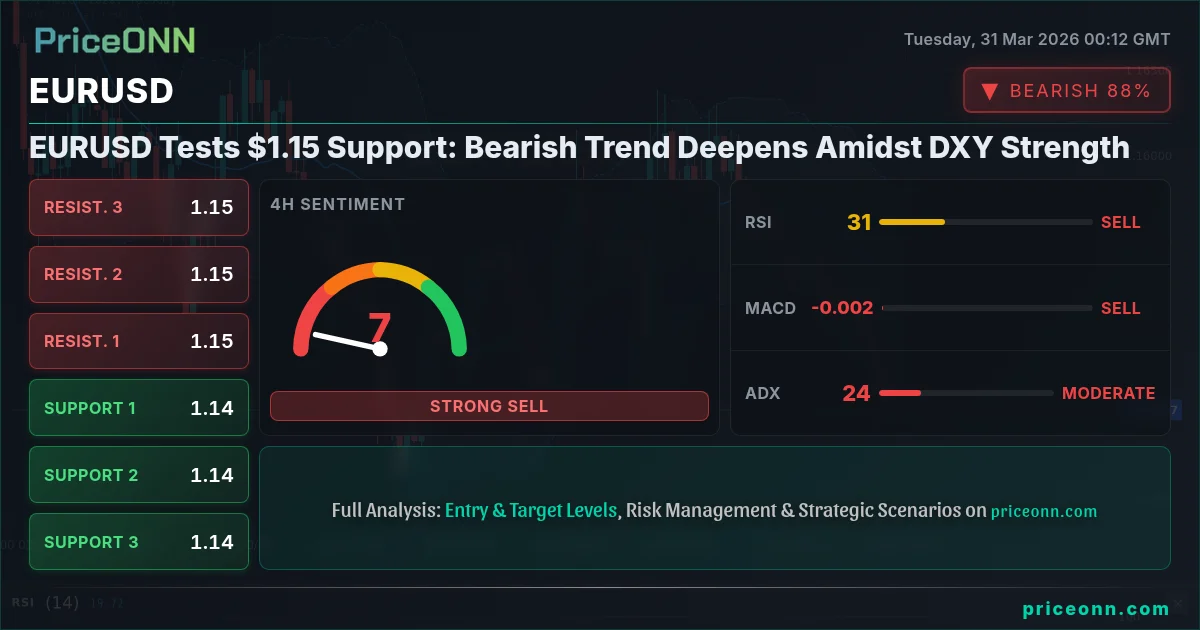
Traders should be on high alert for significant price action in EUR/USD and related Euro pairs. Key levels to watch for EUR/USD will include immediate resistance around the 1.0850 mark and support at 1.0780. A stronger-than-expected German inflation print could push the pair lower, testing the lower support levels. Conversely, any indication from the ECB that they are becoming more concerned about sticky inflation, despite economic headwinds, might offer some support to the Euro.
The geopolitical backdrop adds a risk-off element to trading. Any escalation in the Middle East could trigger broad market sell-offs, benefiting the US Dollar as a safe haven and pressuring the Euro. Traders should monitor news flow from the Middle East closely. In the US, upcoming labor market data, including JOLTS job openings and the pivotal Non-Farm Payrolls report on Friday, will be critical for shaping the Federal Reserve's policy expectations and, by extension, the broader market sentiment.
Outlook
The outlook for the Euro remains contingent on a confluence of factors: the definitive German inflation numbers, the ECB's reaction, and the trajectory of geopolitical events. While higher inflation might initially spook markets and pressure the Euro, it could also lead to a reassessment of the ECB's rate cut timeline, potentially offering longer-term support if markets perceive a more robust fight against inflation. However, in the short term, the combination of inflationary pressures and geopolitical uncertainty points towards heightened volatility, with a potential bias towards downside risk for the single currency if risk aversion intensifies.
Frequently Asked Questions
What is the expected German inflation rate for March?
German inflation is projected to rise to 2.7% year-over-year in March, up from 1.9% in the previous period, primarily driven by increased energy costs.
How could Middle East tensions affect the Euro?
Escalating Middle East tensions can lead to increased oil prices and global economic uncertainty, potentially strengthening the US Dollar as a safe-haven asset and weakening the Euro. This could also disrupt supply chains, further impacting inflation.
What are the key levels to watch for EUR/USD?
Traders should monitor resistance around 1.0850 and support near 1.0780 for EUR/USD. A significant inflation surprise or geopolitical escalation could drive price action through these levels.
Track markets in real-time
Empower your investment decisions with AI-powered analysis, technical indicators and real-time price data.
Join Our Telegram Channel
Get breaking market news, AI analysis and trading signals delivered instantly to your Telegram.
Join Channel

PriceONN