
Is XAU/USD Headed for $4,500 as Middle East Tensions Escalate?

Gold prices experienced a sharp decline at the start of the trading week, opening Monday's session down over 1% and testing levels near $4,445.00. This downward pressure on the precious metal comes amid a significant surge in oil prices, driven by heightened fears of a widening conflict in the Middle East.
Market Context
The West Texas Intermediate (WTI) benchmark crude oil price climbed nearly 3% in early trading, pushing above $102.50 per barrel. This rapid ascent in oil prices, reaching three-week highs after pulling back from $101.40, has amplified global inflation expectations. The geopolitical instability, particularly concerning potential U.S. actions regarding Iran, is creating significant volatility across commodity and financial markets. Early in the week, market sentiment had been cautiously optimistic following diplomatic efforts, which saw oil prices dip and stock markets rise. However, by the close of the previous week, a lack of substantial progress in negotiations and a perceived unwillingness from Iran to de-escalate shifted sentiment back to a risk-off posture. This pivot led to oil prices retesting the $100 mark and U.S. equity markets reversing sharply lower.
Analysis & Drivers
The interplay between geopolitical risk, inflation, and safe-haven assets is currently dominating market narratives. Gold, traditionally viewed as a hedge against inflation and a store of value during turbulent times, is facing headwinds from a surging oil price, which directly fuels inflation fears. While gold's safe-haven status typically benefits from increased global uncertainty, the immediate impact of rising energy costs can dampen its appeal, especially when coupled with a strong U.S. dollar. Market data shows that central banks have been significant buyers of gold, with record purchases in 2022, particularly from emerging economies seeking to diversify reserves and bolster currency strength. This underlying demand from official institutions provides a potential floor for prices. However, the current dynamic sees gold prices pressured as oil, a key inflation indicator, rallies aggressively. This rally in oil is partly attributed to supply disruption fears and the looming possibility of broader conflict in the Middle East, with reports indicating concerns over a potential U.S. invasion on Iran.
Economic data released recently has also contributed to a cautious market outlook. Weaker-than-expected U.S. S&P Global Services PMI figures and a decline in consumer sentiment, with consumers anticipating higher inflation and expressing increased worry about the future, are weighing on risk assets. This environment is characterized by a strong downtrend in U.S. equities, with the Dow Jones Industrial Average closing near its yearly lows. Analysts note that the 10-day moving average is acting as resistance for stocks, reinforcing a bearish technical outlook. For gold, its inverse correlation with the U.S. Dollar and U.S. Treasuries means that any strength in the dollar could further suppress prices. Conversely, a weakening dollar typically supports gold.
Trader Implications
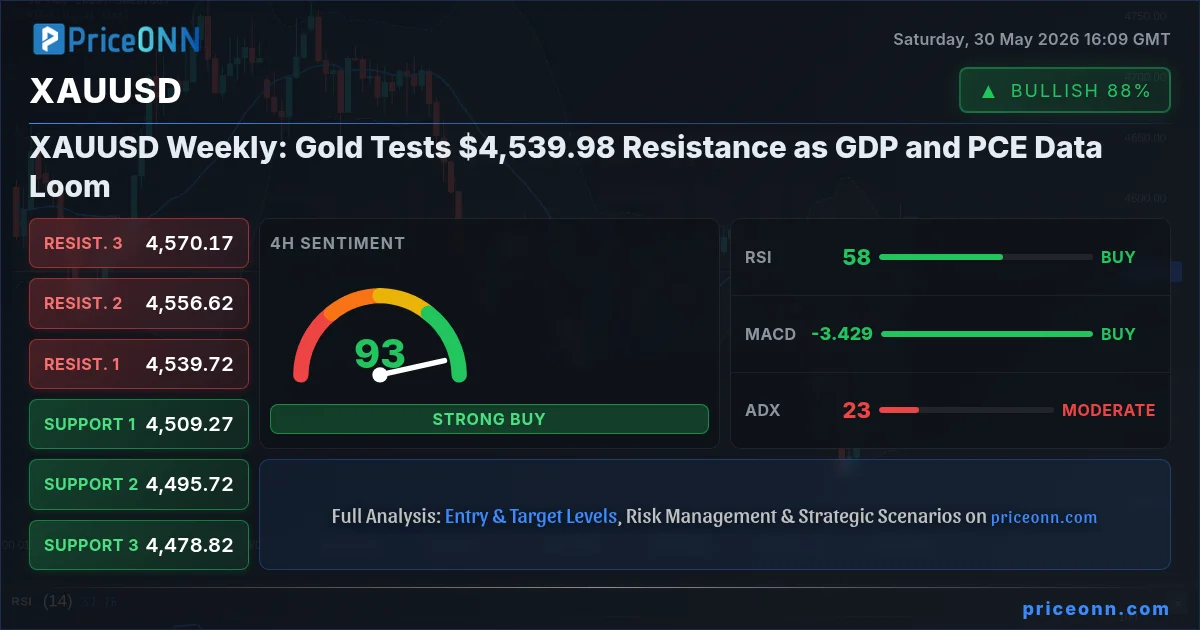
Traders are closely watching the geopolitical developments in the Middle East as the primary driver for both oil and gold. Key levels to monitor for XAU/USD include the immediate support around $4,440, with a break below potentially opening the door to the $4,400 psychological level. Resistance is seen near the weekly opening price of $4,450, and a decisive move above $4,460 could signal a short-term recovery. For WTI crude, sustained trading above $100 suggests further upside potential, with the next significant resistance target potentially around $105.
The current market sentiment is predominantly risk-off, which, while generally favoring gold as a safe haven, is complicated by the simultaneous surge in oil prices. Traders should be wary of the potential for sharp reversals as geopolitical news unfolds. The U.S. dollar's performance will be critical; a strengthening dollar could add further bearish pressure on gold. Investors are advised to remain cautious, focusing on selling opportunities in risk assets unless the conflict shows clear signs of de-escalation. For gold, the ability to hold above the $4,400 support level will be crucial in determining whether it can reassert its safe-haven status or succumb to inflation-driven selling pressure.
Outlook
The immediate outlook for gold remains uncertain, heavily dependent on the trajectory of the Middle East conflict and its impact on global energy markets. Should tensions escalate further, the upward pressure on oil prices could persist, potentially increasing inflation expectations and making it challenging for gold to attract significant safe-haven inflows without a concurrent weakening of the U.S. dollar. Conversely, any diplomatic breakthrough or de-escalation would likely see oil prices retreat, which could provide a tailwind for gold. Traders should brace for continued volatility and closely monitor upcoming economic data releases and central bank commentary for further clues on market direction.
Frequently Asked Questions
What is the current price of Gold (XAU/USD) and what is driving its movement?
Gold opened Monday's session near $4,445.00, trading over 1% lower. The primary driver is the surge in oil prices, with WTI crude nearing $102.50, which fuels inflation fears and impacts gold's safe-haven appeal amid escalating Middle East conflicts.
What are the key support and resistance levels for XAU/USD in the current market?
Immediate support for XAU/USD is seen around $4,440, with a potential fall to $4,400 if this level breaks. Resistance is noted near the opening price of $4,450, and a sustained move above $4,460 could indicate a short-term recovery.
What is the broader outlook for Gold amid rising oil prices and geopolitical tensions?
The outlook for gold is uncertain, largely dictated by the geopolitical situation and its effect on oil. If tensions rise, higher oil prices could boost inflation fears, potentially capping gold's gains unless the U.S. dollar weakens significantly. A diplomatic resolution could lead to lower oil prices, benefiting gold.
Track markets in real-time
Empower your investment decisions with AI-powered analysis, technical indicators and real-time price data.
Join Our Telegram Channel
Get breaking market news, AI analysis and trading signals delivered instantly to your Telegram.
Join Channel PriceONN News
The US Dollar experienced a notable decline last week as markets priced in a potential diplomatic resolution to the US-Iran conflict, leading to a drop in oil prices and Treasury yields. This shift in sentiment suggests a move away from stagflation fears towards a more stable economic outlook.
PriceONN News
Markets are pricing in a potential de-escalation in the US-Iran conflict, leading to a significant drop in crude oil prices and a weakening US Dollar as diplomatic efforts appear to be gaining traction.
PriceONN News
USD/JPY is testing the critical 160 level as stalled US-Iran negotiations and hawkish Federal Reserve rhetoric fuel inflation concerns and a potential for further rate hikes. Traders are closely watching upcoming US Non-Farm Payrolls and Eurozone CPI data for direction.
PriceONN News
The USD/JPY pair is flirting with the 160 level as stalled US-Iran negotiations and hawkish Federal Reserve rhetoric fuel inflation concerns. Traders are closely watching upcoming US Non-Farm Payrolls and Eurozone CPI data.
PriceONN News
EUR/USD stalled below 1.1660 as the US Dollar defied expectations, refusing to weaken despite reports of a US-Iran ceasefire extension. Market participants remain cautious, awaiting concrete confirmation and assessing lingering inflationary pressures.
PriceONN News
The US Dollar experienced a notable dip as a renewed ceasefire between the US and Iran spurred a rally in global equities, particularly in tech stocks. However, persistent core PCE inflation at 3.3% YoY continues to fuel 'higher for longer' rate expectations.
PriceONN News
EUR/USD closed at 1.1640, showing resilience amid mixed signals. Easing US-Iran tensions initially pressured the dollar, but persistent inflation concerns and political ratification hurdles are keeping the greenback surprisingly steady.
PriceONN News
The EUR/USD faces headwinds as core US PCE inflation unexpectedly rose to 3.3% year-over-year, reinforcing a 'higher for longer' interest rate narrative. Meanwhile, a US-Iran ceasefire extension boosted global risk appetite, potentially drawing capital away from safe-haven currencies.
PriceONN News
EUR/USD stabilized around 1.1640 as reports of a US-Iran ceasefire extension and potential Strait of Hormuz reopening eased inflation fears. However, the US Dollar's resilience suggests lingering caution among forex traders.
PriceONN News
Oil markets have stabilised lower for now and global equity markets have rallied this week on the back of renewed optimism around a deal in the Middle East. On Thursday afternoon, media reports emerged that the US and Iranian negotiators had settled on a Memorandum of Understanding (MOU) that would extend the ceasefire by 60 […] The post Weekly Focus – Optimism Around Iran Deal Lifts Market Sentiment appeared first on ActionForex.
PriceONN News
USDJPY has returned to the area of previous interventions. The ECB is moving towards a rate hike in June. The US dollar retreated on Friday amid new record highs for stock indices and rumours of amendments to the US-Iran agreement. However, tit-for-tat exchanges between the adversaries pushed the dollar index back into the support zone […] The post Yen Braces for a New Storm appeared first on ActionForex.
PriceONN News
Canada's economy showed signs of a slowdown in early 2026, but upcoming May jobs data is expected to reveal a modest uplift. Analysts anticipate the unemployment rate to fall to 6.8%.