
Is Gold Poised for Further Gains as US Yields Fall and Geopolitical Risks Mount?


Gold (XAU/USD) is showing resilience, trading around $4,576 as markets grapple with a complex interplay of easing U.S. Treasury yields and heightened geopolitical instability. The precious metal managed to reverse earlier intraday losses, which saw it touch a low of $4,419 during the Asian session on Monday, indicating a renewed appetite for safe-haven assets amidst global uncertainty.
Market Context
The yellow metal has reclaimed ground, reversing an earlier dip and signaling a potential shift in market sentiment. This resurgence comes as U.S. Treasury yields have eased, a factor that typically supports gold prices due to its inverse correlation with interest-bearing assets. Simultaneously, escalating tensions in the Middle East are adding a layer of risk premium to gold, further bolstering its appeal. The market is currently volatile, with investors seeking refuge in assets perceived as stable during turbulent times. This dynamic has seen gold, a traditional store of value, attract renewed interest after an earlier dip.
Analysis & Drivers
Several key factors are driving gold's current trajectory. Firstly, the decline in U.S. Treasury yields is a significant tailwind. Lower yields reduce the opportunity cost of holding gold, which does not offer a dividend or interest payment. This makes the precious metal more attractive relative to income-generating assets. Market data indicates that expectations for the Federal Reserve to maintain current interest rates throughout 2026 are contributing to this yield environment, despite a strong U.S. Dollar.
Secondly, escalating geopolitical tensions in the Middle East are significantly enhancing gold's safe-haven status. In times of conflict or heightened international friction, investors tend to move capital into assets that are perceived as secure, and gold has historically fulfilled this role. This demand surge during uncertainty is a well-established pattern in the precious metals market.
Furthermore, the broader trend of central banks increasing their gold reserves is providing underlying support. Industry reports highlight that central banks added a record 1,136 tonnes of gold, valued at approximately $70 billion, in 2022. Emerging economies, including China, India, and Turkey, are leading this accumulation, seeking to diversify reserves and bolster economic confidence amidst global volatility. This sustained institutional demand acts as a floor for prices.
Gold's inverse correlation with the U.S. Dollar is also a critical element. While the dollar has remained strong, any signs of weakness could provide further impetus for gold prices to climb, as the asset is priced in dollars.
Trader Implications
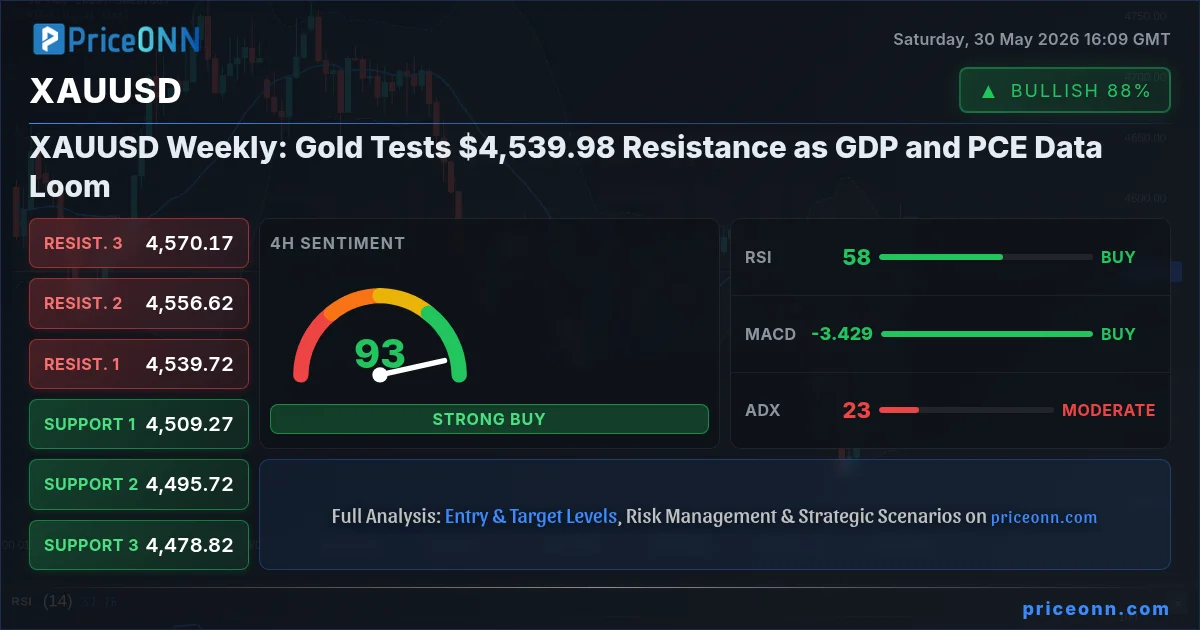
Traders should be closely monitoring key price levels and upcoming economic data. The current trading range, with resistance potentially forming near the recent highs and support holding around the $4,419 level, will be crucial. Any further escalation in Middle East tensions could see gold quickly test higher price points, potentially targeting levels above $4,600.
Conversely, a significant shift in U.S. monetary policy expectations or a de-escalation of geopolitical conflicts could lead to profit-taking and a pullback. The U.S. Dollar Index (DXY) will also be a key indicator to watch; a weakening dollar typically correlates with rising gold prices.
Key levels to watch:
- Support: $4,419, $4,350
- Resistance: $4,576, $4,650, $4,700
Traders looking to capitalize on gold's safe-haven appeal amid geopolitical uncertainty should consider a strategy that allows for flexibility. A cautious approach, focusing on technical breakouts above key resistance levels or bounces off established support zones, may be prudent. Monitoring central bank commentary and inflation data will be vital for anticipating future yield movements.
Outlook
The outlook for gold remains cautiously optimistic, underpinned by persistent geopolitical risks and a supportive interest rate environment. While a strong U.S. Dollar presents some headwinds, the combination of easing yields and global instability suggests that gold is likely to maintain its upward bias. Upcoming economic data releases and any further developments from the Middle East will be critical in determining the short-to-medium term price direction. Investors are likely to continue viewing gold as a crucial component of diversified portfolios.
Frequently Asked Questions
What is the current price support level for Gold (XAU/USD)?
The immediate support level for Gold is around $4,419, a level it touched during the Asian session. A break below this could see prices fall towards $4,350.
Why are US Treasury yields impacting gold prices?
Lower U.S. Treasury yields reduce the opportunity cost of holding gold, which offers no interest. This makes gold more attractive compared to yield-bearing assets, leading to increased demand and higher prices.
What is the short-term outlook for Gold prices?
The outlook is cautiously optimistic, driven by geopolitical tensions and easing yields. Gold may target levels above $4,600 if risks persist, but traders should watch for potential pullbacks on dollar strength or de-escalation.
Track markets in real-time
Empower your investment decisions with AI-powered analysis, technical indicators and real-time price data.
Join Our Telegram Channel
Get breaking market news, AI analysis and trading signals delivered instantly to your Telegram.
Join Channel PriceONN News
The US Dollar experienced a notable dip as a renewed ceasefire between the US and Iran spurred a rally in global equities, particularly in tech stocks. However, persistent core PCE inflation at 3.3% YoY continues to fuel 'higher for longer' rate expectations.
PriceONN News
USDJPY has returned to the area of previous interventions. The ECB is moving towards a rate hike in June. The US dollar retreated on Friday amid new record highs for stock indices and rumours of amendments to the US-Iran agreement. However, tit-for-tat exchanges between the adversaries pushed the dollar index back into the support zone […] The post Yen Braces for a New Storm appeared first on ActionForex.
PriceONN News
The US Dollar experienced a notable decline last week as markets priced in a potential diplomatic resolution to the US-Iran conflict, leading to a drop in oil prices and Treasury yields. This shift in sentiment suggests a move away from stagflation fears towards a more stable economic outlook.
PriceONN News
Canada's labor market is showing signs of stabilization, with analysts predicting a dip in the unemployment rate to 6.8% in May, driven by an expected 25,000 new jobs. This follows a period of sluggish GDP growth and rising joblessness earlier in the year.
PriceONN News
Markets are pricing in a potential de-escalation in the US-Iran conflict, leading to a significant drop in crude oil prices and a weakening US Dollar as diplomatic efforts appear to be gaining traction.
PriceONN News
USD/JPY is testing the critical 160 level as stalled US-Iran negotiations and hawkish Federal Reserve rhetoric fuel inflation concerns and a potential for further rate hikes. Traders are closely watching upcoming US Non-Farm Payrolls and Eurozone CPI data for direction.
PriceONN News
The USD/JPY pair is flirting with the 160 level as stalled US-Iran negotiations and hawkish Federal Reserve rhetoric fuel inflation concerns. Traders are closely watching upcoming US Non-Farm Payrolls and Eurozone CPI data.
PriceONN News
EUR/USD stalled below 1.1660 as the US Dollar defied expectations, refusing to weaken despite reports of a US-Iran ceasefire extension. Market participants remain cautious, awaiting concrete confirmation and assessing lingering inflationary pressures.
PriceONN News
EUR/USD closed at 1.1640, showing resilience amid mixed signals. Easing US-Iran tensions initially pressured the dollar, but persistent inflation concerns and political ratification hurdles are keeping the greenback surprisingly steady.
PriceONN News
The EUR/USD faces headwinds as core US PCE inflation unexpectedly rose to 3.3% year-over-year, reinforcing a 'higher for longer' interest rate narrative. Meanwhile, a US-Iran ceasefire extension boosted global risk appetite, potentially drawing capital away from safe-haven currencies.
PriceONN News
EUR/USD stabilized around 1.1640 as reports of a US-Iran ceasefire extension and potential Strait of Hormuz reopening eased inflation fears. However, the US Dollar's resilience suggests lingering caution among forex traders.
PriceONN News
Canada's economy showed signs of a slowdown in early 2026, but upcoming May jobs data is expected to reveal a modest uplift. Analysts anticipate the unemployment rate to fall to 6.8%.