
Euro gains strongly against Japanese Yen as latter underperforms across board
 PriceONN Editorial Desk
Multi-source verification
PriceONN Editorial Desk
Multi-source verification
Yen's Broad Weakness Fuels Euro Advance
A notable shift in currency markets saw the Euro stage a strong rally against the Japanese Yen, advancing 0.36% to trade near the 185.25 level. This upward movement transpired during the European trading hours on Monday, highlighting a broad underperformance of the Yen across major currency pairs. Hopes for sustained inflation above the Bank of Japan's 2% benchmark did little to stem the Yen's decline.
The Yen's vulnerability was evident against a basket of currencies. Market data shows the Yen registered as the weakest performer against the New Zealand Dollar. This widespread selling pressure underscores a challenging environment for the Japanese currency.
Understanding the Euro's Dynamics
The Euro, representing 20 European Union nations within the Eurozone, holds significant global financial weight. It stands as the second most traded currency worldwide, trailing only the U.S. Dollar. In 2022, the Euro commanded an impressive 31% share of all foreign exchange transactions, with daily turnovers averaging over $2.2 trillion.
Major currency pairs involving the Euro are central to global forex activity. EUR/USD, the most heavily traded, accounts for an estimated 30% of all transactions. Other significant pairs include EUR/JPY at 4%, EUR/GBP at 3%, and EUR/AUD at 2%. These figures illustrate the Euro's pivotal role in international finance.
Overseeing the Eurozone's monetary policy is the European Central Bank (ECB) in Frankfurt. The ECB's core mission is to ensure price stability, a mandate that involves managing inflation or stimulating economic expansion. Its primary instrument for achieving this is the adjustment of interest rates.
When interest rates are relatively high, or anticipated to rise, the Euro typically finds support. Conversely, lower or falling rate expectations tend to weaken the single currency. The ECB's Governing Council, comprising national central bank heads and executive board members including President Christine Lagarde, convenes eight times annually to deliberate on monetary policy.
Inflationary Pressures and Economic Health
Eurozone inflation, meticulously tracked via the Harmonized Index of Consumer Prices (HICP), serves as a critical economic barometer. Should inflation figures exceed projections, particularly if they breach the ECB's 2% target, the central bank faces pressure to implement interest rate hikes to regain control.
A policy of relatively high interest rates compared to other major economies makes the Eurozone a more attractive destination for global capital. This influx of investment can directly bolster the Euro. Conversely, weak economic data releases can exert downward pressure on the currency.
Key economic indicators provide crucial insights into the Eurozone's economic vitality. These include Gross Domestic Product (GDP) figures, Purchasing Managers' Indexes (PMIs) for manufacturing and services sectors, employment statistics, and consumer sentiment surveys. Each of these data points can influence the Euro's trajectory.
The economic performance of the Eurozone's four largest economies-Germany, France, Italy, and Spain-carries particular weight, collectively representing 75% of the bloc's economic output. Their data releases are closely watched by market participants.
Another significant metric is the Trade Balance, which contrasts a nation's export earnings with its import expenditures. A consistent positive net trade balance, indicating strong demand for a country's exports from foreign buyers, typically strengthens its currency. A negative balance, conversely, tends to weaken it.
Market Ripple Effects
The significant divergence observed between the Euro and the Japanese Yen today, with the latter weakening broadly, presents several key considerations for market participants. The Euro's advance, while partly driven by Yen weakness, also reflects underlying Eurozone economic considerations and interest rate differentials. Traders will be closely monitoring upcoming economic data from both regions, particularly inflation reports and central bank commentary.
This currency dynamic has direct implications for global trade flows and investment strategies. For instance, a stronger Euro could make European exports more expensive for non-Eurozone buyers, potentially impacting trade balances. Conversely, a weaker Yen might make Japanese goods more competitive internationally, though the current broad weakness suggests deeper systemic issues rather than targeted export competitiveness.
Related assets to watch include the US Dollar Index (DXY), as shifts in EUR/JPY often correlate with broader risk sentiment and dollar strength. Investors might also consider the performance of European equity indices like the DAX, which could see indirect benefits from a stable or strengthening Euro, and Japanese equities such as the Nikkei 225, which could face headwinds from a persistently weak Yen, although a cheaper Yen can boost exporter earnings.
Traders should be particularly attentive to the European Central Bank's forward guidance on interest rates and inflation. Any indication of a more hawkish stance could further support the Euro. On the Japanese side, market participants are keenly watching for any signs of policy shift from the Bank of Japan, though current indications suggest a continued accommodative stance, which would likely perpetuate Yen weakness.
Track markets in real-time
Empower your investment decisions with AI-powered analysis, technical indicators and real-time price data.
Join Our Telegram Channel
Get breaking market news, AI analysis and trading signals delivered instantly to your Telegram.
Join Channel PriceONN News
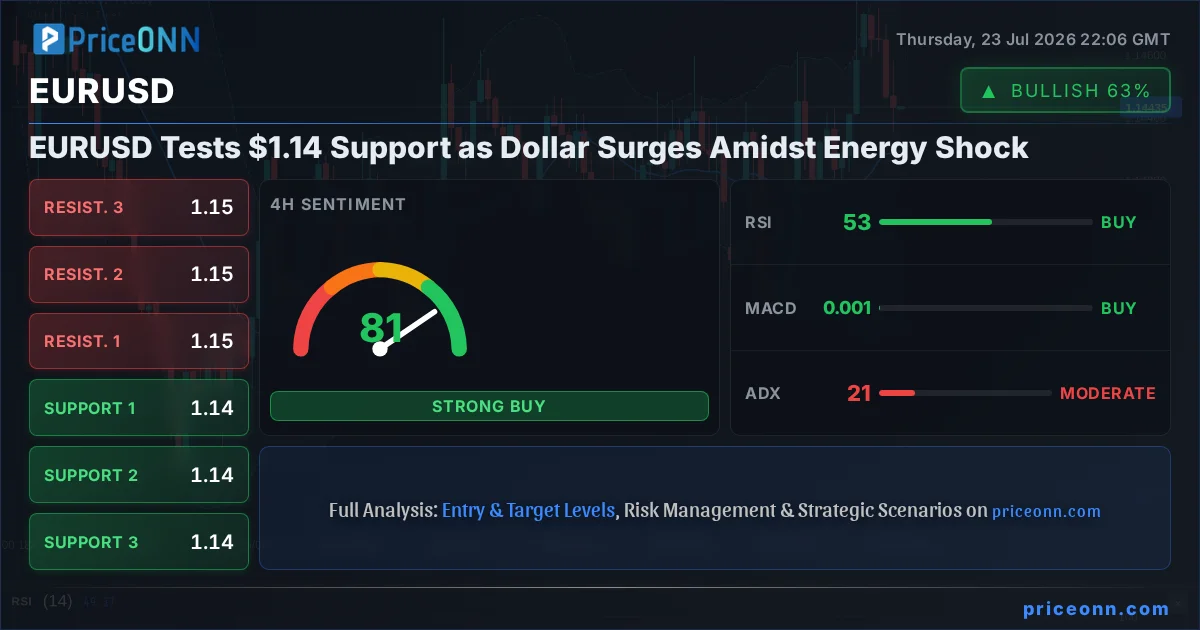
EUR/USD rose to 1.1429 on Thursday, with the US dollar continuing its moderate decline from the previous session. The market is assessing rising inflation risks driven by elevated energy prices against a backdrop of weakening economic data, while seeking further signals on Federal Reserve policy. At next week’s meeting, the regulator is expected to keep […] The post EUR/USD Recovers as Dollar Weakens appeared first on ActionForex.
PriceONN News
EUR/CHF may already be telling investors what to expect from today’s European Central Bank meeting. The cross broke decisively above 0.9278 this week, extending its recent rally as surging oil prices revived inflation concerns across Europe. The move suggests markets have begun positioning for a relatively more hawkish ECB even though policymakers are almost universally […] The post EUR/CHF Rally Points to Hawkish ECB Hold as Oil Reignites Inflation Risks appeared first on ActionForex.
PriceONN News
The Japanese Yen tumbled to another four-decade low today, with USD/JPY breaking above the 163 mark as investors continued to unwind Yen positions against the backdrop of widening global yield differentials and surging energy prices. The move has once again thrust Japan’s currency policy into the spotlight, raising familiar questions over whether authorities will step […] The post Yen Hits Fresh 40-Year Low. Can Japan Still Defend Its Currency? appeared first on ActionForex.
PriceONN News
The Euro’s (EUR) modest upside attempt against the US Dollar (USD) witnessed during Wednesday’s Asian session has been short-lived. The EUR/USD pair was capped below 1.1420, before pulling back to levels a few pips above 1.1400 during the European trading session.
PriceONN News
The Japanese Yen (JPY) attracts significant bids against its major currency peers during the European trading session on Wednesday. The USD/JPY pair falls vertically to near 162.65, but quickly recovers some losses and rebounds to around 162.90.
PriceONN News
UK retail sales volumes jumped 1.0% mom in June, far exceeding expectations for a -0.3% mom decline, following an unrevised 1.2% mom increase in May. The stronger-than-expected performance points to resilient consumer demand despite elevated borrowing costs and persistent cost-of-living pressures. Retailers credited sales promotions and warm weather for boosting spending, particularly at online and […] The post UK Retail Sales Surge 1.0% mom as Online Spending Leads Broad-Based June Rebound...
PriceONN News
Germany’s GfK Consumer Climate edged down from -29.3 to -29.6 for August, highlighting that household confidence remains deeply depressed despite modest improvement in some underlying indicators. The slight deterioration was driven by weaker income expectations and a renewed rise in precautionary saving, offsetting gains in willingness to buy and economic expectations. Income expectations fell from […] The post Germany’s GfK Consumer Climate Slips to -29.6 as Income Outlook Weakens and Saving...
PriceONN News
TL;DR: Gold and Silver tumbled as markets returned to the oil-rates relationship that governed Q2, with Brent above $100 and 10-year Treasury yields above 4.7% restoring pressure on the metals - leaving their next move hostage to Trump’s binary decision on Iran. Why This Matters Gold and Silver tumbled as markets returned to trading precious […] The post Gold and Silver Tumble as Oil Link Returns; Trump’s Looming Decision on Iran Adds Binary Risk appeared first on ActionForex.
PriceONN News
Australia’s private sector gained momentum in July, with the S&P Global Flash Composite PMI rising from 50.4 to 52.6, its highest reading since the start of the year. The improvement was driven primarily by the services sector, where the Services PMI Business Activity Index climbed from 50.5 to 53.0, while Manufacturing PMI edged up from […] The post Australia PMI Composite Hits 2026 High at 52.6 as Domestic Demand Rebounds appeared first on ActionForex.
PriceONN News
Key insights from the week that was. The June Labour Force Survey offered both noise and signal. Employment surprised materially to the upside, rising 76.3k in the month. However, the gain was matched by a sizeable lift in labour supply, the participation rate bouncing 0.3ppts to 67.0%, a 13-month high. The ABS noted in the […] The post Cliff Notes: Markets on Edge appeared first on ActionForex.
PriceONN News
Canada’s retail sales rose 1.0% mom to CAD 73.7B in May, marking a broad-based improvement in consumer spending as all nine retail subsectors posted gains. The increase was led by gasoline stations and fuel vendors, reflecting higher fuel prices, while motor vehicle and parts dealers also contributed with a second consecutive monthly increase. Excluding the […] The post Canada Retail Sales Rise 1.0% in May, June Momentum Seen Continuing appeared first on ActionForex.
PriceONN News
The European Central Bank left its key interest rates unchanged as widely expected, keeping the deposit rate at 2.25%, while acknowledging that renewed energy market volatility has complicated the inflation outlook. Rather than signalling any change in policy direction, the Governing Council emphasized that the “outlook for energy prices, while highly volatile,” remains well above […] The post ECB Holds Rates, Closely Watches Energy Shock and Inflation Spillovers appeared first on ActionForex.