
GBP/USD Under Pressure Amid Growing Domestic Concerns
 PriceONN Editorial Desk
Multi-source verification
PriceONN Editorial Desk
Multi-source verification

Sterling's Slippage Amidst Domestic Headwinds
The British pound experienced a noticeable pullback on Tuesday, reversing earlier gains to trade at 1.3486 against the US dollar. This retreat occurs as markets digest a stream of discouraging economic indicators released late last week. Meanwhile, persistent geopolitical unease in the Middle East has bolstered demand for the US dollar, positioning it as a favored safe-haven asset amid investor caution.
Recent data paints a stark picture of the United Kingdom's economic landscape. April's retail sales figures revealed a significant 1.3% decrease month-on-month, marking the most substantial decline observed in almost a year. This downturn significantly underperformed market expectations, signaling that consumers are increasingly curtailing expenditure. The squeeze on household budgets stems from a confluence of factors including elevated fuel prices, escalating energy bills, and a general sense of unease amplified by international conflicts.
The challenges facing the UK economy extend beyond consumer spending. Earlier reports on the labour market have also signaled a weakening trajectory. Unemployment figures continue their upward trend, while real wage growth is failing to keep pace with the accelerating rate of inflation. This combination of job market softness and real income erosion presents a difficult environment for households and businesses alike.
Further pressure is being exerted on British assets by the nation's deteriorating public finances. The budget deficit recorded for April reached its highest point since the peak of the COVID-19 pandemic, with government borrowing climbing to £24.3 billion. This figure represents the second-highest borrowing total ever recorded for the month of April, underscoring fiscal strains.
Despite these considerable domestic headwinds, sterling has demonstrated a degree of resilience, partially recovering from political anxieties that have shadowed the currency in recent weeks. Market participants are closely monitoring the political fallout from the Labour Party's performance in recent local elections, particularly concerning Prime Minister Keir Starmer's standing.
Market Ripple Effects
The current situation for GBP/USD presents a complex interplay of domestic weakness and external safe-haven flows. The sharp decline in UK retail sales, down 1.3%, and the record post-pandemic borrowing figures of £24.3 billion create a fundamental drag on the pound. This economic fragility provides a fertile ground for the US dollar to strengthen, especially with ongoing concerns in the Middle East driving investors towards perceived safety.
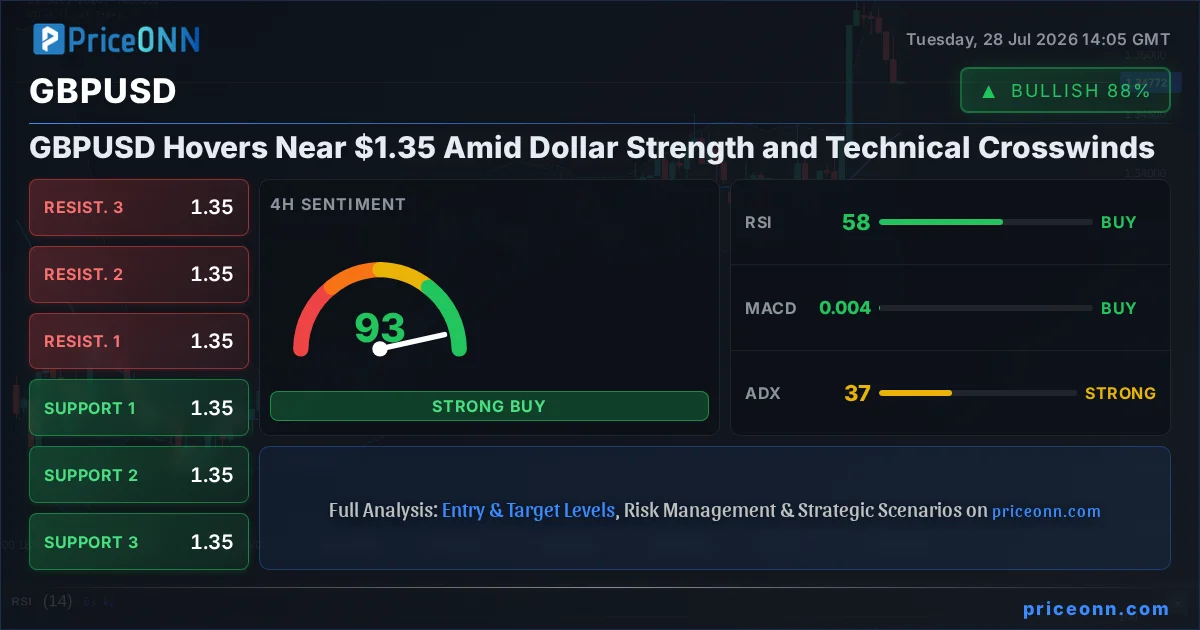
Technically, the pair appears poised for further weakness. On the 4-hour chart, after testing the 1.3500 handle, GBP/USD is consolidating above the 1.3434 support level. A move towards 1.3393 is a distinct possibility in the short term. Beyond this, the pair might enter a period of choppiness, with potential upside limited to 1.3455 and downside risk extending towards 1.3290. The MACD indicator's downward trajectory and the Stochastic oscillator's position below 50 on the hourly chart lend credence to this bearish outlook, suggesting that waning bullish momentum is likely to give way to selling pressure.
The implications for related markets are significant. The weakness in GBP/USD could spill over into other British assets, potentially pressuring UK equity indices like the FTSE 100, particularly if domestic economic concerns continue to escalate. Conversely, the strength of the US dollar, buoyed by geopolitical risks, could weigh on emerging market currencies and riskier commodity assets. Traders will be watching the relationship between the US Dollar Index (DXY) and sterling closely, as well as any shifts in global risk appetite indicators.
The primary risk for sterling remains the intensification of domestic economic woes or unexpected political developments. Conversely, a de-escalation of Middle East tensions could see the dollar's safe-haven appeal diminish, offering some relief to GBP/USD. However, until UK economic data shows a clear turnaround, the path of least resistance for the pair appears to be downwards, with 1.3393 serving as a key near-term level to monitor.
Reading Between the Lines
The confluence of economic fragility and geopolitical tension is creating a challenging environment for the British pound. While the recent dip to 1.3486 on GBP/USD might seem modest, it follows a pattern of deteriorating domestic fundamentals. The sharp 1.3% fall in retail sales is particularly concerning, indicating a tangible impact of inflation and cost of living pressures on consumer behavior. Coupled with a widening budget deficit, now at £24.3 billion for April, the UK faces significant fiscal and economic hurdles.
The market's reaction highlights a clear divergence in currency drivers. Investor caution, fueled by Middle East uncertainty, is actively seeking refuge in the US dollar. This dynamic often overshadows localized economic news, unless that news is exceptionally dire. For sterling, this means that even as domestic data disappoints, its ultimate direction may also hinge on shifts in the global risk sentiment. The recent political pressures, while somewhat receding, add another layer of uncertainty that professional desks are factoring into their positioning.
What smart money is watching extends beyond the headline numbers. Desks are scrutinizing the forward guidance from the Bank of England against the backdrop of slowing growth and persistent inflation. They are also assessing the flow of funds in both currency and bond markets, looking for clues on institutional conviction. The positioning in options markets, for instance, can offer insights into anticipated volatility and directional bias that might not be immediately apparent from spot price action alone. A sustained move below 1.3400 could trigger more significant algorithmic selling, a factor often overlooked by retail traders focused solely on daily price swings.
The potential for further downside towards 1.3393, and perhaps even 1.3290, remains on the table. This outlook is supported by technical indicators suggesting a loss of bullish momentum. Traders should remain vigilant for any signs of a shift in global risk appetite or further negative economic surprises from the UK. The interplay between these factors will dictate whether the current pressure on GBP/USD intensifies or if a stabilization occurs.
Track markets in real-time
Empower your investment decisions with AI-powered analysis, technical indicators and real-time price data.
Join Our Telegram Channel
Get breaking market news, AI analysis and trading signals delivered instantly to your Telegram.
Join Channel PriceONN News
On 21 July, Stats NZ reported an acceleration in inflation: the Consumer Price Index rose 1.5% in the second quarter, while the annual inflation rate climbed to 4.1%, its highest level in more than two years and slightly above analysts’ consensus forecast of 4.0%. The increase was driven primarily by higher fuel prices amid tensions […] The post NZD/USD: Inflation Surge Meets Strong US Dollar Pressure appeared first on ActionForex.
PriceONN News
The ceasefire in the Middle East has disrupted the greenback’s plans. Strong PMI data and falling oil prices are helping the euro. The US dollar faced a downward gap at the start of the week as the Middle East de-escalation of the conflict came as an unwelcome surprise to speculators who had built up net […] The post De-Escalation Undermines the Greenback appeared first on ActionForex.
PriceONN News
EUR/USD enters the final week of July at 1.1369. Friday’s modest decline in energy prices reduced expectations that the Federal Reserve could raise rates as early as its upcoming meeting, scheduled for Tuesday and Wednesday. At the same time, the main currency pair remains very close to the monthly low recorded in late June. Markets […] The post EUR/USD Ahead of a Key Week: Holding Near Lows appeared first on ActionForex.
PriceONN News
Market Overview The crypto market trended lower at the end of Monday, mirroring the US equity market, as it fell from a peak of $2.23T to $2.16T before returning to recent local lows of $2.18T by Tuesday morning. This marks yet another test of the 50-day moving average (MA) as support, which sellers have been […] The post Bitcoin Has Failed to Break Away from Its Long-Term Trend appeared first on ActionForex.
PriceONN News
Gold fell to 4,047 USD per ounce on Tuesday, erasing gains from the previous session. Pressure on the metal is mounting amid fears that the Federal Reserve may raise rates as early as this week. Markets currently estimate the probability of such a move on Wednesday at over 33% – an unusually high level of […] The post Gold Declines, Focus on Fed and Falling Oil Prices appeared first on ActionForex.
PriceONN News
The de-escalation of the conflict in the Middle East has sent Brent prices tumbling. The oil market could return to a surplus as early as the end of 2026. The US dollar and oil have lost their correlation. Brent recorded its worst daily fall in three months after reports of a ceasefire in the Middle […] The post Oil: A Surplus on the Horizon appeared first on ActionForex.
PriceONN News
I am already riding two EURUSD sell entries. Another possible sell opportunity could be forming for traders that are not in yet. EURUSD Possible Bearish Scenario Watch for price to tap 4 Hour FVG (Purple) first. Watch for a bearish shift and bearish reversal signs in the FVG zone. Wait for all above to play […] The post Riding EURUSD Sellside appeared first on ActionForex.
PriceONN News
The Trump administration is weighing whether to extend access to some Chinese rare earth materials beyond the January 1, 2027 cutoff after U.S. producers acknowledged they cannot build sufficient domestic processing and magnet capacity before the deadline, Reuters reported on Monday. Industry executives and Pentagon suppliers told Reuters that U.S. processing and magnet manufacturing capacity remains insufficient to meet despite billions of dollars in federal support for new mines, separation...
PriceONN News
The US stock market is not factoring in the existing risks. Investors are increasingly focusing on the cash flows of S&P 500 companies. US stock indices have closed in the red the last two weeks, something that hasn’t happened since March. The stock market has weathered both the armed conflict in the Middle East and […] The post It’s Time to Weigh Up the Risks for the S&P 500 appeared first on ActionForex.
PriceONN News
(RTTNews) - Gold prices traded higher on Monday as oil prices tumbled amid eased Middle East tensions, helping ease inflation and interest-rate concerns ahead of crucial Fed, BoE and BoJ central bank meetings due this week.
PriceONN News
The dollar heads into a pivotal week trading near 101.80, just off a 15-month high, with the Fed’s July 29 meeting standing as the clear focal point. Markets currently price roughly a 65% chance of a hold, though renewed Middle East escalation has kept a hike back on the table for later this year. Energy […] The post US Dollar Index: a Defining Week for the King of the Markets appeared first on ActionForex.
PriceONN News
European Central Bank Governing Council member Peter Kazimir from Slovak reinforced the hawkish bias on Monday, arguing that policymakers will likely need to raise interest rates at least once more and warning that a worsening energy shock could ultimately require even more tightening than markets currently anticipate. His remarks come just days after the ECB […] The post ECB’s Kazimir Sees At Least One More Rate Hike, Warns Oil Shock Could Require More appeared first on ActionForex.