
Gold Stalls Below $4,500 as Strong Dollar and Geopolitical Tensions Clash
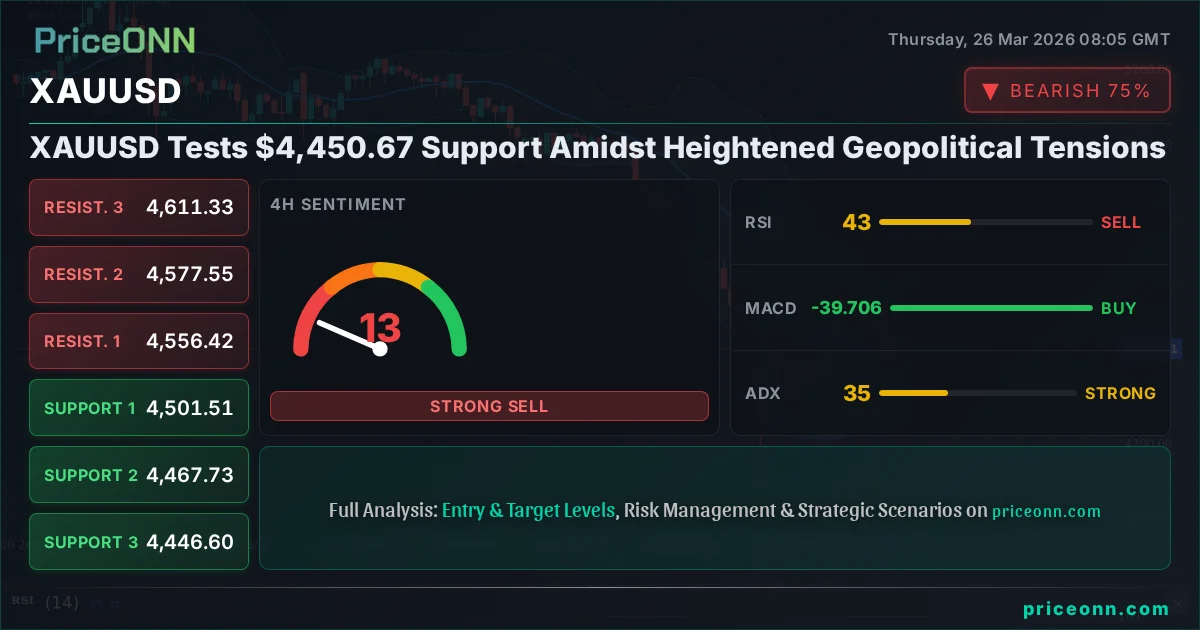
Gold (XAU/USD) is experiencing a period of consolidation, trading below the significant $4,500 psychological mark. This follows a rejection near the 100-day Simple Moving Average (SMA) after an overnight slide. While geopolitical developments often fuel demand for the precious metal as a safe-haven asset, a firming U.S. Dollar is currently capping its upside potential.
Market Context
The yellow metal has demonstrated resilience in recent trade, preventing a sharp decline from its recent highs. However, the upward momentum appears to be stalling. The overnight rejection from the 100-day SMA suggests that immediate bullish sentiment may be waning, or at least facing significant resistance. This price action highlights a critical battle between safe-haven demand, typically boosted by global uncertainty, and the prevailing strength of the U.S. Dollar. Historically, gold has served as a store of value and a hedge against inflation and currency depreciation, often seeing increased demand when central banks diversify reserves. In 2022, central banks added a record 1,136 tonnes of gold, underscoring its perceived stability. The inverse correlation between gold and the USD means a stronger dollar typically weighs on gold prices, and vice versa.
Analysis & Drivers
The primary driver currently exerting pressure on gold is the strength of the U.S. Dollar. As gold is priced in dollars, a stronger dollar makes the commodity more expensive for holders of other currencies, thus dampening demand. Market data indicates that the dollar index has been firming, likely influenced by a combination of factors including economic data releases and shifting interest rate expectations. Simultaneously, geopolitical developments in regions like the Middle East continue to underpin gold's safe-haven appeal. Fears of escalating conflict or prolonged instability typically drive investors towards assets perceived as less risky. However, the market's reaction shows that the dollar's strength is currently overshadowing these traditional safe-haven catalysts. The interplay between these forces-geopolitical risk and currency strength-is creating a delicate balance for gold prices. Furthermore, gold's sensitivity to interest rates means that any indication of higher-for-longer monetary policy from major central banks could also act as a headwind.
Trader Implications
Traders are advised to closely monitor the $4,500 level as a key psychological and technical resistance. A decisive break above this mark, sustained by increasing safe-haven demand and a weakening dollar, could signal a continuation of the bullish trend. Conversely, a sustained push below the 100-day SMA, currently hovering around the $4,450 area, could lead to further downside, potentially testing lower support levels near $4,400. The U.S. Dollar Index (DXY) remains a critical indicator; a dip in the DXY would likely provide a significant tailwind for gold. Conversely, continued dollar strength could cap any rallies. Investors should also be mindful of upcoming economic data releases, particularly from the United States, which could influence Federal Reserve policy expectations and, consequently, the dollar's trajectory and gold prices.
Outlook
The outlook for gold remains mixed, caught between the opposing forces of geopolitical uncertainty and a robust U.S. Dollar. While the safe-haven narrative provides a floor, the strong dollar is acting as a significant impediment to substantial upside. Traders should remain vigilant for shifts in either the geopolitical landscape or U.S. monetary policy signals. A clear break above $4,500 could open the door to further gains, but a failure to do so, coupled with continued dollar strength, might see gold retrace towards the $4,400 support zone. The coming days will be crucial in determining whether safe-haven demand can overcome currency headwinds.
Frequently Asked Questions
What is the immediate resistance level for Gold (XAU/USD)?
The immediate resistance for Gold is the psychological level of $4,500. A sustained break above this point, supported by weakening USD and rising geopolitical concerns, could signal further upside potential.
Why is the strong U.S. Dollar impacting Gold prices?
Gold is priced in U.S. Dollars, so a stronger dollar makes the precious metal more expensive for buyers using other currencies, thereby reducing demand and capping price increases. Market data shows the dollar index has recently firmed.
What key support level should traders watch for Gold?
Traders should monitor the 100-day Simple Moving Average (SMA), which is currently around the $4,450 mark. A decisive break below this level could lead to a test of further support near $4,400.
Track markets in real-time
Empower your investment decisions with AI-powered analysis, technical indicators and real-time price data.
Join Our Telegram Channel
Get breaking market news, AI analysis and trading signals delivered instantly to your Telegram.
Join Channel

PriceONN