
Gold extends recovery as Oil prices pull back on US-Iran ceasefire hopes
 PriceONN Editorial Desk
Multi-source verification
PriceONN Editorial Desk
Multi-source verification
A Safe Haven's Resurgence
The yellow metal, XAU/USD, is demonstrating resilience, clawing back ground after plumbing depths not seen in four months earlier this week. This recovery is being fueled by a fresh wave of buying interest that has emerged following a significant price correction. Gold's historical role as a primary store of value and a hedge against economic uncertainty continues to resonate with investors navigating today's volatile markets.
Beyond its allure in jewelry, gold is universally recognized as a premier safe-haven asset. This designation means it's often favored during periods of heightened global tension or economic instability. Its appeal extends to being a shield against the erosion of purchasing power from inflation and the devaluation of fiat currencies, largely because it is not tied to any single government or central bank's monetary policy. This intrinsic independence grants it a unique stability.
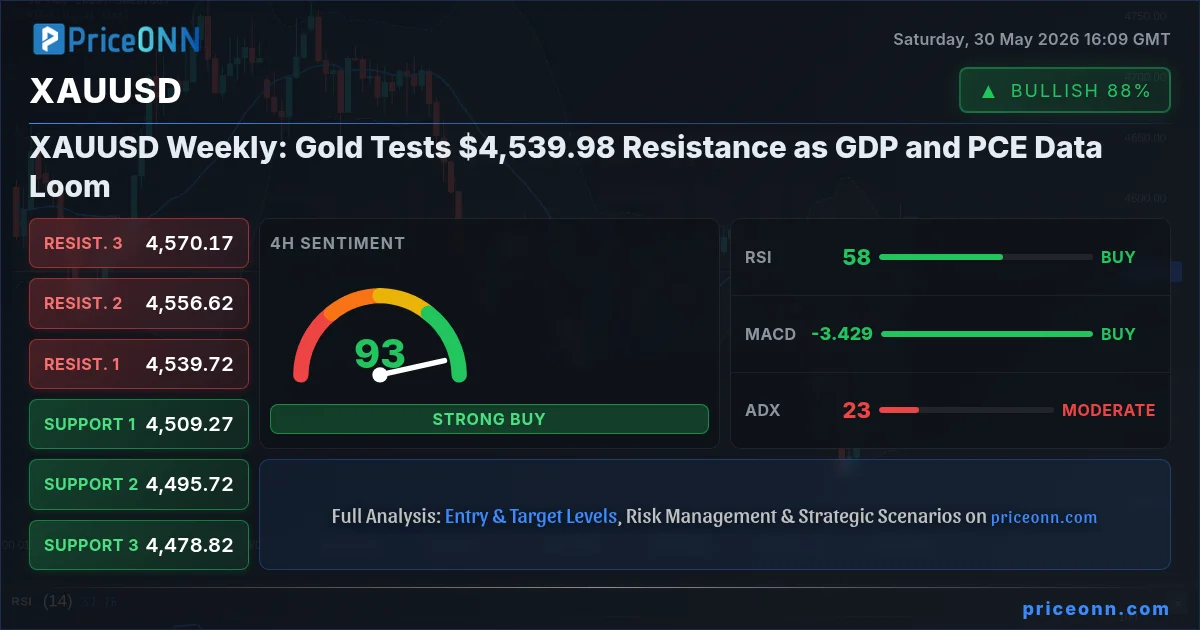
Central Banks' Growing Gold Appetite
The world's central banks are significant players in the gold market, consistently adding to their holdings. In their strategic efforts to bolster national currencies and fortify economies, especially during uncertain times, these institutions frequently diversify their reserve assets by acquiring gold. The presence of substantial gold reserves can enhance a nation's perceived financial solvency and instill greater confidence in its economic stability.
Recent data from the World Gold Council reveals a dramatic acceleration in this trend. In 2022, central banks collectively purchased a staggering 1,136 tonnes of gold, a move valued at approximately $70 billion. This figure represents the largest annual accumulation of gold by central banks on record, underscoring a profound shift in global reserve management strategies. Emerging economies, notably China, India, and Turkey, are at the forefront of this surge, aggressively expanding their gold stockpiles.
Market Dynamics and Gold's Interplay
Gold's price movements are intricately linked to broader financial market trends. It typically exhibits an inverse correlation with the US Dollar and U.S. Treasury bonds, both of which are considered major reserve assets and safe havens themselves. When the dollar weakens, gold often strengthens, offering a valuable diversification opportunity for both institutional investors and central banks seeking to mitigate risk during turbulent periods.
Furthermore, gold's relationship with riskier assets like equities is also inversely proportional. A robust rally in stock markets can often suppress gold prices, while significant downturns in equities tend to provide a tailwind for the precious metal. Geopolitical flare-ups or widespread fears of a severe economic recession can trigger rapid escalations in gold prices due to its established safe-haven status.
As an asset that generates no yield, gold's performance is sensitive to interest rate environments. Typically, lower interest rates make holding gold more attractive, whereas rising rates, which increase the cost of capital, tend to put downward pressure on its price. However, the most dominant factor influencing gold's trajectory remains the behavior of the US Dollar, given that gold is primarily priced in dollars (XAU/USD). A strong dollar generally caps gold's upward potential, while a weaker dollar provides fertile ground for gold prices to climb.
Market Ripple Effects
The recent pullback in oil prices, partly attributed to speculative trading around potential diplomatic breakthroughs between the US and Iran, presents a complex backdrop for gold. While easing energy price pressures might slightly dampen inflation expectations, potentially reducing the immediate need for gold as an inflation hedge, the underlying geopolitical uncertainty remains a significant supportive factor.
Traders are closely watching the interplay between crude oil benchmarks like Brent and WTI, the US Dollar Index (DXY), and gold. A sustained decline in oil prices could ease some inflationary concerns, potentially giving the Federal Reserve more room to maneuver on interest rates, which would typically be bearish for gold. However, any resurgence in geopolitical tensions, even with ceasefire hopes, could quickly override this dynamic, pushing gold higher on safe-haven demand. The Canadian Dollar (CAD), often sensitive to oil price fluctuations, may also see volatility as these energy markets adjust.
Track markets in real-time
Empower your investment decisions with AI-powered analysis, technical indicators and real-time price data.
Join Our Telegram Channel
Get breaking market news, AI analysis and trading signals delivered instantly to your Telegram.
Join Channel PriceONN News
Gold futures broke above $4,500 per ounce on Friday, driven by increasing optimism for a de-escalation in the U.S.-Iran conflict and the potential reopening of the Strait of Hormuz. Silver also saw significant gains, reflecting a broader shift towards precious metals as geopolitical tensions ease.
PriceONN News
Gold prices experienced a significant decline on Wednesday, falling over 1% as diplomatic optimism surrounding U.S.-Iran talks grew, despite ongoing military actions. The June gold contract settled at $4,444.50.
PriceONN News
Gold prices experienced a significant downturn, shedding 2% this week to settle near $4,444.50 per ounce. This decline is attributed to evolving U.S.-Iran diplomatic efforts and concerns over potential central bank rate hikes.
PriceONN News
Gold prices retreated to $4,504.30 per troy ounce despite ongoing geopolitical tensions and the closure of the Strait of Hormuz, suggesting a complex market dynamic beyond typical safe-haven demand. Silver, however, managed a modest gain.
PriceONN News
Gold (XAU/USD) rebounds sharply on Monday as hopes for a US-Iran deal to end the war in the Middle East and reopen the Strait of Hormuz weigh on the US Dollar (USD) and Oil prices. At the time of writing, XAU/USD is trading around $4,556, up 1.0% on the day.
PriceONN News
Gold prices fell on Friday as concerns over crude oil inventories and the prolonged closure of the Strait of Hormuz fueled inflation anxieties, overshadowing U.S.-Iran peace talks. The June Comex Gold contract settled down 0.55% at $4,517.40.
PriceONN News
(RTTNews) - Gold prices have soared on Friday amid rising optimism about an end to the Middle East war with the chances of reopening of the Strait of Hormuz and resumption of oil and energy trade growing stronger.
PriceONN News
(RTTNews) - After moving sharply lower earlier in the day, the price of gold has shown a significant turnaround over the course of the trading session on Thursday.
PriceONN News
Gold prices fell below the $4500 mark on Wednesday, extending previous losses as oil prices tumbled and geopolitical tensions between the US and Iran remained a key market driver. Investors are weighing inflation concerns against hopes of de-escalation.
PriceONN News
(RTTNews) - Extending the losses from yesterday's session, gold prices have slumped on Wednesday as traders watch the ongoing efforts to end the U.S.-Iran standoff with cautious optimism while the blockade on the Strait of Hormuz continues. The rising inflationary pressure weighe
PriceONN News
(RTTNews) - Gold prices traded lower on Wednesday, extending losses from the previous session as investors fretted about oil-driven inflation and the potential impact on interest rates.
PriceONN News
(RTTNews) - Gold prices have edged lower on Tuesday amid renewed concerns of inflationary pressure following fresh U.S. military strikes on Iran yesterday while the Strait of Hormuz remains closed for oil and energy transit.