
Gold Surges Past $4,500 as U.S.-Iran De-escalation Hopes Ignite Safe-Haven Demand

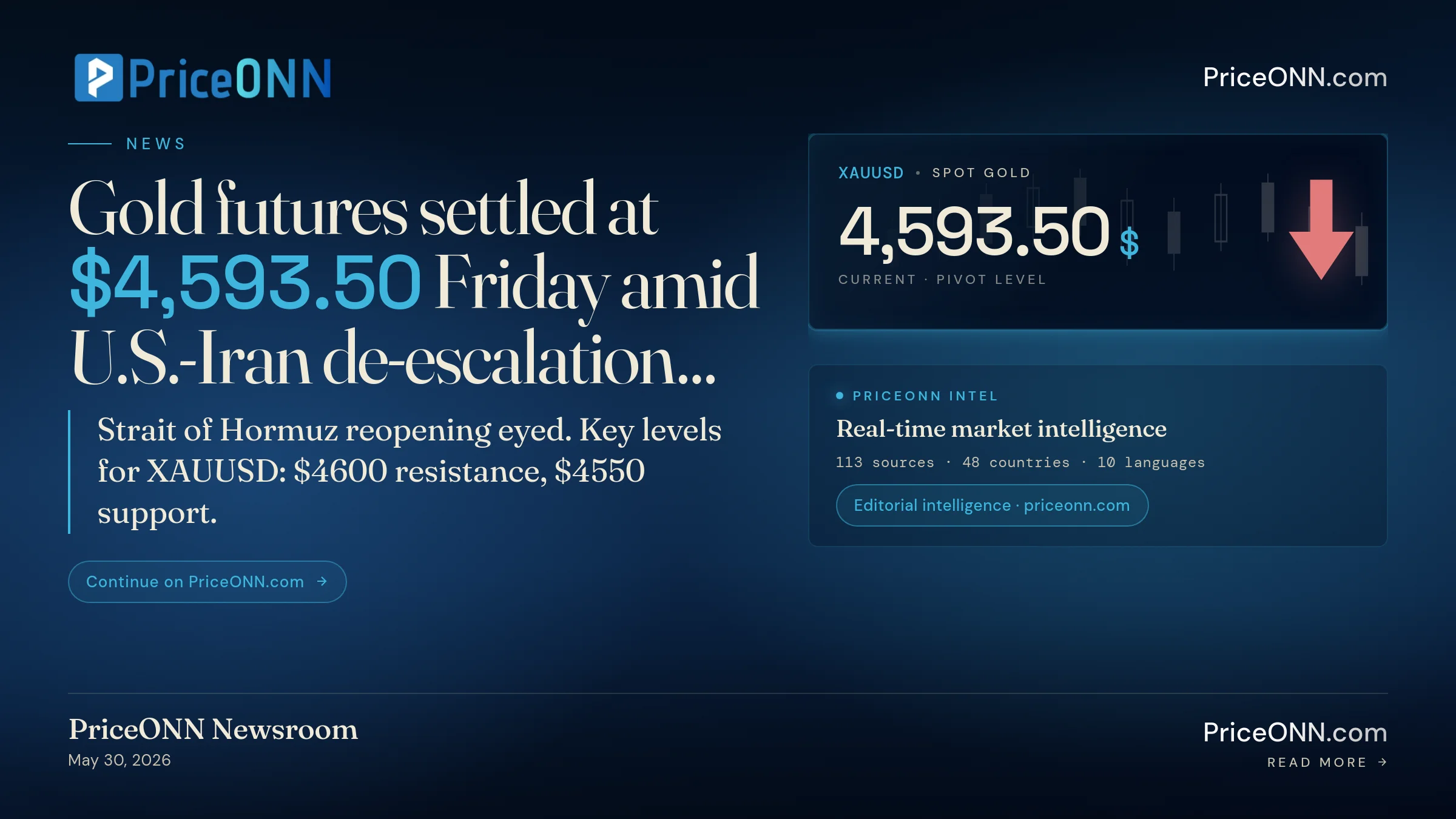
Gold prices experienced a significant surge on Friday, with August futures climbing $61.10 to settle at $4,593.50 per troy ounce. This rally was primarily catalyzed by growing expectations of a potential resolution to the ongoing Middle East conflict. As diplomatic efforts appear to be gaining traction, hopes for the reopening of the critical Strait of Hormuz and the resumption of vital energy trade routes are boosting demand for safe-haven assets.
Market Context
The precious metal market demonstrated robust upward momentum throughout the past week, culminating in Friday's impressive gains for gold. The August Comex silver contract also followed suit, appreciating by $0.850, or 1.12 percent, to close at $77.055 per troy ounce. This synchronized rise in both gold and silver prices underscores a notable shift in market sentiment, moving away from heightened geopolitical risk premiums towards a more optimistic outlook. The conflict, which has been ongoing for 91 days, has seen periods of intense military activity, including recent U.S. Central Command operations near Bandar Abbas aimed at neutralizing naval mines. These actions, described as defensive by U.S. forces, were met with claims from Iran's Islamic Revolutionary Guards Corps of striking a U.S. base involved in the operation. However, beneath these surface-level escalations, discreet diplomatic channels have reportedly been active, signaling a potential breakthrough.
Analysis & Drivers
The primary driver for gold's ascent is the emerging narrative of a potential U.S.-Iran détente. Market data indicates that discussions around a Memorandum of Understanding (MOU) between the two nations have begun to circulate. If finalized, this agreement could potentially extend the existing ceasefire by an additional 60 days, providing a crucial window for broader negotiations, including discussions on Iran's nuclear program. While official statements from figures like Vice President JD Vance expressed optimism regarding the proximity of a deal and the perceived good faith of Iranian negotiators, the situation remains fluid, with conflicting reports sometimes emerging from various sources. The potential reopening of the Strait of Hormuz is a critical factor. This vital chokepoint for global oil supply has been a focal point of tension. Any indication of its secure passage would significantly reduce energy supply risks and, paradoxically, could initially boost risk appetite but also solidify confidence in a stable geopolitical environment, which often benefits gold as a store of value.
Furthermore, the broader economic backdrop continues to support precious metals. While specific inflation data is not the immediate catalyst here, persistent concerns about global economic stability and the potential for future monetary policy shifts by major central banks keep the underlying demand for gold robust. Investors are often seeking to hedge against uncertainties, and a de-escalation in a major geopolitical hotspot like the Middle East reduces one significant source of that uncertainty, allowing other, more fundamental economic considerations to come to the fore. The interplay between easing geopolitical tensions and underlying economic factors creates a complex but ultimately supportive environment for gold.
Trader Implications
For traders, the shift in geopolitical sentiment presents both opportunities and risks. The immediate implication is a potential continuation of the upward trend in gold and silver prices as long as de-escalation signals remain dominant. Key resistance levels to watch for gold will be the $4,600 mark, followed by potential tests of higher psychological levels if momentum sustains. On the downside, significant support is now expected to hold around the $4,550 level, which acted as a recent resistance. For silver, traders should monitor the $77.50 resistance and the $76.00 support. A sustained break above these levels could signal further upside potential.
Traders should remain vigilant for any official announcements regarding the MOU or the status of the Strait of Hormuz. Any resurgence in tensions or failure of diplomatic talks could lead to a sharp reversal, with gold potentially falling back towards previous support levels. The market's reaction to any news regarding Iran's nuclear program will also be critical. Volatility is likely to remain elevated until a more concrete and lasting resolution is established. Risk management strategies, such as utilizing stop-loss orders and carefully managing position sizing, are paramount in this evolving landscape. The focus should be on confirmed price action and validated news flow rather than speculation.
Outlook
The immediate outlook for gold and silver appears cautiously optimistic, contingent on the sustained progress of diplomatic efforts between the U.S. and Iran. If talks continue to yield positive results and the Strait of Hormuz remains open and secure, precious metals may consolidate recent gains or even push higher. However, the inherent volatility of geopolitical situations means that any setback in negotiations could quickly reignite safe-haven demand. Upcoming economic data releases from major economies and any further signals from central banks regarding monetary policy will also play a role in shaping broader market sentiment and influencing the trajectory of precious metals. The market will be closely watching for confirmation of any ceasefire extension and the commencement of substantive nuclear program discussions.
Frequently Asked Questions
What is the current price of gold and what is driving its recent surge?
As of Friday's settlement, gold futures for August delivery reached $4,593.50 per troy ounce. The primary driver for this surge is increasing optimism surrounding a de-escalation of the U.S.-Iran conflict and the potential reopening of the Strait of Hormuz, which bolsters demand for safe-haven assets.
What are the key price levels traders should watch for gold and silver?
Traders should monitor gold's resistance at $4,600, with potential upside towards higher psychological levels. Key support for gold is seen around $4,550. For silver, resistance is at $77.50 and support is at $76.00.
What is the short-term outlook for gold prices amid these developments?
The short-term outlook for gold is cautiously optimistic, provided diplomatic progress between the U.S. and Iran continues and the Strait of Hormuz remains secure. A sustained de-escalation could lead to consolidation or further gains, but any breakdown in talks could trigger a sharp reversal.
Track markets in real-time
Empower your investment decisions with AI-powered analysis, technical indicators and real-time price data.
Join Our Telegram Channel
Get breaking market news, AI analysis and trading signals delivered instantly to your Telegram.
Join Channel PriceONN News
(RTTNews) - Gold prices have edged higher on Friday, partially offsetting the losses from yesterday's plunge after crude oil prices plummeted, lowering both oil-linked inflation concerns and the consequential expectations of an interest-rate hike by the U.S. Federal Reserve.
PriceONN News
Gold price (XAU/USD) is up 1.5% to near $4,067 during the European trading session on Tuesday. The precious metal outperforms as the rally in oil prices has stalled, with investors turning confident that negotiations between the United States (US) and Iran towards peace have resumed.
PriceONN News
(RTTNews) - Gold prices were sharply lower on Tuesday as traders waited for the Federal Reserve policy decision.
PriceONN News
(RTTNews) - Gold prices have advanced on Monday, extending the gains from Friday's session as a pause on mutual attacks by both the U.S. and Iran eased escalation tensions in the ongoing gulf crisis. Expectations of a tighter monetary policy in the U.S. diminished amid a freefall
PriceONN News
(RTTNews) - Gold prices have tumbled on Thursday as the Middle East crisis deepens after Iran-backed Houthi militants of Yemen attacked two Saudi Arabian vessels in the Red Sea, raising concerns of intense oil supply disruption for an extended period. The possibility of an intere
PriceONN News
(RTTNews) - Gold prices fell from a two-week high on Thursday as escalating West Asia tensions rekindled inflation fears and clouded the outlook for interest rates.
PriceONN News
(RTTNews) - Gold prices traded higher on Wednesday, extending gains for a fourth consecutive session and hitting a two-week high as investors reacted to escalating Middle East tensions and looked ahead to next week's Federal Reserve meeting.
PriceONN News
Gold (XAU/USD) rallies to an over two-week high, around the $4,140-$4,141 area, during the Asian session on Wednesday amid hopes that US-Iran diplomacy could ease energy prices and temper hawkish US Federal Reserve (Fed) expectations.
PriceONN News
Gold (XAU/USD) edges higher on Tuesday as buying interest around the $4,000 psychological level supports prices, while traders assess developments in the Middle East and their potential economic fallout. At the time of writing, XAU/USD trades around $4,058, up 1.27% on the day.
PriceONN News
Silver (XAG/USD) is rallying, favoured by a mild US Dollar weakness on Tuesday.
PriceONN News
Gold (XAU/USD) regains positive traction following the previous day's two-way price moves, though it struggles to capitalize on the move and trades below the $4,050 level during the Asian session on Tuesday.
PriceONN News
Gold (XAU/USD) trades in a volatile range on Monday as markets react to conflicting headlines from the Middle East. At the time of writing, XAU/USD trades around $4,010, little changed on the day after climbing to an intra-day high of $4,040.