
Gold Dips Below $4500 On Rate Hike Worries
 PriceONN Editorial Desk
Multi-source verification
PriceONN Editorial Desk
Multi-source verification

Market Under Pressure
The precious metal faced headwinds on Wednesday, extending a sell-off from the prior trading session. Investors are increasingly concerned that rising oil prices could ignite broader inflation, compelling central banks, particularly the U.S. Federal Reserve, to consider aggressive monetary tightening. This sentiment is placing considerable pressure on non-yielding assets like gold.
Spot gold saw a 0.4 percent decline, reaching $4,490.29 per ounce. Simultaneously, U.S. gold futures contracts for August delivery registered a 0.3 percent dip, settling at $4,522.70. The bearish momentum appears to be fueled by a complex geopolitical landscape and evolving monetary policy expectations.
Geopolitical Tensions Simmer
Adding to market uncertainty, renewed tensions between the United States and Iran near the critical Strait of Hormuz have injected a layer of risk. Tehran has leveled accusations against Washington, alleging a breach of a ceasefire and issuing stern warnings of retaliation. This follows reports of U.S. forces striking Iranian missile sites and maritime vessels.
The intricacies of a potential peace settlement remain complex, with significant hurdles persisting, notably concerning Iran's frozen financial assets and the crucial passage through the Strait of Hormuz. Adding to the charged atmosphere, Iran's Islamic Revolutionary Guard Corps claimed to have engaged and targeted an F-35 fighter jet and multiple drones identified as "hostile aircraft" encroaching on Iranian airspace.
Concerns are mounting that any further military escalation could provoke retaliatory actions from Iran against its regional neighbors. Iran's Supreme Leader, Mojtaba Khamenei, issued a strong statement via state television, asserting that regional nations would no longer serve as mere shields for U.S. military installations.
Central Bank Watch
The U.S. dollar index held firm, buoyed by anticipation of key economic data. Thursday's upcoming U.S. Personal Consumption Expenditures (PCE) price index report is widely expected to confirm continued elevated price pressures, a critical factor for the Federal Reserve's policy decisions.
Earlier in the day, Bank of Japan Governor Kazuo Ueda cautioned against analyzing oil price fluctuations in isolation, suggesting a more holistic view of inflationary drivers is necessary for central bankers. Meanwhile, Minneapolis Fed President Neel Kashkari acknowledged rising inflation risks but indicated it was premature to definitively forecast an imminent rate hike.
Investor sentiment regarding future Fed actions can be gauged by CME Group's FedWatch tool. Currently, the market assigns a 37 percent probability to a 25 basis-point interest rate increase by the Federal Reserve in December. This suggests a degree of uncertainty, but a growing inclination towards tighter monetary policy.
Adding another layer to the global monetary policy discussion, European Central Bank Executive Board member Isabel Schnabel stated that the ECB should proceed with a rate increase in June, irrespective of a swift resolution to the Middle East conflict. This indicates a focus on domestic inflation targets even amidst external geopolitical shocks.
Reading Between the Lines
The current market environment presents a classic tug-of-war between geopolitical risk premiums and the specter of persistent inflation driving central bank tightening. While the Strait of Hormuz tensions provide a short-term bullish catalyst for safe-haven assets, the persistent inflation data and hawkish rhetoric from central bankers are creating a more potent, sustained headwind for gold.
The Federal Reserve's path forward remains a critical determinant for gold prices. While current market pricing suggests less than a 50 percent chance of a December hike, any data prints that signal accelerating inflation could rapidly shift these expectations. Traders are closely monitoring the PCE data, as well as employment figures and other inflation-related indicators, for clues on the Fed's next move.
Furthermore, the European Central Bank's hawkish stance, even in the face of geopolitical instability, signals a broader trend of global monetary authorities prioritizing inflation control. This unified focus on combating inflation could lead to a synchronized tightening cycle, exerting downward pressure across a range of risk assets, with gold being particularly sensitive.
The interplay between oil prices, geopolitical events, and central bank policy creates a complex and volatile landscape. Investors are being forced to weigh the immediate safety offered by gold against the potential for significant capital erosion if interest rates climb substantially higher. The coming weeks will be crucial in determining whether the inflation narrative or the geopolitical narrative dominates market sentiment.
Track markets in real-time
Empower your investment decisions with AI-powered analysis, technical indicators and real-time price data.
Join Our Telegram Channel
Get breaking market news, AI analysis and trading signals delivered instantly to your Telegram.
Join Channel PriceONN News
(RTTNews) - Gold prices fell from a two-week high on Thursday as escalating West Asia tensions rekindled inflation fears and clouded the outlook for interest rates.
PriceONN News
(RTTNews) - Gold prices have edged higher on Friday, partially offsetting the losses from yesterday's plunge after crude oil prices plummeted, lowering both oil-linked inflation concerns and the consequential expectations of an interest-rate hike by the U.S. Federal Reserve.
PriceONN News
(RTTNews) - Gold prices have tumbled on Thursday as the Middle East crisis deepens after Iran-backed Houthi militants of Yemen attacked two Saudi Arabian vessels in the Red Sea, raising concerns of intense oil supply disruption for an extended period. The possibility of an intere
PriceONN News
(RTTNews) - Gold prices traded higher on Wednesday, extending gains for a fourth consecutive session and hitting a two-week high as investors reacted to escalating Middle East tensions and looked ahead to next week's Federal Reserve meeting.
PriceONN News
Gold price (XAU/USD) is up 1.5% to near $4,067 during the European trading session on Tuesday. The precious metal outperforms as the rally in oil prices has stalled, with investors turning confident that negotiations between the United States (US) and Iran towards peace have resumed.
PriceONN News
Silver price (XAG/USD) trades 1.33% lower to near $58.00 during the European trading session on Thursday. The white metal faces selling pressure as elevated energy prices due to renewed aggression between the United States (US) and Iran have de-anchored inflation expectations again.
PriceONN News
The Gold price turns negative on Wednesday, even though the last two US inflation reports showed that prices are dropping, though developments in the Middle East sent energy prices higher. At the time of writing, the XAU/USD traded at $4,034, down some 0.53%.
PriceONN News
(RTTNews) - Gold prices were sharply lower on Tuesday as traders waited for the Federal Reserve policy decision.
PriceONN News
(RTTNews) - Gold prices have advanced on Monday, extending the gains from Friday's session as a pause on mutual attacks by both the U.S. and Iran eased escalation tensions in the ongoing gulf crisis. Expectations of a tighter monetary policy in the U.S. diminished amid a freefall
PriceONN News
Gold (XAU/USD) rallies to an over two-week high, around the $4,140-$4,141 area, during the Asian session on Wednesday amid hopes that US-Iran diplomacy could ease energy prices and temper hawkish US Federal Reserve (Fed) expectations.
PriceONN News
Silver price (XAG/USD) gains ground for the fourth successive day, trading around $59.70 per troy ounce during the Asian hours on Wednesday. Silver prices are surging despite rising rate-hike expectations, as powerful market forces outweigh the drag of higher interest rates.
PriceONN News
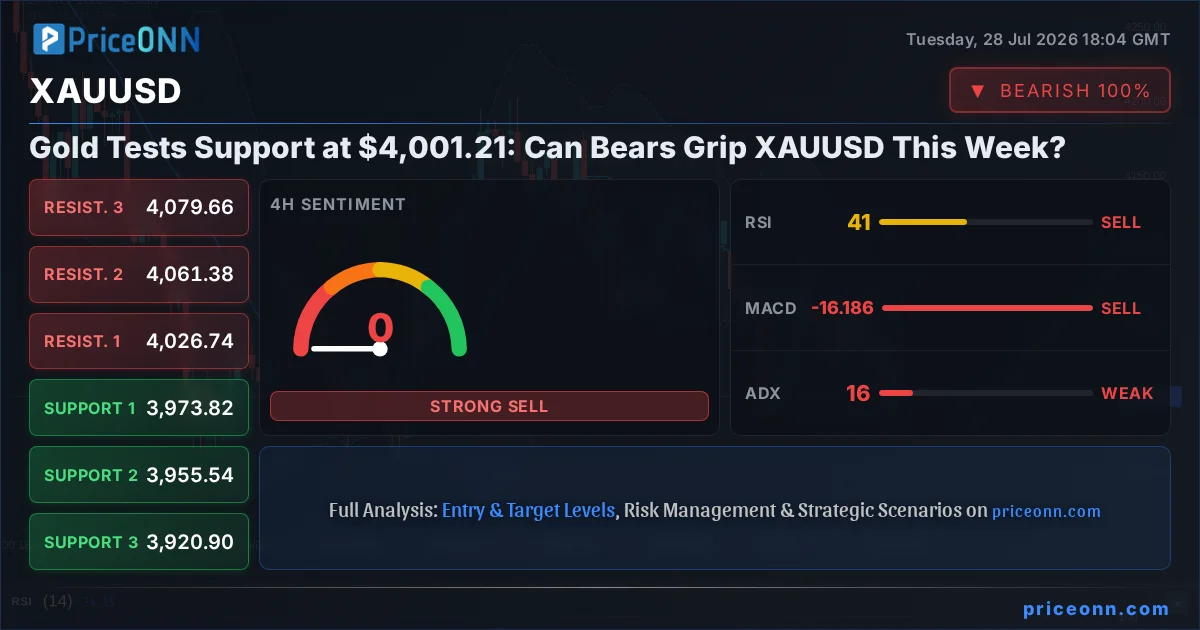
Gold (XAU/USD) edges higher on Tuesday as buying interest around the $4,000 psychological level supports prices, while traders assess developments in the Middle East and their potential economic fallout. At the time of writing, XAU/USD trades around $4,058, up 1.27% on the day.