
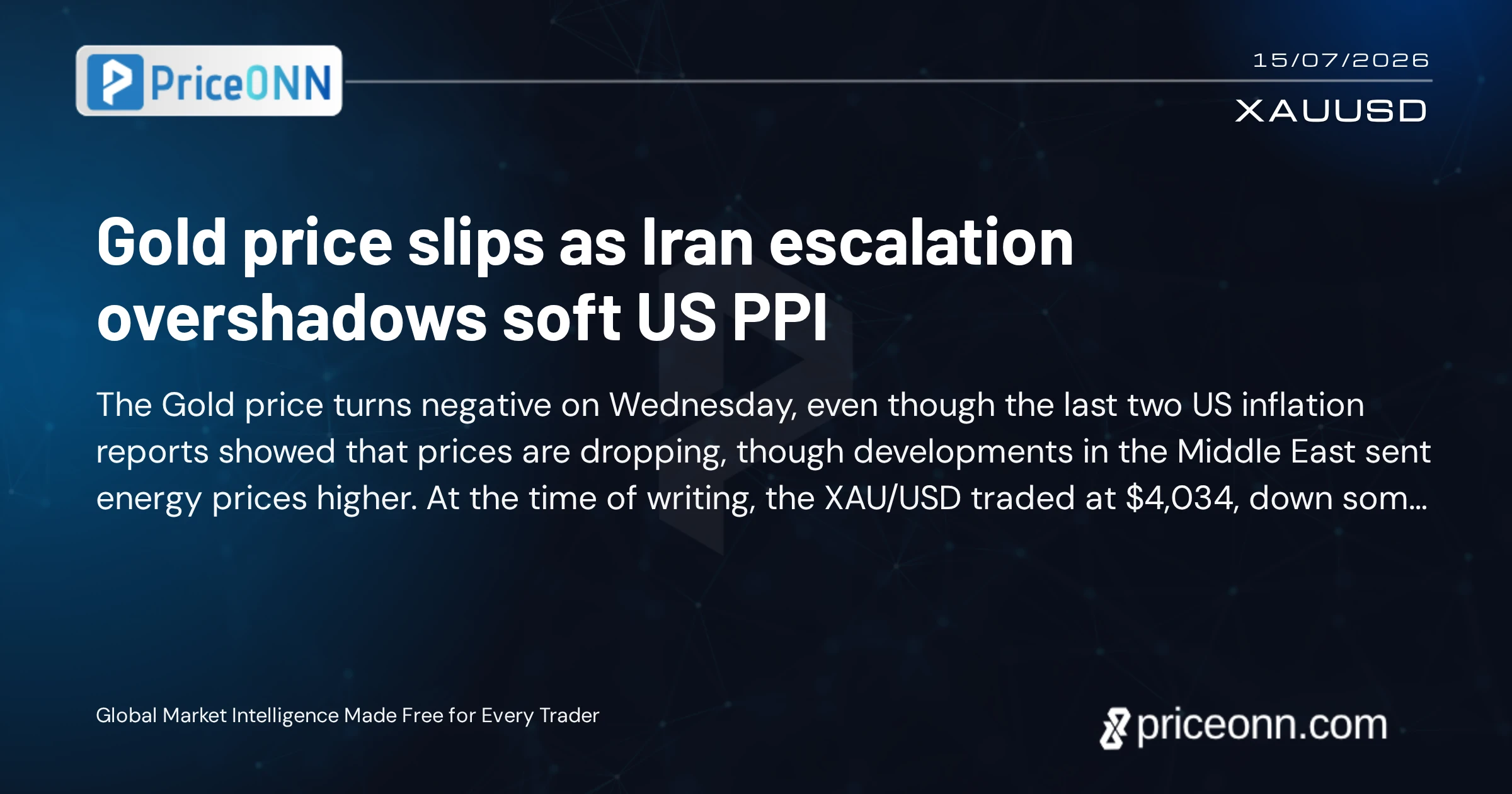
Gold price slips as Iran escalation overshadows soft US PPI
 PriceONN Editorial Desk
Multi-source verification
PriceONN Editorial Desk
Multi-source verification
The Enduring Allure of Gold
For millennia, gold has served as a bedrock of financial systems, functioning as both a store of value and a medium for exchange. Beyond its aesthetic appeal and use in adornments, this precious metal is now predominantly recognized as a sanctuary asset. Its reputation as a reliable investment during periods of heightened uncertainty makes it a cornerstone for portfolio resilience.
Furthermore, gold is widely perceived as a potent hedge against inflationary pressures and the erosion of currency values. Its intrinsic worth is not tethered to any single governmental or institutional backing, providing a unique stability. This characteristic is particularly appealing in an era of fluctuating fiat currencies.
Central banks globally are the largest custodians of gold. In their strategic efforts to bolster currency strength and economic stability, particularly during volatile times, these institutions frequently diversify their foreign exchange reserves by acquiring gold. A substantial gold reserve can significantly enhance a nation's perceived financial solvency and economic robustness.
The scale of central bank accumulation is striking. In 2022 alone, these institutions collectively added an unprecedented 1,136 tonnes of gold to their holdings, a move valued at approximately $70 billion. This represents the most significant annual net purchase on record, underscoring a clear trend among major economies. Emerging market central banks, notably from China, India, and Turkey, are leading this accelerated acquisition of gold reserves.
Market Dynamics Shaping Gold's Trajectory
Gold's price movements are intricately linked to several key financial instruments. It typically exhibits an inverse correlation with the US Dollar and US Treasuries, both of which are themselves considered major reserve assets and safe havens. When the dollar weakens, gold often strengthens, offering investors and central banks a vital avenue for asset diversification amidst global financial turbulence.
The precious metal also demonstrates an inverse relationship with risk-associated assets. A robust performance in equity markets can often put downward pressure on gold prices. Conversely, significant sell-offs in riskier market segments tend to boost demand for gold, reinforcing its safe-haven appeal.
The price of gold is subject to a complex interplay of factors. Geopolitical instability or the palpable fear of a severe economic downturn can trigger rapid price escalations for gold, directly attributable to its established safe-haven status. As an asset that generates no yield, gold typically thrives in an environment of declining interest rates. Conversely, a higher cost of borrowing generally exerts downward pressure on the yellow metal.
However, the behavior of the US Dollar often dictates the most significant price swings for gold, given that the commodity is priced in dollars (XAU/USD). A strong dollar tends to cap gold's appreciation, while a weakening dollar typically propels gold prices upward. Today's market action, however, presented a divergence where geopolitical fears, specifically concerning Iran, drove energy prices higher, while gold struggled for gains despite softer US inflation readings.
Reading Between the Lines
Wednesday's market action provided a classic example of competing narratives influencing asset prices. While the latest US Producer Price Index (PPI) data suggested a cooling inflation trend, with producer prices falling, this did little to boost gold. The precious metal, typically a beneficiary of lower inflation expectations or a weaker dollar, found itself unable to capitalize.
The real story driving market sentiment was the escalating geopolitical tensions in the Middle East. Fears of wider conflict involving Iran sent shockwaves through energy markets, pushing crude oil prices sharply higher. This surge in energy costs can, paradoxically, become inflationary, creating a complex scenario for central banks and potentially underpinning a different kind of safe-haven demand, though not immediately for gold.
The current price of gold at $4,034, representing a 0.53% dip, indicates that the immediate risk-on sentiment driven by energy price spikes is temporarily outweighing gold's traditional safe-haven role. Traders are likely weighing the immediate threat of energy supply disruptions against the longer-term implications of US inflation data. The market is watching closely to see if this geopolitical premium in energy markets translates into broader inflation concerns that might eventually support gold, or if the US dollar's reaction will be the dominant factor.
This divergence highlights the nuanced environment traders are currently navigating. While soft PPI might normally be a tailwind for gold, the immediate, tangible threat from geopolitical events is commanding market attention, leading to a peculiar scenario where energy futures are rallying while the traditional safe haven hesitates.
Track markets in real-time
Empower your investment decisions with AI-powered analysis, technical indicators and real-time price data.
Join Our Telegram Channel
Get breaking market news, AI analysis and trading signals delivered instantly to your Telegram.
Join Channel PriceONN News
(RTTNews) - Gold ticked higher on Monday as the dollar dipped on Iran peace deal hopes and after joint intervention by the United States and Japan to prop up the Japanese yen.
PriceONN News
Saxo Bank says bullion has to hold $4,360 to keep the rally alive, with headwinds building from oil, yields and the dollar into Wednesday’s inflation print.
PriceONN News
(RTTNews) - Gold was subdued on Tuesday after two consecutive sessions of gains on receding Fed hike bets and reports suggesting that China's central bank stepped up gold purchases in July.
PriceONN News
(RTTNews) - Gold prices held steady on Monday after U.S. employers unexpectedly cut jobs in July and hiring figures for the prior two months were also revised downward, helping ease the risk of an immediate U.S. interest-rate hike.
PriceONN News
(RTTNews) - Gold climbed above $4,300 an ounce on Friday and was set for its biggest weekly gain since January on hopes of peace in the Middle East, eased inflation concerns and reduced expectations for a Federal Reserve rate hike in September.
PriceONN News
(RTTNews) - Gold prices traded higher for a fourth straight session to hit a seven-week high on Thursday, driven by softer U.S. labor market data released overnight, a weaker dollar and lower Treasury yields.
PriceONN News
(RTTNews) - Gold prices surged 2 percent to hit a one-month high on Wednesday as a sharp fall in oil prices helped ease concerns around inflation and interest rates.
PriceONN News
(RTTNews) - Gold prices were largely unchanged on Tuesday as the U.S.-Iran conflict remained at a stalemate and investors looked forward to the release of a series of U.S. labor market reports this week that might provide fresh insights into the economic and rate outlook.
PriceONN News
(RTTNews) - Extending the losses from Friday's session, gold prices have edged lower on Monday as traders assess the plunge in crude oil prices due to the cancellation of planned U.S. strikes on Iran against Iran's refusal to acknowledge any ongoing peace talks with the U.S. and
PriceONN News
(RTTNews) - After two consecutive days of gains, gold prices have tumbled on Friday as crude oil prices soared with no end in sight to the U.S.-Iran conflict, leading to expectations of a high interest rate regime in the U.S. in the upcoming months. In addition, traders opted to
PriceONN News
All-in costs hit a record $1,785 an ounce in Q1, and the World Gold Council expects the conflict-driven energy bill to show up in the numbers still to come.
PriceONN News
(RTTNews) - Gold prices were up more than 1 percent on Wednesday amid rising bets that the U.S. Federal Reserve will not hike interest rates anytime soon.