
Gold Shows Notable Turnaround Amid Substantial Pullback By Crude Oil
 PriceONN Editorial Desk
Multi-source verification
PriceONN Editorial Desk
Multi-source verification

Gold's Unforeseen Rally
Gold prices executed a striking comeback on Thursday, dramatically reversing earlier declines. After commencing the session with a sharp downward trajectory, the precious metal managed to reclaim lost ground and then some, defying earlier pessimism.
The August gold futures contract, which had plunged by as much as $85.90 or 1.9 percent to touch a two-month low of $4,395.60 an ounce, ultimately surged $52.50 or 1.2 percent to settle at $4,534 an ounce. This impressive rebound occurred despite the earlier sharp sell-off, highlighting a significant shift in market sentiment throughout the trading day.
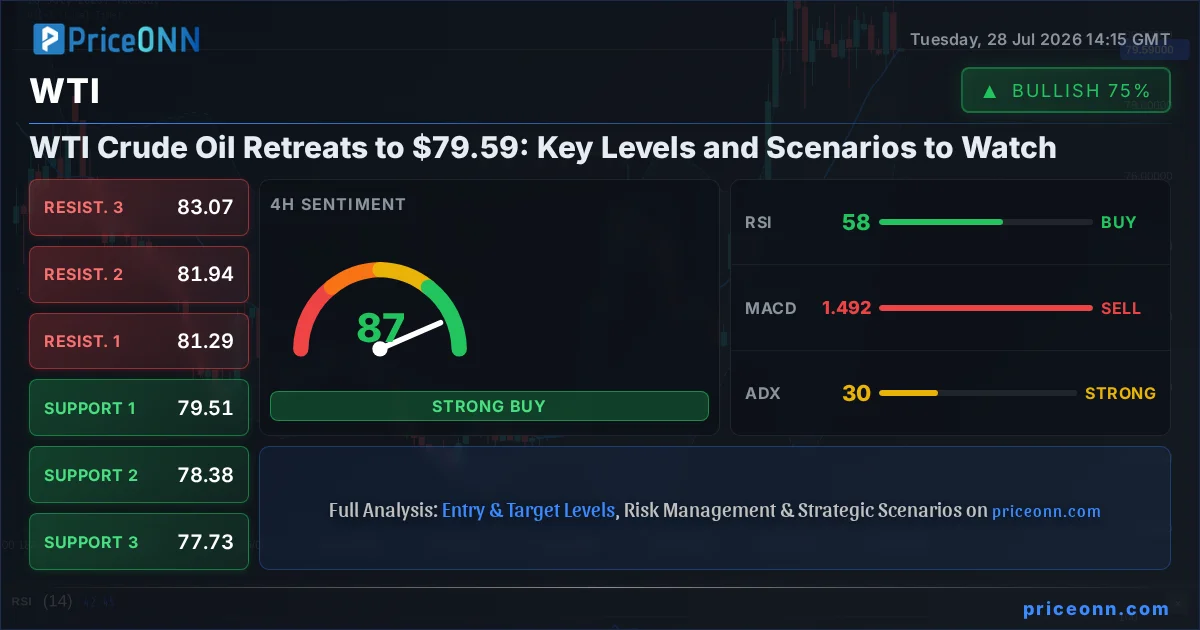
Crude Oil's Volatile Session
The dramatic recovery in gold unfolded against a backdrop of considerable volatility in the energy markets. Crude oil futures experienced a sharp retreat from their earlier highs, a move that appears to have directly benefited the precious metal.
The catalyst for oil's reversal appears to be a report from Axios suggesting a potential breakthrough in U.S.-Iran negotiations. According to the report, citing sources involved in mediation, an agreement on a 60-day memorandum of understanding (MOU) has been reached. This MOU would reportedly extend the existing ceasefire and initiate discussions concerning Iran's nuclear program.
While U.S. crude oil futures had initially soared by as much as 4.3 percent, fueled by earlier reports of U.S. "self-defense strikes" in southern Iran and subsequent Iranian retaliation, the market quickly pared those gains. Despite the pullback, oil futures remained modestly in positive territory by the close of trading.
It's worth noting that President Donald Trump has not yet given final approval for the reported MOU, with U.S. officials indicating he requires a few days to deliberate. This element of uncertainty may contribute to the ongoing price fluctuations in both oil and gold.
Economic Data Offers Mixed Signals
In U.S. economic news, data released by the Commerce Department provided a mixed picture of consumer price inflation. The report indicated that the personal consumption expenditures (PCE) price index rose by 0.4 percent in April, a figure that came in slightly below economists' expectations of a 0.5 percent increase. This followed a 0.7 percent rise in March.
On an annual basis, the PCE price index saw its growth rate accelerate to 3.8 percent in April, up from 3.5 percent in March. This annual increase was in line with market expectations.
Digging deeper, the core PCE price index, which excludes volatile food and energy components, showed a more subdued increase. It crept up by 0.2 percent in April, a slight deceleration from the 0.3 percent gain observed in March. Analysts had projected a 0.3 percent rise for the core index. The year-over-year growth for the core PCE price index edged up to 3.3 percent in April, matching the previous month's 3.2 percent and meeting forecasts.
Market Ripple Effects
The interplay between gold and oil prices, influenced by geopolitical developments and inflation data, presents a complex scenario for traders. The sharp reversal in gold, particularly as oil pulled back from its highs, suggests that market participants may be prioritizing safe-haven assets amidst geopolitical tensions, even as inflation figures remain somewhat elevated.
The potential de-escalation signaled by the U.S.-Iran MOU, if finalized, could lead to a further easing of crude oil prices. This, in turn, might create additional headwinds for inflation expectations, potentially benefiting gold as a store of value against rising prices. Conversely, any breakdown in these negotiations or renewed escalation could send oil prices soaring again, potentially dampening gold's appeal and increasing inflationary pressures.
Traders will be closely watching the official confirmation or denial of the U.S.-Iran MOU, as well as any further statements from the White House regarding President Trump's decision. The sensitivity of gold to geopolitical risk premiums and oil's direct impact on inflation metrics make this a critical nexus to monitor. Furthermore, the U.S. dollar index (DXY) could also see volatility, as a less tense geopolitical climate might reduce demand for the safe-haven dollar, while persistent inflation could bolster it.
Track markets in real-time
Empower your investment decisions with AI-powered analysis, technical indicators and real-time price data.
Join Our Telegram Channel
Get breaking market news, AI analysis and trading signals delivered instantly to your Telegram.
Join Channel PriceONN News
(RTTNews) - Gold prices have edged higher on Friday, partially offsetting the losses from yesterday's plunge after crude oil prices plummeted, lowering both oil-linked inflation concerns and the consequential expectations of an interest-rate hike by the U.S. Federal Reserve.
PriceONN News
(RTTNews) - Gold prices fell from a two-week high on Thursday as escalating West Asia tensions rekindled inflation fears and clouded the outlook for interest rates.
PriceONN News
(RTTNews) - Gold prices were sharply lower on Tuesday as traders waited for the Federal Reserve policy decision.
PriceONN News
(RTTNews) - Gold prices have advanced on Monday, extending the gains from Friday's session as a pause on mutual attacks by both the U.S. and Iran eased escalation tensions in the ongoing gulf crisis. Expectations of a tighter monetary policy in the U.S. diminished amid a freefall
PriceONN News
(RTTNews) - Gold prices traded higher on Wednesday, extending gains for a fourth consecutive session and hitting a two-week high as investors reacted to escalating Middle East tensions and looked ahead to next week's Federal Reserve meeting.
PriceONN News
Gold price (XAU/USD) is up 1.5% to near $4,067 during the European trading session on Tuesday. The precious metal outperforms as the rally in oil prices has stalled, with investors turning confident that negotiations between the United States (US) and Iran towards peace have resumed.
PriceONN News
(RTTNews) - Gold was little changed on Monday, reversing early losses as the dollar eased and risk currencies rebounded on signs of renewed diplomatic efforts between the United States and Iran.
PriceONN News
Silver price (XAG/USD) trades 1.33% lower to near $58.00 during the European trading session on Thursday. The white metal faces selling pressure as elevated energy prices due to renewed aggression between the United States (US) and Iran have de-anchored inflation expectations again.
PriceONN News
The Gold price turns negative on Wednesday, even though the last two US inflation reports showed that prices are dropping, though developments in the Middle East sent energy prices higher. At the time of writing, the XAU/USD traded at $4,034, down some 0.53%.
PriceONN News
(RTTNews) - Gold prices have tumbled on Thursday as the Middle East crisis deepens after Iran-backed Houthi militants of Yemen attacked two Saudi Arabian vessels in the Red Sea, raising concerns of intense oil supply disruption for an extended period. The possibility of an intere
PriceONN News
Gold (XAU/USD) rallies to an over two-week high, around the $4,140-$4,141 area, during the Asian session on Wednesday amid hopes that US-Iran diplomacy could ease energy prices and temper hawkish US Federal Reserve (Fed) expectations.
PriceONN News
Silver price (XAG/USD) gains ground for the fourth successive day, trading around $59.70 per troy ounce during the Asian hours on Wednesday. Silver prices are surging despite rising rate-hike expectations, as powerful market forces outweigh the drag of higher interest rates.