
Why Did Gold Prices Tumble 2% This Week Amid Shifting Geopolitical Tensions?

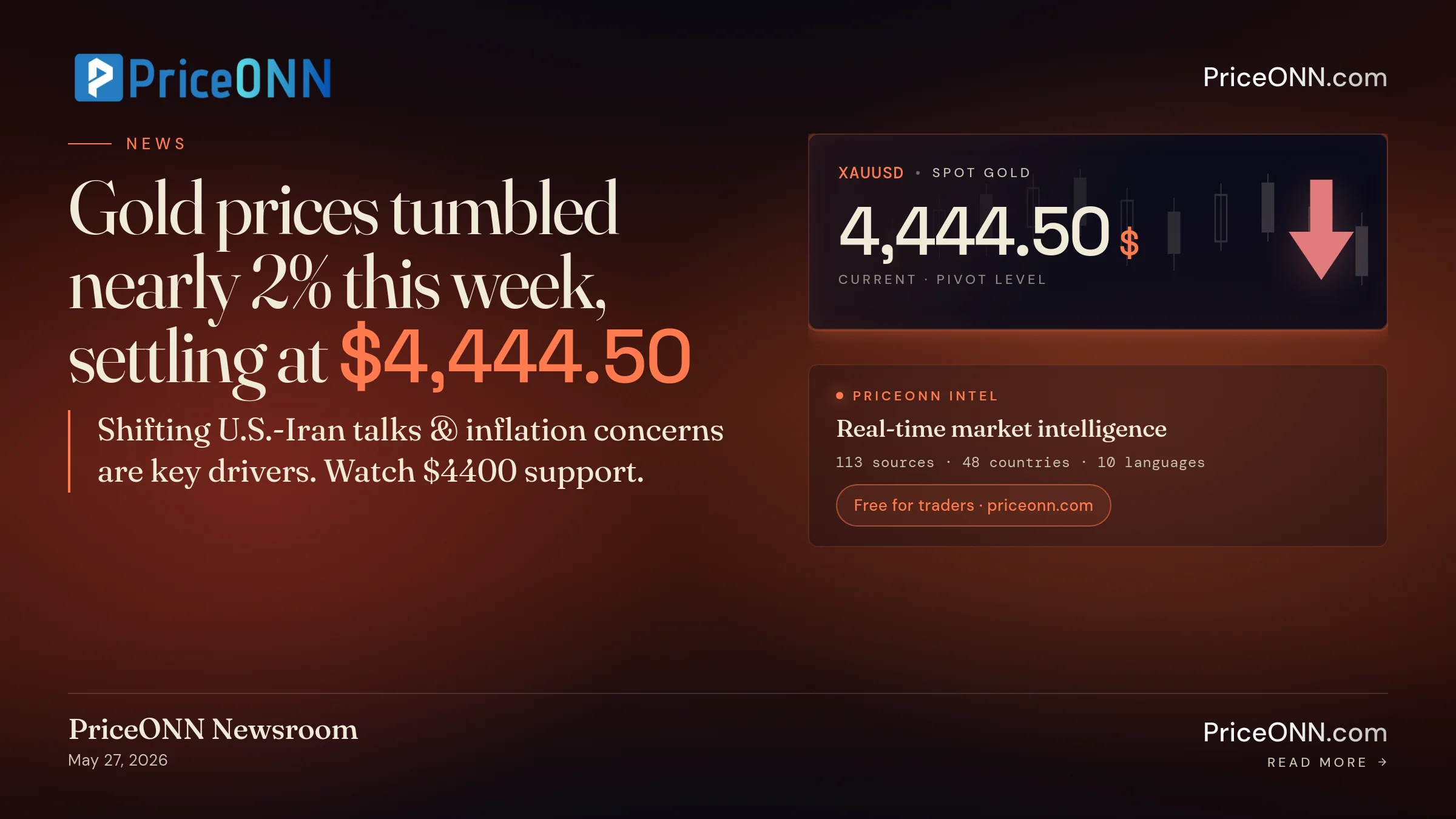
Gold prices have experienced a sharp decline this week, with the June Comex contract tumbling by 1.28% to settle at $4,444.50 per troy ounce. This significant move represents a roughly 2% drop over the past few trading sessions and underscores the volatile nature of the precious metal in response to geopolitical developments and monetary policy expectations.
Market Context
The yellow metal faced considerable selling pressure throughout the week, extending losses from previous sessions. The primary driver appears to be a delicate dance between ongoing diplomatic efforts to de-escalate tensions between the United States and Iran, and persistent concerns about inflation. While a ceasefire in the broader West Asia conflict has largely held since early April, the path to a comprehensive peace deal remains uncertain. The persistent blockade on the vital Strait of Hormuz and underlying inflationary pressures have weighed heavily on asset values, pushing investors away from safe-haven assets like gold. Silver, a close indicator for gold, also saw a sharp downturn, with its June contract dropping 2.08% to close at $74.755 per troy ounce.
Analysis & Drivers
The market's reaction has been a complex interplay of factors. Firstly, renewed optimism, albeit cautious, surrounding potential U.S.-Iran diplomatic progress has diminished gold's safe-haven appeal. Reports of U.S. forces conducting strikes against Iranian missile sites and mine-laying vessels within the Strait of Hormuz initially injected volatility, but the overarching narrative has shifted towards the possibility of extended ceasefire talks. This diplomatic maneuvering, even with lingering disagreements over Iran's nuclear program and frozen financial assets, has led traders to price in a reduced geopolitical risk premium.
Secondly, the specter of rising oil prices and subsequent inflation continues to influence market sentiment. While oil benchmarks like Brent crude and WTI futures saw sharp declines this week (Brent down 3.6%, WTI down 4.4%) on hopes of a U.S.-Iran deal, the underlying inflationary pressures remain a key concern for central banks. Analysts note that if inflation proves more persistent, central banks, particularly the U.S. Federal Reserve, may be compelled to maintain a hawkish stance or even implement further monetary tightening. Such a scenario typically puts pressure on non-yielding assets like gold.
Adding to the geopolitical complexity, statements from Iranian leadership, including warnings of retaliation and claims of engaging hostile aircraft, continue to add an element of risk, preventing a complete collapse in safe-haven demand. However, for now, the market appears to be prioritizing the potential for de-escalation over immediate conflict escalation.
Trader Implications
Traders should closely monitor the developments in U.S.-Iran diplomatic talks. Any concrete progress towards a peace accord could exert further downward pressure on gold, potentially testing key support levels. Conversely, a breakdown in negotiations or a resurgence of direct military confrontation could rapidly reverse the current trend, sending gold prices higher. Key levels to watch for gold include the recent lows around $4,444 and the subsequent support at $4,400. On the upside, a break above the $4,500 mark would be needed to signal a potential reversal.
The upcoming U.S. Personal Consumption Expenditure (PCE) data, a key inflation gauge, will also be critical. Stronger-than-expected inflation figures could reignite rate hike fears, offering some support to gold. However, the dominant narrative this week has been the shift away from immediate geopolitical conflict, leading to a bearish sentiment for the precious metal. Traders should remain vigilant for any shifts in central bank rhetoric or significant geopolitical escalations.
Outlook
The immediate outlook for gold remains subdued, contingent on the trajectory of U.S.-Iran negotiations and inflation data. While the potential for de-escalation has pressured prices, the underlying inflationary concerns and the complex regional dynamics mean that significant volatility is likely to persist. A sustained diplomatic breakthrough could see gold test lower price levels, while any renewed tensions could quickly propel it upwards. Traders should approach the market with caution, focusing on key technical levels and event-driven catalysts.
Frequently Asked Questions
What caused the recent drop in gold prices?
Gold prices dropped primarily due to cautious optimism surrounding U.S.-Iran diplomatic efforts and concerns that persistent inflation could lead to further central bank interest rate hikes. The June Comex gold contract fell to $4,444.50 per troy ounce.
What are the key support and resistance levels for gold?
Traders should watch the support levels around $4,444 and $4,400. A significant move upwards would require breaking through the resistance at $4,500 to indicate a trend reversal.
What is the short-term outlook for gold prices?
The short-term outlook for gold is subdued, heavily dependent on the progress of U.S.-Iran peace talks and upcoming inflation data. Any renewed geopolitical tensions could quickly reverse the current downward trend.
Track markets in real-time
Empower your investment decisions with AI-powered analysis, technical indicators and real-time price data.
Join Our Telegram Channel
Get breaking market news, AI analysis and trading signals delivered instantly to your Telegram.
Join Channel PriceONN News
Gold price (XAU/USD) is up 1.5% to near $4,067 during the European trading session on Tuesday. The precious metal outperforms as the rally in oil prices has stalled, with investors turning confident that negotiations between the United States (US) and Iran towards peace have resumed.
PriceONN News
The Gold price turns negative on Wednesday, even though the last two US inflation reports showed that prices are dropping, though developments in the Middle East sent energy prices higher. At the time of writing, the XAU/USD traded at $4,034, down some 0.53%.
PriceONN News
(RTTNews) - Gold prices have edged higher on Friday, partially offsetting the losses from yesterday's plunge after crude oil prices plummeted, lowering both oil-linked inflation concerns and the consequential expectations of an interest-rate hike by the U.S. Federal Reserve.
PriceONN News
(RTTNews) - Gold prices fell from a two-week high on Thursday as escalating West Asia tensions rekindled inflation fears and clouded the outlook for interest rates.
PriceONN News
(RTTNews) - Gold prices traded higher on Wednesday, extending gains for a fourth consecutive session and hitting a two-week high as investors reacted to escalating Middle East tensions and looked ahead to next week's Federal Reserve meeting.
PriceONN News
Gold (XAU/USD) rallies to an over two-week high, around the $4,140-$4,141 area, during the Asian session on Wednesday amid hopes that US-Iran diplomacy could ease energy prices and temper hawkish US Federal Reserve (Fed) expectations.
PriceONN News
Gold (XAU/USD) edges higher on Tuesday as buying interest around the $4,000 psychological level supports prices, while traders assess developments in the Middle East and their potential economic fallout. At the time of writing, XAU/USD trades around $4,058, up 1.27% on the day.
PriceONN News
Gold (XAU/USD) regains positive traction following the previous day's two-way price moves, though it struggles to capitalize on the move and trades below the $4,050 level during the Asian session on Tuesday.
PriceONN News
Gold (XAU/USD) trades in a volatile range on Monday as markets react to conflicting headlines from the Middle East. At the time of writing, XAU/USD trades around $4,010, little changed on the day after climbing to an intra-day high of $4,040.
PriceONN News
Silver price (XAG/USD) trades 1.33% lower to near $58.00 during the European trading session on Thursday. The white metal faces selling pressure as elevated energy prices due to renewed aggression between the United States (US) and Iran have de-anchored inflation expectations again.
PriceONN News
(RTTNews) - Gold prices were sharply lower on Tuesday as traders waited for the Federal Reserve policy decision.
PriceONN News
(RTTNews) - Gold prices have advanced on Monday, extending the gains from Friday's session as a pause on mutual attacks by both the U.S. and Iran eased escalation tensions in the ongoing gulf crisis. Expectations of a tighter monetary policy in the U.S. diminished amid a freefall