
Gold Dips Amid Inflation Fears and Strait of Hormuz Uncertainty

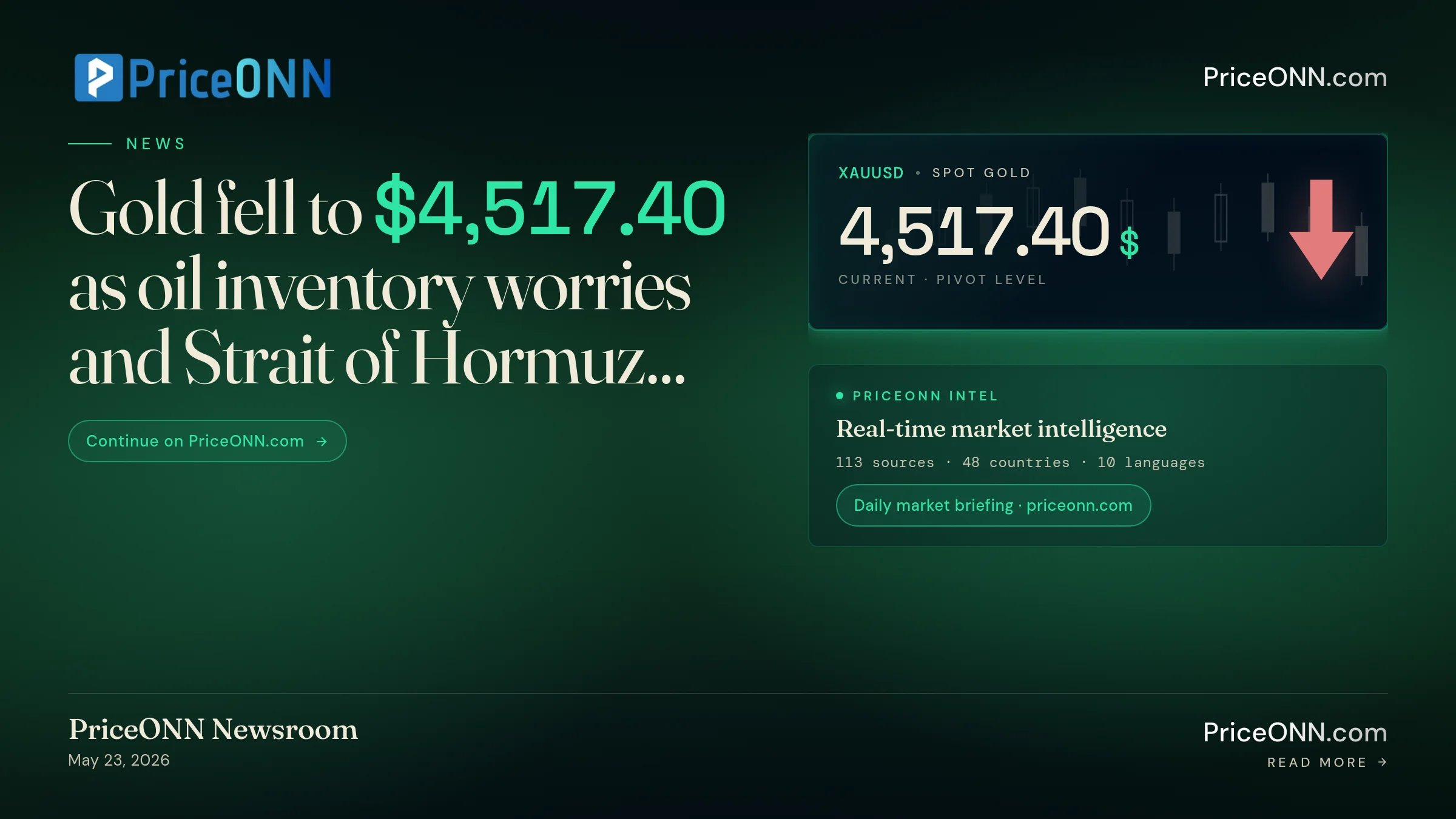
Gold prices experienced a notable decline on Friday, as a complex interplay of geopolitical developments and supply-side anxieties pressured the safe-haven asset. While diplomatic efforts between the United States and Iran offered a glimmer of de-escalation, these were largely overshadowed by persistent worries regarding crude oil inventories and the critical Strait of Hormuz shipping lane remaining disrupted.
Market Context: Inflationary Headwinds Trump Diplomatic Progress
The market's focus shifted towards potential inflationary pressures stemming from supply chain disruptions. The extended delay in reopening the Strait of Hormuz, a crucial artery for global oil trade, heightened concerns about energy supply and, consequently, broader price stability. This risk-off sentiment, driven by inflation fears, weighed heavily on gold. The front-month Comex Gold contract for June delivery saw a decrease of $25.10, settling at $4,517.40 per troy ounce, representing a 0.55% slide. Similarly, the precious metal's sister commodity, silver, also retreated. The June silver contract on Comex lost $0.540, trading down 0.71% at $75.932 per troy ounce.
Analysis and Drivers: Geopolitics and Oil Supply in Focus
Developments in U.S.-Iran relations provided a mixed backdrop. Reports indicated that negotiations were making "some progress," according to statements from a senior U.S. official, with a Qatari team reportedly mediating. The aim was to de-escalate tensions and address outstanding issues. However, conflicting information regarding Iran's nuclear program added layers of uncertainty. Initial reports of Iran's refusal to move enriched uranium outside the country were later dismissed by some sources as incorrect propaganda, citing senior Iranian officials. Meanwhile, geopolitical stances remained firm, with Israeli leadership reiterating the necessity of eliminating Iran's nuclear weapons capability for any resolution. President Trump publicly stated the U.S. would secure and potentially destroy enriched uranium rather than allow Iran to possess it. This diplomatic ambiguity, coupled with the tangible threat of oil supply disruptions from the Strait of Hormuz, created a potent cocktail of market uncertainty. The market's reaction suggests that immediate supply-side inflation risks, particularly concerning energy, are currently a more dominant driver for gold than the potential long-term impact of diplomatic breakthroughs.
Trader Implications: Watching Key Levels and Inflation Data
Traders will be closely monitoring the situation at the Strait of Hormuz for any definitive signs of resolution. A sustained closure or further escalation in the region could propel gold prices higher as inflation fears intensify. Key support levels for gold are now being watched around the $4,500 mark, with a decisive break below this level potentially signaling further downside. Conversely, any concrete de-escalation in U.S.-Iran tensions or a swift reopening of the Strait could lead to a temporary pullback in gold, offering potential buying opportunities for those anticipating a longer-term rally. The upcoming economic data releases, particularly inflation indicators such as CPI and PPI, will be crucial in determining the market's conviction regarding inflationary pressures. A hawkish shift in central bank rhetoric, spurred by rising inflation, would further support gold. Traders should maintain a cautious approach, hedging against potential volatility driven by geopolitical headlines and energy market fluctuations.
Outlook: Volatility Expected as Inflation and Geopolitics Collide
The outlook for gold remains complex, with both bullish and bearish factors at play. While diplomatic progress could offer some respite, the persistent threat of inflation, amplified by energy supply concerns, provides a strong underlying bid for the precious metal. Traders should brace for continued volatility as these competing narratives unfold. The market's sensitivity to developments in the Middle East and U.S. monetary policy expectations will likely dictate price direction in the short to medium term.
Frequently Asked Questions
What is the immediate impact of the Strait of Hormuz situation on gold prices?
The prolonged disruption to the Strait of Hormuz has heightened concerns about crude oil supply, fueling inflation fears and contributing to gold's recent slide. A sustained closure could push gold prices towards the $4,500 support level, or even higher if inflation expectations significantly increase.
How are U.S.-Iran negotiations influencing the gold market?
While there are reports of progress in U.S.-Iran talks, conflicting information and firm stances from key players create uncertainty. This ambiguity prevents a strong bullish sentiment for gold, with markets currently prioritizing immediate inflation risks over potential future de-escalation.
What key factors should traders watch for gold in the coming week?
Traders should closely monitor developments regarding the Strait of Hormuz, any further U.S.-Iran diplomatic updates, and upcoming U.S. inflation data (CPI, PPI). Key price levels to watch for gold are the $4,500 support and recent highs near $4,550.
Track markets in real-time
Empower your investment decisions with AI-powered analysis, technical indicators and real-time price data.
Join Our Telegram Channel
Get breaking market news, AI analysis and trading signals delivered instantly to your Telegram.
Join Channel PriceONN News
(RTTNews) - Gold prices have edged higher on Friday, partially offsetting the losses from yesterday's plunge after crude oil prices plummeted, lowering both oil-linked inflation concerns and the consequential expectations of an interest-rate hike by the U.S. Federal Reserve.
PriceONN News
(RTTNews) - Gold prices fell from a two-week high on Thursday as escalating West Asia tensions rekindled inflation fears and clouded the outlook for interest rates.
PriceONN News
Gold price (XAU/USD) is up 1.5% to near $4,067 during the European trading session on Tuesday. The precious metal outperforms as the rally in oil prices has stalled, with investors turning confident that negotiations between the United States (US) and Iran towards peace have resumed.
PriceONN News
The Gold price turns negative on Wednesday, even though the last two US inflation reports showed that prices are dropping, though developments in the Middle East sent energy prices higher. At the time of writing, the XAU/USD traded at $4,034, down some 0.53%.
PriceONN News
(RTTNews) - Gold prices were sharply lower on Tuesday as traders waited for the Federal Reserve policy decision.
PriceONN News
(RTTNews) - Gold prices have advanced on Monday, extending the gains from Friday's session as a pause on mutual attacks by both the U.S. and Iran eased escalation tensions in the ongoing gulf crisis. Expectations of a tighter monetary policy in the U.S. diminished amid a freefall
PriceONN News
(RTTNews) - Gold prices traded higher on Wednesday, extending gains for a fourth consecutive session and hitting a two-week high as investors reacted to escalating Middle East tensions and looked ahead to next week's Federal Reserve meeting.
PriceONN News
Gold (XAU/USD) rallies to an over two-week high, around the $4,140-$4,141 area, during the Asian session on Wednesday amid hopes that US-Iran diplomacy could ease energy prices and temper hawkish US Federal Reserve (Fed) expectations.
PriceONN News
Gold (XAU/USD) edges higher on Tuesday as buying interest around the $4,000 psychological level supports prices, while traders assess developments in the Middle East and their potential economic fallout. At the time of writing, XAU/USD trades around $4,058, up 1.27% on the day.
PriceONN News
Gold (XAU/USD) regains positive traction following the previous day's two-way price moves, though it struggles to capitalize on the move and trades below the $4,050 level during the Asian session on Tuesday.
PriceONN News
Gold (XAU/USD) trades in a volatile range on Monday as markets react to conflicting headlines from the Middle East. At the time of writing, XAU/USD trades around $4,010, little changed on the day after climbing to an intra-day high of $4,040.
PriceONN News
(RTTNews) - Gold was little changed on Monday, reversing early losses as the dollar eased and risk currencies rebounded on signs of renewed diplomatic efforts between the United States and Iran.