
Why Did Gold Slip Below $4500 Amid US-Iran Tensions and Oil Price Plunge?

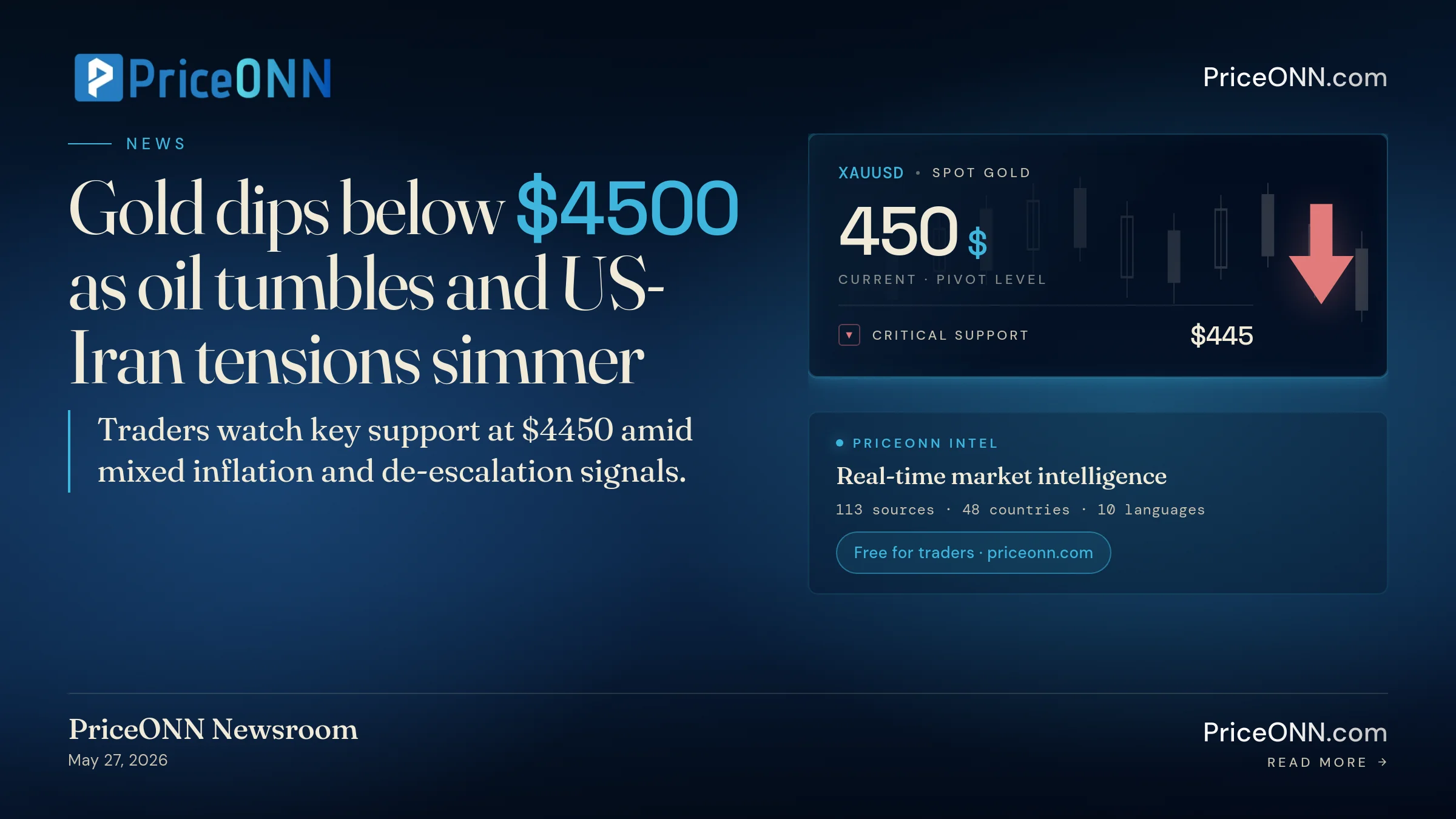
Gold prices experienced a notable decline, trading below $4,500 per ounce on Wednesday. This downward movement extended losses from the prior session, driven by a confluence of factors including falling oil prices and persistent geopolitical anxieties surrounding US-Iran relations. The precious metal, often seen as a safe-haven asset, is navigating a complex market environment where inflation expectations clash with potential diplomatic breakthroughs.
Market Context
Spot gold saw a 0.4 percent decline, reaching $4,490.29 per ounce, while U.S. gold futures for August delivery dipped 0.3 percent to settle at $4,522.70. This pressure on gold comes as oil benchmarks experienced a sharp sell-off. August Brent crude futures dropped 3.6 percent to $93.22 per barrel, and July WTI crude futures plunged 4.4 percent to close at $89.78. The simultaneous moves in gold and oil highlight the intricate interplay between commodity prices, geopolitical risks, and monetary policy expectations that are shaping market sentiment.
Analysis & Drivers
The market’s focus has been divided between concerns over potential oil-driven inflation and emerging hopes for a de-escalation in US-Iran tensions. While rising oil prices typically fuel inflation fears, prompting central banks like the Federal Reserve to consider tighter monetary policy – a negative for non-yielding assets like gold – recent developments suggest a potential diplomatic path. Reports indicate that the United States and Iran might be moving closer to a resolution, despite ongoing military actions in the Strait of Hormuz. This optimism, however fragile, is tempering the inflation narrative and reducing the immediate safe-haven demand for gold. Lingering geopolitical friction, including Iran's accusations of ceasefire breaches and warnings of retaliation, alongside reports of U.S. forces striking missile sites and vessels, adds a layer of complexity. The potential for a 60-day ceasefire extension is being weighed against disagreements over Iran's frozen assets and maritime passage rights.
Trader Implications
Traders are closely monitoring the developments in the Strait of Hormuz and the U.S. dollar index, which held firm on anticipation of key economic data. The immediate outlook for gold hinges on whether diplomatic efforts gain traction or if renewed escalation occurs. Key support levels for gold are being tested, with a sustained break below $4,450 potentially signaling further downside. Conversely, any significant geopolitical flare-up or unexpected inflation data could trigger a reversal. Investors should watch for statements from U.S. and Iranian officials, as well as upcoming U.S. economic indicators, particularly those related to inflation and consumer spending, which could influence Federal Reserve policy. The interplay between commodity prices and central bank reactions remains a critical factor.
Outlook
The path forward for gold remains uncertain, caught between the dual forces of geopolitical risk and potential diplomatic progress. While a de-escalation in US-Iran tensions could weigh on gold prices by reducing safe-haven demand and dampening inflation expectations, any resurgence in conflict could quickly push prices higher. Market participants will be keenly watching the progress of any potential ceasefire extension and the implications for global energy markets and broader inflation trends. Upcoming U.S. economic data will be crucial in shaping the Federal Reserve's policy stance, which will, in turn, impact gold's trajectory in the coming weeks.
Frequently Asked Questions
What is the current price of gold and why is it falling?
Gold is currently trading below $4,500 per ounce, with spot prices reaching $4,490.29. The decline is attributed to falling oil prices and cautious optimism surrounding potential US-Iran de-escalation, which reduces safe-haven demand.
What is the significance of the US-Iran tensions for commodity markets?
Tensions in the Strait of Hormuz directly impact oil supply concerns. While U.S. military actions have occurred, hopes for a ceasefire extension are tempering oil prices. Any escalation could disrupt shipping routes and send oil and consequently gold prices higher.
What key levels should traders watch for gold?
Traders should watch the $4,450 support level for gold. A break below this could lead to further declines towards $4,400. Conversely, a sustained move above $4,550 might signal a renewed upward trend.
Track markets in real-time
Empower your investment decisions with AI-powered analysis, technical indicators and real-time price data.
Join Our Telegram Channel
Get breaking market news, AI analysis and trading signals delivered instantly to your Telegram.
Join Channel PriceONN News
(RTTNews) - Gold prices fell from a two-week high on Thursday as escalating West Asia tensions rekindled inflation fears and clouded the outlook for interest rates.
PriceONN News
The Gold price turns negative on Wednesday, even though the last two US inflation reports showed that prices are dropping, though developments in the Middle East sent energy prices higher. At the time of writing, the XAU/USD traded at $4,034, down some 0.53%.
PriceONN News
(RTTNews) - Gold prices were sharply lower on Tuesday as traders waited for the Federal Reserve policy decision.
PriceONN News
(RTTNews) - Gold prices have advanced on Monday, extending the gains from Friday's session as a pause on mutual attacks by both the U.S. and Iran eased escalation tensions in the ongoing gulf crisis. Expectations of a tighter monetary policy in the U.S. diminished amid a freefall
PriceONN News
(RTTNews) - Gold prices have edged higher on Friday, partially offsetting the losses from yesterday's plunge after crude oil prices plummeted, lowering both oil-linked inflation concerns and the consequential expectations of an interest-rate hike by the U.S. Federal Reserve.
PriceONN News
Gold (XAU/USD) rallies to an over two-week high, around the $4,140-$4,141 area, during the Asian session on Wednesday amid hopes that US-Iran diplomacy could ease energy prices and temper hawkish US Federal Reserve (Fed) expectations.
PriceONN News
Gold (XAU/USD) edges higher on Tuesday as buying interest around the $4,000 psychological level supports prices, while traders assess developments in the Middle East and their potential economic fallout. At the time of writing, XAU/USD trades around $4,058, up 1.27% on the day.
PriceONN News
Gold price (XAU/USD) is up 1.5% to near $4,067 during the European trading session on Tuesday. The precious metal outperforms as the rally in oil prices has stalled, with investors turning confident that negotiations between the United States (US) and Iran towards peace have resumed.
PriceONN News
Gold (XAU/USD) regains positive traction following the previous day's two-way price moves, though it struggles to capitalize on the move and trades below the $4,050 level during the Asian session on Tuesday.
PriceONN News
Gold (XAU/USD) trades in a volatile range on Monday as markets react to conflicting headlines from the Middle East. At the time of writing, XAU/USD trades around $4,010, little changed on the day after climbing to an intra-day high of $4,040.
PriceONN News
(RTTNews) - Gold was little changed on Monday, reversing early losses as the dollar eased and risk currencies rebounded on signs of renewed diplomatic efforts between the United States and Iran.
PriceONN News
(RTTNews) - Gold prices have tumbled on Thursday as the Middle East crisis deepens after Iran-backed Houthi militants of Yemen attacked two Saudi Arabian vessels in the Red Sea, raising concerns of intense oil supply disruption for an extended period. The possibility of an intere