
Why Did Gold Slip Below $4,500 Despite Strait of Hormuz Tensions?

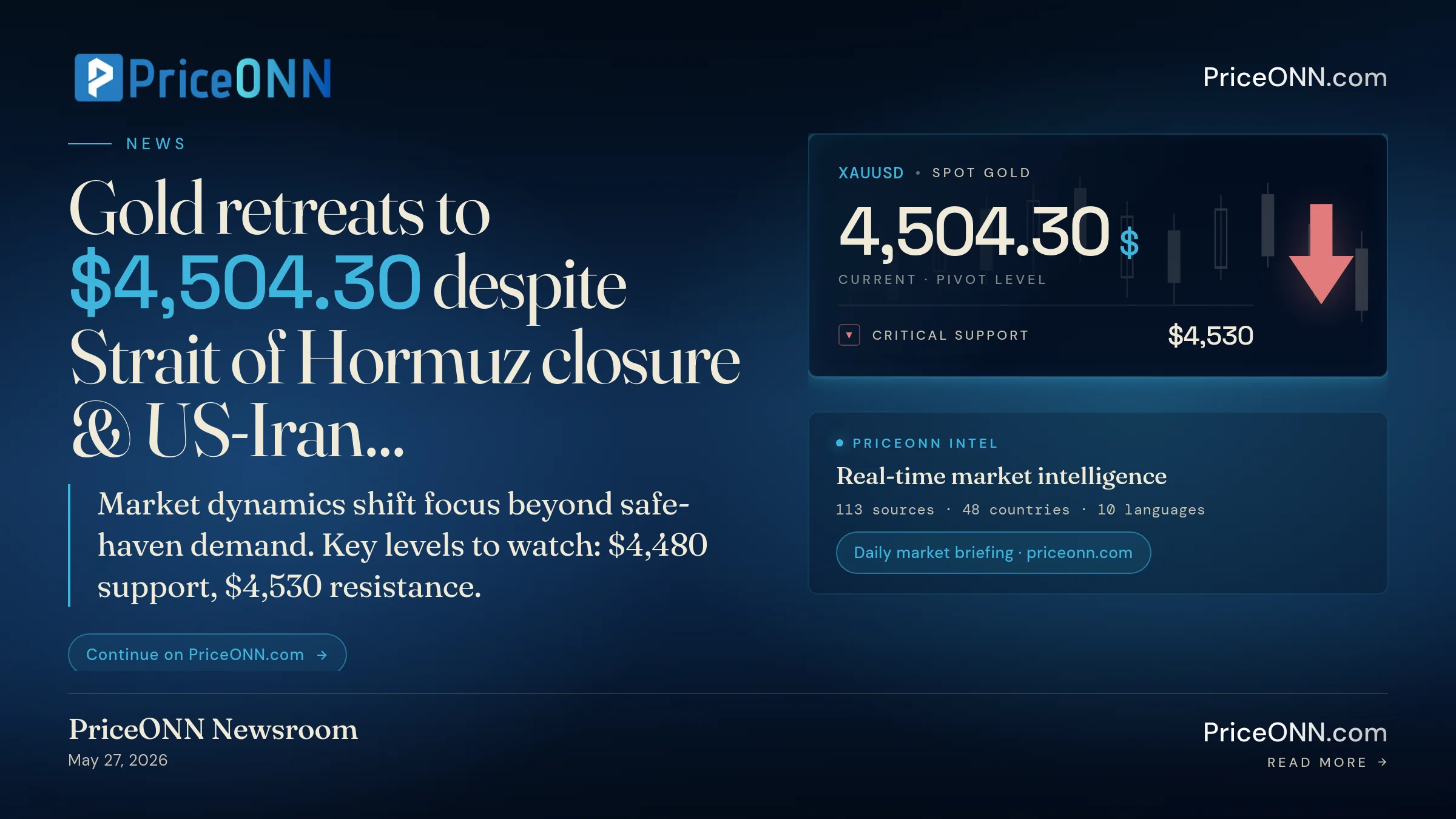
Gold prices experienced a notable dip on Tuesday, settling below the key $4,500 psychological level, even as significant geopolitical events unfolded. The precious metal, typically a beneficiary of safe-haven demand, slid 0.42% to $4,504.30 per troy ounce for June futures. This decline occurred despite the continued closure of the Strait of Hormuz, a critical artery for global energy transit, and ongoing military actions between the U.S. and Iran.
Market Context
The precious metal's move lower on Tuesday marked a departure from its traditional role as a safe haven. While tensions between the U.S. and Iran persist, and the vital Strait of Hormuz remains impassable for oil shipments, market participants appeared to look beyond these immediate risks. This suggests that other factors are currently exerting a stronger influence on gold's price trajectory. In contrast to gold's retreat, silver futures for June delivery managed to eke out a gain, climbing 0.51% to end the session at $76.320 per troy ounce. This divergence between the two major precious metals highlights differing market sentiment and specific drivers for each.
Analysis & Drivers
The complex geopolitical landscape, now in its 88th day, has been a mix of diplomatic maneuvering and military escalation. The closure of the Strait of Hormuz, a direct consequence of the hostilities, has severely disrupted energy flows. Adding another layer of complexity, U.S. President Trump's directives regarding naval blockades and the Abraham Accords, alongside his cautious approach to a potential ceasefire deal, have created uncertainty. While whispers of a deal involving a ceasefire extension and the reopening of the Strait circulated over the weekend, the President indicated a preference for a slower resolution, emphasizing the removal of enriched uranium from Iran. This stance appears to clash with hardline factions within Iran. Amidst these diplomatic crosscurrents, the U.S. conducted limited strikes, described as self-defense actions, near Bandar Abbas and at Iranian missile launch sites. Market data shows these events, while significant, did not trigger the expected flight to safety for gold, indicating that inflationary concerns or other economic data may be taking precedence in trader calculations.
Trader Implications
Traders should monitor the evolving diplomatic communications closely, as any clear signs of de-escalation or further escalation could rapidly shift market sentiment. The $4,500 level now acts as a key psychological support for gold; a sustained break below this could open the door for further downside. Conversely, a clear resolution to the Strait of Hormuz issue or a significant de-escalation in military actions might remove a primary bullish catalyst for gold. The diverging performance of silver, which is more sensitive to industrial demand, suggests that investors are weighing different risk profiles. Key levels to watch for gold include immediate support at $4,480 and resistance around $4,530. For silver, a hold above $75.50 would be constructive, with upside targets near $77.00.
Outlook
The immediate outlook for gold remains uncertain, caught between geopolitical risks and potential shifts in monetary policy expectations. While the Strait of Hormuz situation provides a backdrop of potential supply disruption, the lack of a strong safe-haven bid suggests that inflationary pressures or broader economic concerns are currently dominating market focus. Investors will be keenly watching upcoming economic data releases from major economies and any further statements from central banks regarding interest rate policy. The precious metal's ability to reclaim and hold above $4,500 will be a critical indicator of underlying market strength.
Frequently Asked Questions
Why did gold prices fall despite the Strait of Hormuz closure?
Gold prices fell to $4,504.30 as market participants may be prioritizing other economic concerns, such as inflation, over immediate geopolitical risks. The lack of a strong safe-haven bid suggests these other factors are currently more influential.
What is the significance of the Strait of Hormuz closure for energy markets?
The Strait of Hormuz is a critical chokepoint for global oil and energy transit. Its closure significantly disrupts supply routes, potentially leading to higher energy prices, though this impact is not currently translating into a strong rally for gold.
What are the key price levels to watch for gold and silver?
For gold, traders should monitor immediate support at $4,480 and resistance around $4,530. Silver's key level to hold is $75.50, with potential upside targets near $77.00.
Track markets in real-time
Empower your investment decisions with AI-powered analysis, technical indicators and real-time price data.
Join Our Telegram Channel
Get breaking market news, AI analysis and trading signals delivered instantly to your Telegram.
Join Channel PriceONN News
Gold price (XAU/USD) is up 1.5% to near $4,067 during the European trading session on Tuesday. The precious metal outperforms as the rally in oil prices has stalled, with investors turning confident that negotiations between the United States (US) and Iran towards peace have resumed.
PriceONN News
(RTTNews) - Gold prices have edged higher on Friday, partially offsetting the losses from yesterday's plunge after crude oil prices plummeted, lowering both oil-linked inflation concerns and the consequential expectations of an interest-rate hike by the U.S. Federal Reserve.
PriceONN News
(RTTNews) - Gold prices traded higher on Wednesday, extending gains for a fourth consecutive session and hitting a two-week high as investors reacted to escalating Middle East tensions and looked ahead to next week's Federal Reserve meeting.
PriceONN News
Gold (XAU/USD) rallies to an over two-week high, around the $4,140-$4,141 area, during the Asian session on Wednesday amid hopes that US-Iran diplomacy could ease energy prices and temper hawkish US Federal Reserve (Fed) expectations.
PriceONN News
Gold (XAU/USD) edges higher on Tuesday as buying interest around the $4,000 psychological level supports prices, while traders assess developments in the Middle East and their potential economic fallout. At the time of writing, XAU/USD trades around $4,058, up 1.27% on the day.
PriceONN News
Gold (XAU/USD) regains positive traction following the previous day's two-way price moves, though it struggles to capitalize on the move and trades below the $4,050 level during the Asian session on Tuesday.
PriceONN News
Gold (XAU/USD) trades in a volatile range on Monday as markets react to conflicting headlines from the Middle East. At the time of writing, XAU/USD trades around $4,010, little changed on the day after climbing to an intra-day high of $4,040.
PriceONN News
The Gold price turns negative on Wednesday, even though the last two US inflation reports showed that prices are dropping, though developments in the Middle East sent energy prices higher. At the time of writing, the XAU/USD traded at $4,034, down some 0.53%.
PriceONN News
(RTTNews) - Gold prices were sharply lower on Tuesday as traders waited for the Federal Reserve policy decision.
PriceONN News
(RTTNews) - Gold prices have advanced on Monday, extending the gains from Friday's session as a pause on mutual attacks by both the U.S. and Iran eased escalation tensions in the ongoing gulf crisis. Expectations of a tighter monetary policy in the U.S. diminished amid a freefall
PriceONN News
(RTTNews) - Gold prices have tumbled on Thursday as the Middle East crisis deepens after Iran-backed Houthi militants of Yemen attacked two Saudi Arabian vessels in the Red Sea, raising concerns of intense oil supply disruption for an extended period. The possibility of an intere
PriceONN News
(RTTNews) - Gold prices fell from a two-week high on Thursday as escalating West Asia tensions rekindled inflation fears and clouded the outlook for interest rates.