
Gold Tests 4,500 Support Amid Liquidity Squeeze and Forced Selling


Gold has found a tentative footing near the 4,500 mark following a brutal and disorderly selloff witnessed yesterday. This sharp descent appears to have been largely triggered by a significant liquidity crunch, where market mechanics rather than core economic fundamentals dictated price action.
Market Context
While hawkish signals from major central banks, including the Federal Reserve, European Central Bank, Bank of England, and Bank of Japan, certainly exerted downward pressure on gold this week, the sheer magnitude and velocity of the price drop point towards a market dislocation. The yellow metal decisively broke below the psychologically significant 5,000 level, which acted as a catalyst for a cascade of margin calls on highly leveraged positions. This forced selling snowballed, triggering further liquidation rounds in a damaging cycle often characteristic of liquidity stress.
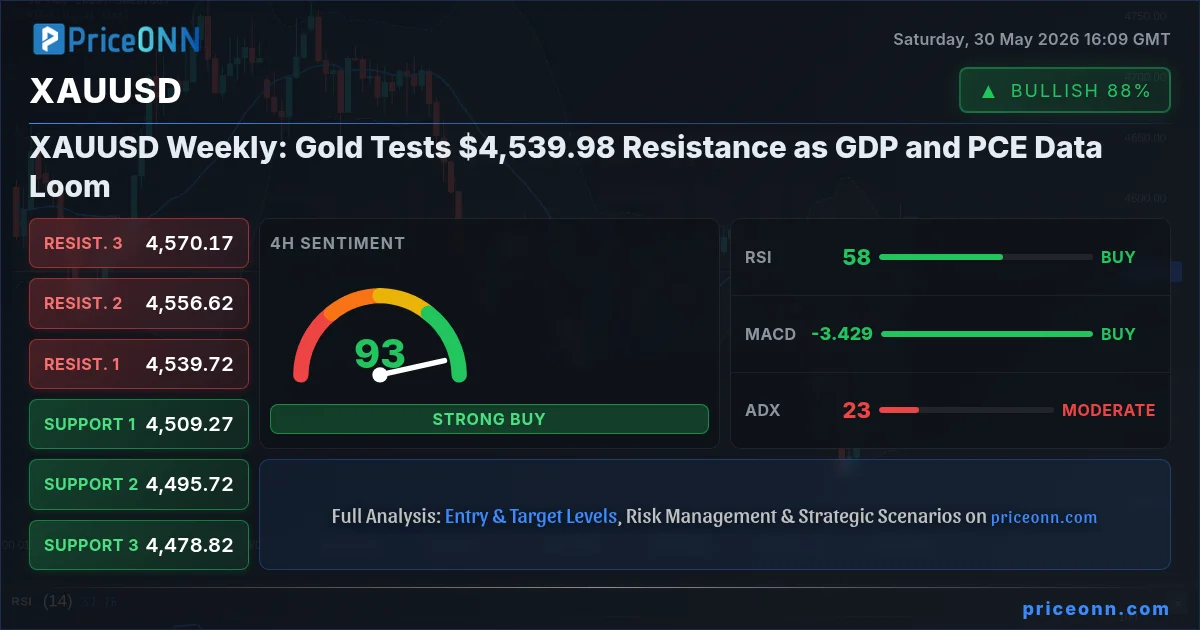
Adding to the selling pressure, substantial outflows were observed from major gold-backed exchange-traded funds. Significant redemptions from prominent funds underscore an aggressive unwinding of institutional positions. Intriguingly, this sharp selloff coincided with a softening U.S. Dollar, further reinforcing the narrative that liquidity constraints, not currency headwinds, were the primary driver of the dramatic price action.
Analysis & Drivers
The recent price action in gold highlights the fragility of markets when liquidity dries up. Central bank rhetoric, while typically a key driver for gold, took a backseat to the immediate pressures of forced deleveraging. The break below 5,000 was a critical technical and psychological failure, unleashing a wave of stop-loss orders and margin calls that overwhelmed buying interest. This type of cascade is a clear indicator of systemic liquidity issues, where the ability to execute trades at desired prices becomes severely impaired.
The substantial outflows from gold ETFs, such as GLD, indicate that institutional investors were actively reducing their exposure. This move away from gold, even as the U.S. Dollar weakened, is a telling sign that the selling was driven by a need for immediate liquidity across various asset classes, rather than a shift in long-term investment strategy or sentiment towards the precious metal itself. The fact that gold sold off despite dollar weakness suggests that the bid for physical gold or safe-haven assets was overshadowed by the urgent need to meet collateral calls or deleverage positions.
Trader Implications
With the most intense phase of forced selling likely behind us, gold is beginning to establish support in the vicinity of 4,500. This stabilization suggests that extreme selling pressure may have abated, potentially paving the way for a period of consolidation. Traders should closely monitor this 4,500 level as a key support zone. A decisive break below this could signal further downside, with the next significant psychological level being 4,000.
Conversely, if gold can hold above 4,500 and begin to form higher lows, it could indicate a bottoming process. Key resistance levels to watch on the upside would be the previous psychological barrier at 5,000, followed by any levels established during the ensuing consolidation phase. The current market sentiment is heavily influenced by liquidity conditions, making it crucial for traders to remain aware of broader financial market plumbing and potential contagion risks.
The interplay between the U.S. Dollar and gold may become more relevant again once the liquidity crisis subsides. However, for the immediate future, the focus remains on whether the 4,500 support can hold and if market participants will begin to re-enter positions on a more fundamental basis. Traders looking to enter long positions should exercise caution, perhaps waiting for clearer signs of a sustained recovery and confirmation of support at 4,500, or even a retest and hold of higher technical levels.
Outlook
The immediate outlook for gold hinges on the resolution of the liquidity squeeze and the sustainability of the current support around 4,500. If the forced selling has indeed exhausted itself, gold could enter a consolidation phase, potentially testing higher levels as market participants reassess fundamentals. However, the possibility of further volatility remains, especially if broader financial market stress re-emerges. The 4,000 level remains a potential target if the 4,500 support fails, indicating a deeper correction driven by ongoing liquidity concerns or a significant shift in central bank policy expectations.
Frequently Asked Questions
What caused the recent sharp decline in gold prices?
The primary driver was a significant liquidity crunch that triggered forced selling and margin calls, particularly after gold broke below 5,000. This market dislocation overwhelmed fundamental factors.
Is the 4,500 level a strong support for gold?
The 4,500 level is currently acting as a tentative support zone following the intense liquidation. Traders are watching closely to see if it holds, with a potential downside target at 4,000 if this support fails.
What should traders watch for in the coming days?
Traders should monitor the 4,500 support level for stability and signs of a potential bottoming process. Key resistance to watch on the upside is the 5,000 mark. Broader financial market liquidity conditions remain a critical factor.
Track markets in real-time
Empower your investment decisions with AI-powered analysis, technical indicators and real-time price data.
Join Our Telegram Channel
Get breaking market news, AI analysis and trading signals delivered instantly to your Telegram.
Join Channel PriceONN News
USDJPY has returned to the area of previous interventions. The ECB is moving towards a rate hike in June. The US dollar retreated on Friday amid new record highs for stock indices and rumours of amendments to the US-Iran agreement. However, tit-for-tat exchanges between the adversaries pushed the dollar index back into the support zone […] The post Yen Braces for a New Storm appeared first on ActionForex.
PriceONN News
Markets are pricing in a potential de-escalation in the US-Iran conflict, leading to a significant drop in crude oil prices and a weakening US Dollar as diplomatic efforts appear to be gaining traction.
PriceONN News
USD/CAD faces pressure as Canada's economy shows signs of stalling, with Q1 GDP contracting 0.1% and domestic demand weakening. This comes as trade negotiations and geopolitical shifts add layers of uncertainty.
PriceONN News
AUD/USD’s late break of 0.7183 resistance suggests that pullback from 0.7277 has already completed at 0.7076, after defending 55 D EMA. Initial bias is back on the upside this week for retesting 0.7277 high first. Firm break there will resume larger up trend. For now, risk will stay on the upside as long as 0.7076 […] The post AUD/USD Weekly Report appeared first on ActionForex.
PriceONN News
USD/CAD is showing signs of potential upward movement as Canada's economy grapples with a significant slowdown, marked by weak domestic demand and stalled investment, while trade negotiations loom large.
PriceONN News
Canada's economy showed signs of weakness in early 2026, but upcoming May jobs data is expected to reveal a moderate uplift. Analysts anticipate job growth of around 25,000 positions and a potential dip in the unemployment rate to 6.8%.
PriceONN News
The USD/JPY pair is flirting with the 160 level as stalled US-Iran negotiations and hawkish Federal Reserve rhetoric fuel inflation concerns. Traders are closely watching upcoming US Non-Farm Payrolls and Eurozone CPI data.
PriceONN News
EUR/USD stalled below 1.1660 as the US Dollar defied expectations, refusing to weaken despite reports of a US-Iran ceasefire extension. Market participants remain cautious, awaiting concrete confirmation and assessing lingering inflationary pressures.
PriceONN News
EUR/USD closed at 1.1640, showing resilience amid mixed signals. Easing US-Iran tensions initially pressured the dollar, but persistent inflation concerns and political ratification hurdles are keeping the greenback surprisingly steady.
PriceONN News
The USD/JPY pair is showing signs of upside exhaustion, struggling to overcome the 159.65 resistance level and trading below a key bullish trend line. This technical setup raises concerns about a potential pullback in the near term.
PriceONN News
The EUR/USD faces headwinds as core US PCE inflation unexpectedly rose to 3.3% year-over-year, reinforcing a 'higher for longer' interest rate narrative. Meanwhile, a US-Iran ceasefire extension boosted global risk appetite, potentially drawing capital away from safe-haven currencies.
PriceONN News
EUR/USD stabilized around 1.1640 as reports of a US-Iran ceasefire extension and potential Strait of Hormuz reopening eased inflation fears. However, the US Dollar's resilience suggests lingering caution among forex traders.