
Japanese Yen gains against US Dollar despite renewed geopolitical risks
 PriceONN Editorial Desk
Multi-source verification
PriceONN Editorial Desk
Multi-source verification

Global Currency Currents Shift
In a surprising turn of events, the Japanese Yen has managed to claw back ground against the US Dollar today. This upward movement for JPY occurs against a backdrop of simmering geopolitical concerns, a situation that typically sees investors flocking to safer havens or established global reserve currencies like the USD. The dollar's performance against other major currencies today was notably weak, with the New Zealand Dollar showing the most significant gain against it. This divergence highlights a complex market sentiment where traditional risk-off plays are not entirely dictating currency flows.
The US Dollar, officially the currency of the United States, plays a far more expansive role in the global economy. Its influence extends beyond American borders, serving as the de facto medium of exchange in numerous other nations. This global ubiquity is staggering; data from 2022 indicates it underpins over 88% of all international foreign exchange activity, translating to an average daily turnover of a colossal $6.6 trillion. Such dominance solidifies its position as the world's premier trading currency.
The Fed's Financial Levers
The trajectory of the US Dollar's value is intrinsically linked to the monetary policy decisions emanating from the Federal Reserve (the Fed). Established post World War II, and taking over global reserve status from the British Pound, the dollar's power was once anchored by gold. However, the 1971 Bretton Woods Agreement marked a departure from the gold standard, fundamentally altering the currency's backing. Today, its strength hinges on the Fed's dual mandate: maintaining price stability, which translates to controlling inflation, and promoting maximum employment.
The primary instrument the Fed wields to achieve these objectives is the adjustment of benchmark interest rates. When inflationary pressures mount and prices climb beyond the Fed's 2% target, the central bank typically raises interest rates. This action generally bolsters the dollar's value by making dollar-denominated assets more attractive. Conversely, if inflation dips below the target or unemployment figures rise significantly, the Fed might opt to lower rates, exerting downward pressure on the greenback.
Unconventional Monetary Tools
In more extreme economic circumstances, the Federal Reserve possesses additional, non-standard tools. When credit markets freeze up-a situation where banks hesitate to lend to one another due to fears of counterparty default-and lowering interest rates proves insufficient, the Fed can resort to quantitative easing (QE). This process involves injecting substantial liquidity into the financial system by purchasing assets, predominantly US government bonds, from financial institutions. Historically, QE has often correlated with a weakening US Dollar.
The inverse of QE is quantitative tightening (QT). This involves the Federal Reserve scaling back its asset purchases, allowing its bond holdings to mature without reinvesting the principal. This deliberate reduction in the central bank's balance sheet is typically viewed as a supportive factor for the US Dollar's strength.
Reading Between the Lines
The current market dynamic, with the Yen showing resilience against a broadly weaker Dollar despite escalating geopolitical risks, presents a curious scenario for traders. Typically, heightened global uncertainty prompts a flight to perceived safety, which often benefits the USD. However, the current data suggests other factors are at play, perhaps indicating a specific risk aversion that doesn't uniformly favor dollar assets, or perhaps a reassessment of the Fed's immediate policy path.
For investors and traders, this divergence is critical. It implies that standard risk-on/risk-off correlations may be temporarily disrupted. The US Dollar Index (DXY), which measures the dollar against a basket of major currencies, could see increased volatility. Furthermore, currencies of export-heavy nations, such as the Euro (EUR) and potentially even the Australian Dollar (AUD), might react more to global growth sentiment than direct dollar weakness. Traders should monitor upcoming economic data releases from both the US and Japan, looking for clues on inflation and employment trends that could influence future central bank policy. The real question is whether this Yen strength is a fleeting anomaly or the start of a sustained trend, especially if geopolitical events intensify.
Track markets in real-time
Empower your investment decisions with AI-powered analysis, technical indicators and real-time price data.
Join Our Telegram Channel
Get breaking market news, AI analysis and trading signals delivered instantly to your Telegram.
Join Channel PriceONN News
The US Dollar (USD) extends its losing streak for the third trading day on Friday amid signs of de-escalation in the ongoing clash between the United States (US) and Iran.
PriceONN News
European currencies are showing mixed performance as they attempt to stabilise following their recent decline and the release of the Federal Reserve’s latest meeting minutes. The minutes revealed growing concern over persistent inflationary pressures, with several policymakers supporting the possibility of an immediate interest rate increase, while the majority maintained a more cautious approach to […] The post European Currencies Seek Stability Amid Rising Geopolitical Tensions appeared first...
PriceONN News
Oil is back in the driver’s seat, and both the pound and the aussie are feeling its grip. The Bank of England held rates at 3.75% in June, but with UK inflation at 2.8% and crude oil climbing on renewed Middle East tensions, markets now lean towards a hike before year-end. Down under, the Reserve […] The post GBP/AUD Analysis: the Tug-Of-War Begins appeared first on ActionForex.
PriceONN News
Rumours of talks between the US and Iran are dragging down the USD index. The ECB intends to act decisively on raising interest rates. The US dollar continued to retreat following Donald Trump’s statement that Iran is seeking a deal. Investors have encountered such rhetoric from the US president many times since April, and each […] The post The Dollar: Things Are Heading Towards De-Escalation appeared first on ActionForex.
PriceONN News
The minutes from the Reserve Bank of Australia’s (RBA) June meeting, released on 30 June, suggested that policymakers are not yet ready to rule out further policy tightening. Board members noted persistent excess demand and broad-based inflationary pressures across the economy, leaving the door open for another interest rate increase if required. Against this backdrop, […] The post Australian Dollar Holds Above the Current Market Profile appeared first on ActionForex.
PriceONN News
The NZD/USD pair trades in positive territory around 0.5775 during the early European session on Friday. The New Zealand Dollar (NZD) gathers strength to its strongest level in three weeks against the US Dollar (USD) on a hawkish rate hike from the Reserve Bank of New Zealand (RBNZ).
PriceONN News
Silver price (XAG/USD) trades 0.4% higher to near $60.22 during the European trading session on Friday. The white metal gains as the US Dollar (USD) continues to remain under pressure amid hopes that the restart of the war between the United States (US) and Iran won’t long last.
PriceONN News
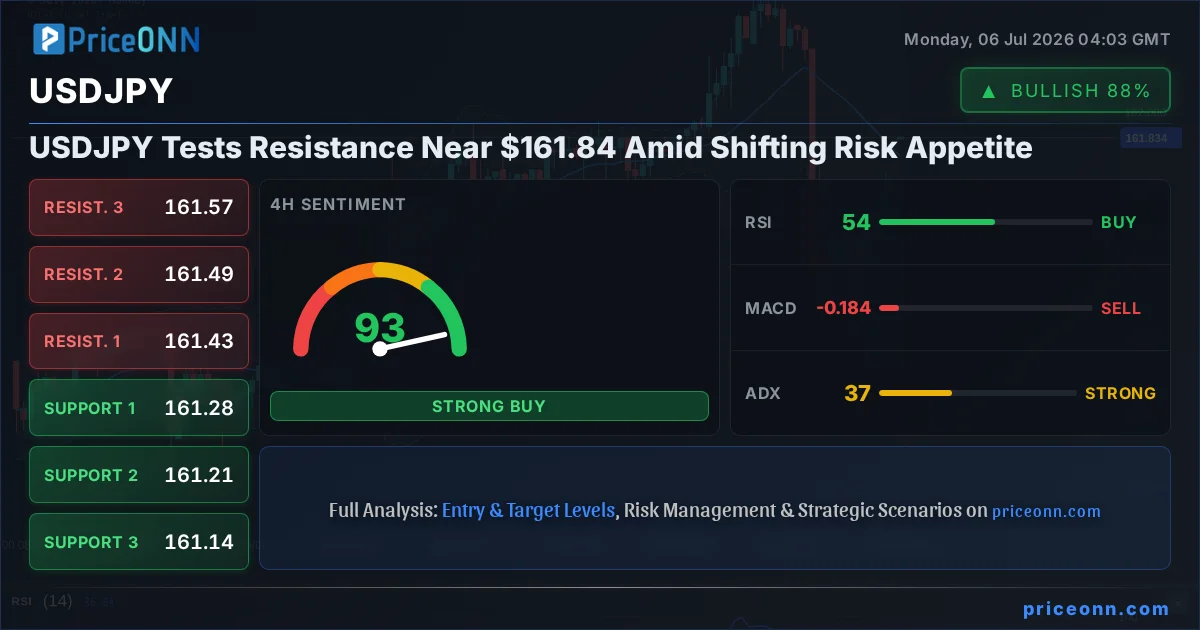
The USD/JPY pair tumbles to around 161.50 during the early European trading hours on Friday. The Japanese Yen (JPY) edges higher against the US Dollar (USD) after the reports that Japan plans to encourage pension funds to increase their holdings of domestic financial assets.
PriceONN News
The Swiss Franc (CHF) pares some of its early gains against the US Dollar (USD) during the early European trading session on Friday. The USD/CHF pair is 0.26% lower at around 0.8048 even after a slight recovery move.
PriceONN News
The Indian Rupee (INR) extends Thursday’s recovery against the US Dollar (USD) in the opening session on Friday. The USD/INR pair falls further to near 95.22 as the US Dollar weakens as the restart of the war in the Middle East between the United States (US) and Iran won’t be prolonged.
PriceONN News
The GBP/USD pair trades in positive territory around 1.3430 during the early European trading hours on Friday. The UK government leadership transition and growing expectations of further Bank of England (BoE) interest rate hikes underpin the British Pound (GBP) against the US Dollar (USD).
PriceONN News
The EUR/USD pair attracts some buyers for the third consecutive day and touches a fresh weekly high, around the 1.1460 area, during the Asian session on Friday.