
NZD/USD rises above 0.5850 on narrower-than-expected trade deficit
 PriceONN Editorial Desk
Multi-source verification
PriceONN Editorial Desk
Multi-source verification

Kiwi Gains Traction on Trade Data Surprise
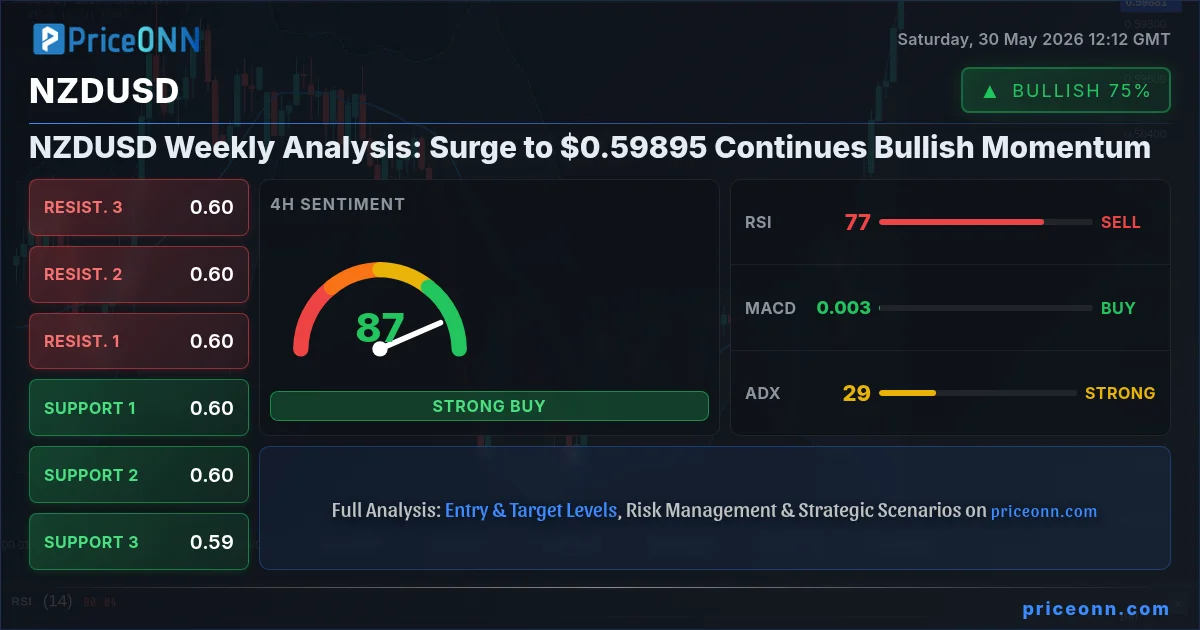
The New Zealand Dollar, affectionately known as the Kiwi, demonstrated surprising strength during Friday's Asian session, climbing to approximately 0.5880 against its US counterpart. This upward movement was directly linked to the latest trade balance figures, which revealed a deficit considerably smaller than economists had projected. Such data often serves as a potent catalyst for currency appreciation, especially when it defies negative expectations.
Understanding the forces that shape the Kiwi's trajectory involves more than just domestic economic indicators. Its performance is intricately tied to global economic sentiment and the health of key international markets. For instance, the economic vitality of China, New Zealand's largest trading partner, exerts a profound influence. A slowdown in the Chinese economy typically translates to reduced demand for New Zealand's exports, thereby dampening economic activity and putting downward pressure on the NZD.
Furthermore, the global prices of key commodities play a critical role. Dairy products form the backbone of New Zealand's export revenue. When international dairy prices surge, New Zealand's export earnings receive a substantial boost, positively impacting the nation's balance of payments and bolstering the currency's value. Conversely, a slump in dairy prices can have the opposite effect, creating headwinds for the Kiwi.
Monetary Policy and Market Sentiment's Role
The Reserve Bank of New Zealand (RBNZ) operates with a mandate to maintain inflation within a specific band, typically between 1% and 3% over the medium term, with a target midpoint of 2%. To achieve this, the central bank strategically adjusts interest rates. An environment of high inflation often prompts the RBNZ to hike interest rates. This policy tightening not only aims to cool domestic demand but also makes New Zealand government bonds more attractive to international investors due to higher yields. Such capital inflows can significantly strengthen the NZD.
Conversely, a lower interest rate environment, or expectations of rate cuts, tends to weaken the Kiwi. The divergence in interest rate policies between New Zealand and other major economies, particularly the United States, is a crucial determinant of the NZD/USD exchange rate. A widening interest rate differential in favor of New Zealand typically supports the pair.
Broader market sentiment also dictates the Kiwi's fortunes. During periods characterized by investor optimism and a general appetite for risk, often termed 'risk-on' environments, currencies like the NZD tend to perform well. This is because investors feel more comfortable allocating capital to assets perceived as higher-yielding but also carrying more risk, which often includes commodity-linked currencies. However, when global uncertainty escalates and fear grips financial markets ('risk-off'), investors typically retreat to perceived safe-haven assets. In such scenarios, the NZD often faces selling pressure as capital flows away from riskier currencies.
Market Ripple Effects
Today's narrower New Zealand trade deficit offers a welcome reprieve, suggesting that external demand for NZ goods might be more resilient than feared, or that import costs have moderated. This development could have several knock-on effects across financial markets.
Firstly, the immediate impact is seen on the NZD/USD pair itself. A stronger Kiwi suggests potential for further upside, especially if this positive trade momentum continues and is supported by other robust economic data. Traders will be watching closely to see if this data prompts a reassessment of the RBNZ's future policy stance, though immediate rate cut expectations are likely to remain subdued.
Secondly, this news could indirectly influence sentiment towards other commodity currencies, such as the Australian Dollar (AUD) and the Canadian Dollar (CAD). A sign of improving trade balances in one major commodity exporter can sometimes spill over, indicating a potentially healthier global demand for raw materials or a less severe economic downturn than anticipated. This could provide a modest lift to these related currencies.
Thirdly, the US Dollar Index (DXY), which measures the greenback's strength against a basket of major currencies, might experience a slight dip if the Kiwi's strength is part of a broader trend of USD weakness or a general shift away from safe havens. However, the impact on the DXY is likely to be marginal unless accompanied by significant shifts in US interest rate expectations.
Finally, the surprising resilience indicated by this trade data could offer a sliver of optimism for global growth outlooks, potentially benefiting risk assets like equities, although the broader macroeconomic picture remains complex. Investors should monitor key commodity prices, particularly dairy, and upcoming inflation and employment data from New Zealand to gauge the sustainability of this currency strength.
Track markets in real-time
Empower your investment decisions with AI-powered analysis, technical indicators and real-time price data.
Join Our Telegram Channel
Get breaking market news, AI analysis and trading signals delivered instantly to your Telegram.
Join Channel PriceONN News
USDJPY has returned to the area of previous interventions. The ECB is moving towards a rate hike in June. The US dollar retreated on Friday amid new record highs for stock indices and rumours of amendments to the US-Iran agreement. However, tit-for-tat exchanges between the adversaries pushed the dollar index back into the support zone […] The post Yen Braces for a New Storm appeared first on ActionForex.
PriceONN News
Canada's labor market is showing signs of stabilization, with analysts predicting a dip in the unemployment rate to 6.8% in May, driven by an expected 25,000 new jobs. This follows a period of sluggish GDP growth and rising joblessness earlier in the year.
PriceONN News
Markets are pricing in a potential de-escalation in the US-Iran conflict, leading to a significant drop in crude oil prices and a weakening US Dollar as diplomatic efforts appear to be gaining traction.
PriceONN News
Canada's economy showed signs of a slowdown in early 2026, but upcoming May jobs data is expected to reveal a modest uplift. Analysts anticipate the unemployment rate to fall to 6.8%.
PriceONN News
USD/CAD faces pressure as Canada's economy shows signs of stalling, with Q1 GDP contracting 0.1% and domestic demand weakening. This comes as trade negotiations and geopolitical shifts add layers of uncertainty.
PriceONN News
Canada's economy showed signs of life in early 2026, with analysts expecting a moderate job growth of around 25,000 positions and a potential dip in the unemployment rate to 6.8% for May.
PriceONN News
AUD/USD’s late break of 0.7183 resistance suggests that pullback from 0.7277 has already completed at 0.7076, after defending 55 D EMA. Initial bias is back on the upside this week for retesting 0.7277 high first. Firm break there will resume larger up trend. For now, risk will stay on the upside as long as 0.7076 […] The post AUD/USD Weekly Report appeared first on ActionForex.
PriceONN News
USD/CAD is showing signs of potential upward movement as Canada's economy grapples with a significant slowdown, marked by weak domestic demand and stalled investment, while trade negotiations loom large.
PriceONN News
Canada's economy showed signs of weakness in early 2026, but upcoming May jobs data is expected to reveal a moderate uplift. Analysts anticipate job growth of around 25,000 positions and a potential dip in the unemployment rate to 6.8%.
PriceONN News
The USD/JPY pair is flirting with the 160 level as stalled US-Iran negotiations and hawkish Federal Reserve rhetoric fuel inflation concerns. Traders are closely watching upcoming US Non-Farm Payrolls and Eurozone CPI data.
PriceONN News
EUR/USD stalled below 1.1660 as the US Dollar defied expectations, refusing to weaken despite reports of a US-Iran ceasefire extension. Market participants remain cautious, awaiting concrete confirmation and assessing lingering inflationary pressures.
PriceONN News
The New Zealand Dollar surged on Friday, with investors interpreting Reserve Bank of New Zealand (RBNZ) comments as a sign that interest rate hikes could resume sooner and be larger than previously anticipated. This hawkish pivot has created significant trading opportunities.