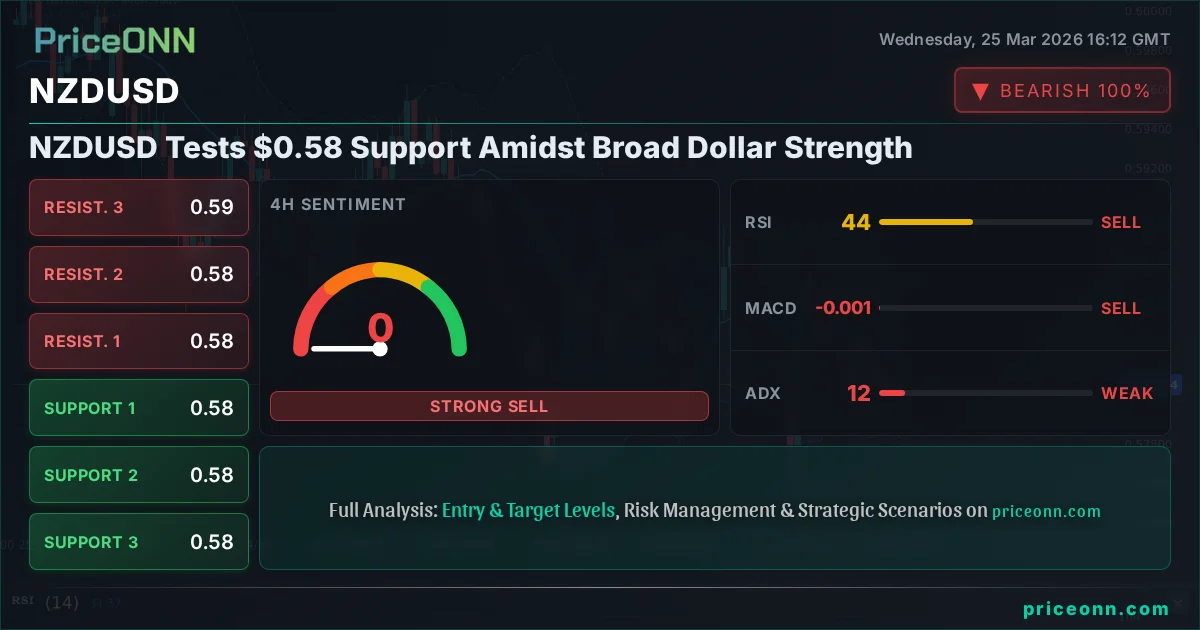
NZD/USD trades with caution near 0.5800 as Iran rejects US ceasefire proposal

Market Sentiment Hangs in the Balance
Investor appetite for risk remains a critical barometer for currency movements, with the terms 'risk-on' and 'risk-off' defining the prevailing market mood. In periods of heightened optimism, a 'risk-on' environment encourages a greater willingness among investors to embrace assets carrying higher potential rewards and, consequently, higher volatility. Conversely, a 'risk-off' scenario sees a pronounced shift towards perceived safety. During these times, apprehension about the future prompts a retreat from speculative ventures, favoring assets that offer a greater degree of capital preservation, even if returns are modest.
Historically, a 'risk-on' phase often correlates with ascendant stock markets and a broad-based appreciation in most commodities, with the notable exception of gold. This commodity strength is driven by the anticipation of robust economic activity and increased demand for raw materials. Currencies of nations heavily reliant on commodity exports, such as Australia and New Zealand, tend to strengthen as global demand for their resources picks up. Cryptocurrencies have also, in recent years, shown a tendency to rally in such environments.
The dynamic shifts dramatically during 'risk-off' periods. Fixed income, particularly major government bonds, typically sees increased demand. Gold, often considered a classic safe haven, tends to shine. Safe-haven currencies like the Japanese Yen (JPY), the Swiss Franc (CHF), and the US Dollar (USD) all experience a notable uplift. Currencies of commodity-exporting nations like the Australian Dollar (AUD), the Canadian Dollar (CAD), and the New Zealand Dollar (NZD), along with others such as the South African Rand (ZAR), often face headwinds. This is directly linked to the expected slowdown in economic activity and reduced demand for raw materials.
The US Dollar's resilience in 'risk-off' markets stems from its status as the world's primary reserve currency and the perceived safety of U.S. government debt, backed by the planet's largest economy. The Yen benefits from demand for Japanese government bonds, a significant portion of which are held domestically, leading to less selling pressure even during crises. The Swiss Franc's appeal is bolstered by Switzerland's stringent banking secrecy laws, which provide enhanced capital protection for investors.
Reading Between the Lines
The current cautious trading near the 0.5800 level for NZD/USD suggests that prevailing geopolitical uncertainties are casting a long shadow over market sentiment. While the specific catalyst mentioned relates to a rejected proposal, the broader implication is that global tensions are keeping investors on edge. This environment favors a degree of caution, potentially dampening enthusiasm for higher-yielding, growth-sensitive currencies like the Kiwi. The market is likely weighing the immediate implications of geopolitical events against the underlying economic fundamentals.
The interplay between global stability and currency markets is a constant dance. When geopolitical risks elevate, capital tends to flow towards assets perceived as secure. This dynamic can create headwinds for currencies like the NZD, which often performs better when global growth prospects are bright and commodity prices are firm, indicative of a 'risk-on' mood. The fact that the pair is trading with caution rather than outright selling off indicates a level of resilience or perhaps a belief that current geopolitical issues may not escalate significantly, but the underlying tension is palpable.
Traders will be closely monitoring any further developments that could signal an escalation or de-escalation of international tensions. Such shifts can trigger rapid movements in currency pairs that are sensitive to global risk sentiment. The 0.5800 mark, therefore, represents not just a price level but a psychological threshold where caution is currently winning out over aggressive positioning.
Market Ripple Effects
The cautious sentiment surrounding NZD/USD can have broader implications across several interconnected markets. Firstly, the US Dollar Index (DXY), which measures the dollar's strength against a basket of major currencies, might find underlying support as a safe haven, even if not experiencing a dramatic surge. This is because heightened global uncertainty typically drives capital towards perceived safety, and the USD remains a primary beneficiary.
Secondly, the performance of commodity currencies like the Australian Dollar (AUD) could be indirectly affected. While the NZD is showing caution, a sustained period of global unease could put downward pressure on commodity prices due to anticipated slower global growth, which would then weigh on the AUD and other commodity-linked currencies.
Thirdly, global equity markets, particularly those with high growth or speculative components, may experience increased volatility or a muted risk appetite. This is because the 'risk-off' sentiment that influences currency pairs like NZD/USD often correlates with a more defensive stance in stock markets. Finally, even safe-haven assets like Gold could see some benefit, not necessarily from immediate price surges, but from increased investor interest in hedging against broader market instability.
Track markets in real-time
Empower your investment decisions with AI-powered analysis, technical indicators and real-time price data.
Join Our Telegram Channel
Get breaking market news, AI analysis and trading signals delivered instantly to your Telegram.
Join Channel