
Oil Prices Have Jumped 12% Since Friday as War Risks Return
 PriceONN Editorial Desk
Multi-source verification
PriceONN Editorial Desk
Multi-source verification
Crude Markets Roar Back on Geopolitical Storm
The price of oil has staged a dramatic comeback, surging 12% since Friday's close and extending Monday's powerful gains into Tuesday's Asian trading session. This sharp upward movement has propelled Brent Crude to a one-month peak, effectively dismantling the period of calmer trading observed in recent weeks. The catalyst appears to be a renewed sense of geopolitical risk centered on U.S.-Iran tensions and the United States' decision to reimpose sanctions on Iranian oil exports.
By Tuesday, both the leading oil benchmarks, Brent and WTI, were on the ascent, each marking gains of approximately 2%. These advances pushed prices to levels not seen in weeks, signaling a market repricing that accounts for potential disruptions to traffic through the critical Strait of Hormuz. The smooth recovery of maritime passage that some had anticipated, particularly from mid-June levels, now appears far more complex and subject to escalating volatility.
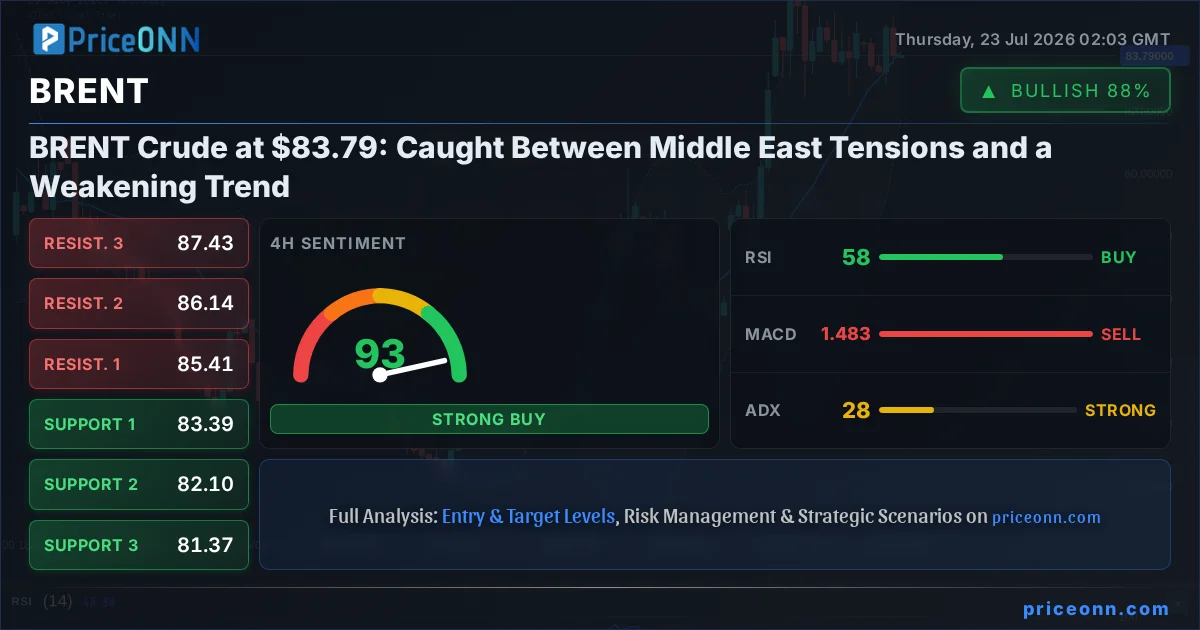
Brent Crude futures were seen nearing the significant psychological barrier of $85 per barrel. Concurrently, the West Texas Intermediate (WTI) benchmark was making a concerted effort to break through the $80 per barrel mark. In early Asian trade, Brent Crude registered a 1.91% increase, trading at $84.89. The U.S. WTI benchmark followed suit, advancing 2.02% to $79.72 per barrel.
These gains built upon Monday's impressive 8% leap, a surge directly linked to the weekend's re-escalation of tensions and President Trump's subsequent announcement regarding the reinstatement of U.S. blockades on Iranian oil shipments. The market is now grappling with the implications of this renewed friction, particularly concerning the flow of crude through one of the world's most vital energy chokepoints.
Uncertainty Surrounds New Tariff Proposals
Adding another layer of complexity to the oil market's outlook is President Trump's proposition of a 20% fee, framed as compensation for the U.S. acting as the "Guardian of the Hormuz Strait." This potential levy, intended to cover "any and all costs necessary to do the job of providing safety and security to this very volatile section of the World," has left market observers and analysts seeking clarity.
The feasibility and seriousness of this proposal are subjects of considerable debate. As commodities strategists Warren Patterson and Ewa Manthey from ING noted in a recent commentary, "There are few details on how this would work-or how serious Trump is about it." The practical application of such a fee remains highly speculative.
If implemented, the economic impact could be substantial. For a supertanker carrying approximately 2 million barrels of crude at a price point of $80 per barrel, a 20% fee would equate to roughly $32 million. This translates to an additional cost of approximately $16 per barrel. Such a figure starkly contrasts with Iran's previously proposed toll of around $1 per barrel, highlighting the significant potential financial implications if this measure were to be enacted.
Reading Between the Lines
The oil market commenced the week with a stark realization: any attempt to normalize or recover oil flows through the Strait of Hormuz will not be a straightforward endeavor. The renewed geopolitical friction has fundamentally altered the risk calculus for traders and refiners. The narrative has shifted from one of steady supply recovery to one dominated by the potential for significant supply disruptions, driving prices higher.
The market's reaction underscores the sensitivity of oil prices to geopolitical events, especially those involving major energy producers and critical transit routes. The U.S. action to reinstate sanctions, coupled with the ambiguous tariff proposal, has created a potent mix of immediate supply concerns and future uncertainty. This environment favors upward price pressure as traders price in a higher probability of supply constraints.
The implications extend beyond immediate price movements. Lingering tensions and potential sanctions enforcement could impact global refining margins and trade flows, creating ripple effects across the energy sector and the broader economy. Investors and policymakers are closely watching for any further escalation or de-escalation, recognizing that the situation remains fluid and carries significant weight for inflation expectations and global economic stability.
Track markets in real-time
Empower your investment decisions with AI-powered analysis, technical indicators and real-time price data.
Join Our Telegram Channel
Get breaking market news, AI analysis and trading signals delivered instantly to your Telegram.
Join Channel PriceONN News
Brent crude has broken back above $100 a barrel for the first time in nearly two months as escalating attacks on commercial shipping in the Red Sea deepen concerns that the Middle East supply crisis is spreading beyond the Strait of Hormuz. As of mid-morning Thursday, front-month Brent for September delivery was trading at $100.69 a barrel, up more than 7% on the day after touching an intraday high of $101.01. WTI was also sharply higher, with the entire Brent forward curve moving higher as...
PriceONN News
Oil prices rose for the fifth consecutive day early on Thursday, topping $98 per barrel to the highest level in nearly two months, as Houthi attacks on tankers on the Red Sea route intensified concerns about supply from the Middle East. Early on Thursday in Europe, Brent Crude prices passed $98 per barrel, rising by 4.21% to $98.03. The U.S. benchmark, WTI Crude, was nearing the $90 per barrel mark, trading at $89.57, up by 3.16% on the day, as the Iran-aligned Houthis appeared to make good on...
PriceONN News
At least two tankers have turned away from the Bab el-Mandeb Strait after Yemen’s Houthis said they have struck two Saudi tankers in the chokepoint in the latest Middle East war escalation, saying they had violated the naval blockade that the Yemeni forces declared earlier this week. According to reports, one of the tankers was loaded with Saudi crude for India and the other was carrying oil to China. “While it’s only two vessels so far, it suggests owners and operators are taking the threat...
PriceONN News
Crude oil prices were on course for a sizable weekly gain today, as the Strait of Hormuz remains almost entirely paralysed and the Yemeni Houthis target tankers in the Bab el-Mandeb Strait in the Red Sea. To make matters worse, Kazakhstan has suspended oil flows via the Caspian Pipeline Consortium system following Ukrainian drone attacks. At the time of writing, Brent crude was trading at $100.30 per barrel, with West Texas Intermediate at $91.70 per barrel, both up by over $10 per barrel since...
PriceONN News
India is on track to export the highest volume of refined petroleum products in months as refining margins have jumped with the re-escalation of the Middle East conflict. India is estimated to ship as many as 1.55 million barrels per day (bpd) of light and middle distillates in July, per data by commodity analysts Kpler cited by Reuters columnist Clyde Russell. The July volumes would be nearly double the fuel export volumes of just 866,000 bpd in May, when the Strait of Hormuz crisis hit crude...
PriceONN News
The war in the Middle East has diminished the negotiating power that key regional LNG exporters Qatar and the United Arab Emirates (UAE) have enjoyed for years. Importers of LNG from Europe to Asia plan to negotiate better terms in future long-term deals and ask for lower prices and higher contract flexibility, industry executives at LNG importing companies have told Reuters. For years, Qatar and the UAE commanded significant negotiating power, tied to their reliability as LNG suppliers. The...
PriceONN News
Renewed Houthi blockade of Saudi Red Sea ports threatens up to 4 million bpd of redirected Saudi crude exports, adding fresh supply risks as the Strait of Hormuz remains effectively disrupted The latest reignition of hostilities between the United States and Iran led to a spike in oil prices that, contrary to some observers’ expectations proved to be temporary. After jumping, prices once again moved lower, driven by hope for peace. Yet the recent announcement by Yemen’s Houthis that they would...
PriceONN News
Since Middle East hostilities reignited, oil prices have soared higher, although they remain below the highs witnessed during April 2026. This can be blamed on U.S. strikes against Iran, with Tehran and Washington disrupting traffic in the Strait of Hormuz, through which a fifth of global hydrocarbon supplies are shipped. This has sparked greater demand for Brazil’s high-quality oil grades, notably from Asia, because there is no need for shipments to pass through contested waters. This will...
PriceONN News
The last EU agreement about the latest sanctions package against Russia is being presented by Brussels as another demonstration of European unity and determination to sustain economic pressure on the Kremlin. Since February 2022, sanctions have been one of the EU's principal strategic instruments, targeting Russian banking, technology, defense industries and increasingly Russia’s energy sector. However, the negotiations surrounding the latest package have now revealed that Europe continues to...
PriceONN News
Two China-owned and operated tankers loaded with Saudi crude continued on Thursday to travel in the Red Sea toward the Bab el-Mandeb Strait despite the overnight Houthi attacks on Saudi vessels, ship-tracking data monitored by Bloomberg showed. The Cosco Shipping-operated tankers, the Xin Long Yang and the Cosnew Lake, are openly broadcasting their Chinese destination as they are traveling through the Red Sea approaching Bab el-Mandeb. Both China-owned tankers had loaded Saudi crude at Yanbu...
PriceONN News
The European Union will exempt Greek Dynagas from the latest sanctions package for Russia after pressure from the Greek government, which said the package would harm the country’s economy. The package, set to be voted on today, includes a ban on LNG shipments to third countries and a total ban on LNG purchases by EU entities. However, with several EU member states now complaining about the adverse effects of these sanctions on their economies, Brussels has been placed in a position to negotiate...
PriceONN News
The regional price of natural gas produced in the Permian, the top U.S. oil basin, was negative for most of the first half of the year. Rising associated gas output from oil-targeting wells has had nowhere to go. Producers had to either flare the gas, within allowed limits, or pay to get rid of what many Permian players see as an undesirable by-product of the valuable crude. For years, the key constraint to local gas prices has been the insufficient pipeline takeaway capacity, which hasn’t...