
Oil Prices Rebound as Iran Denies US Talks and Hormuz Passage Resumes


Oil prices experienced a significant rebound in early Asian market hours on Tuesday, clawing back some of the sharp declines seen in the previous session. The immediate catalyst for this recovery appears to be Iran's strong denial of any direct negotiations with the United States regarding its energy sector. As of the latest reporting, West Texas Intermediate (WTI) crude had climbed 3.87% to $91.54 per barrel, while the international benchmark, Brent crude, rose 3.43% to $103.40.
Market Context
This volatile price action marks a stark reversal from Monday's dramatic selloff, during which Brent crude briefly dipped below the psychologically important $100 per barrel mark for the first time since March 11. The initial downturn on Monday was reportedly influenced by statements from U.S. President Trump, who had suggested that Washington had engaged in "very good and productive" discussions with Iran and that planned strikes on Iranian energy infrastructure would be postponed. Market interpretations initially leaned towards de-escalation, providing a temporary reprieve. However, the narrative shifted rapidly as Iran issued immediate and firm denials of any direct negotiations with the U.S. While acknowledging some third-party channels, Tehran was unequivocal against direct talks. This geopolitical uncertainty, coupled with an Israeli official reportedly informing Axios of U.S. negotiators being in contact with Iranian Parliament Speaker Mohammad Bagher Ghalibaf, who himself vehemently denied such meetings on social media, amplified market anxieties.
Analysis & Drivers
The persistent volatility in oil prices is deeply rooted in the complex geopolitical landscape involving the U.S. and Iran. Despite U.S. President Trump's reported decision to postpone potential strikes on Iran's energy infrastructure for a five-day period, the situation remains highly unstable. Reports of explosions in Tehran and other Iranian cities, combined with Iran's firm stance against U.S. peace talks, have amplified market fears. Iranian officials have characterized U.S. statements as tactics to manipulate financial and oil markets and to deflect from other geopolitical quagmires. The conflict has now extended for over 25 days, with no clear resolution in sight. Adding another layer of complexity, key regional players like Saudi Arabia and the United Arab Emirates are reportedly becoming more inclined to confront Iran, further escalating tensions. Adding a crucial counterpoint to the supply disruption narrative, a very large crude carrier, the Omega Trader, flying a Panamanian flag, has successfully traversed the Strait of Hormuz carrying 2 million barrels of Iraqi crude. This marks the first tanker to export Iraqi crude since Iran significantly restricted passage through the vital waterway. Ship-tracking intelligence indicates the vessel reached its destination in India, a primary recipient of oil shipments permitted through the Strait in recent weeks. This selective passage suggests Iran is exercising increased control, allowing specific vessel types and cargo movements, often within designated corridors, rather than an outright closure.
Trader Implications
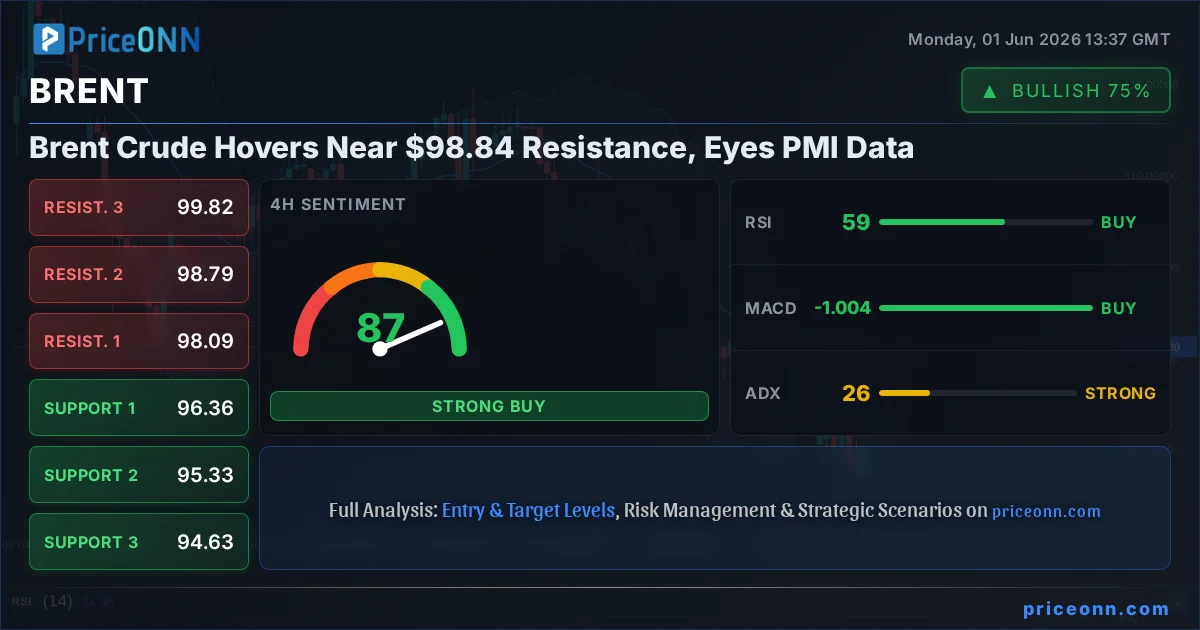
Traders should closely monitor official statements from both the U.S. and Iran for any further shifts in rhetoric or confirmed actions. Key levels to watch for Brent crude include immediate resistance around the $100 per barrel mark, with a sustained break above $103.40 potentially signaling further upside. On the downside, a break below $95 could indicate renewed selling pressure. For WTI, resistance lies near the recent high of $91.54, with support anticipated around the $88-$90 range. The successful passage of the Omega Trader through the Strait of Hormuz, while positive for immediate sentiment, does not negate the broader supply risks stemming from the U.S.-Iran standoff. The market remains highly sensitive to any news regarding potential military actions or diplomatic breakthroughs. Traders should maintain a cautious approach, with risk management paramount given the potential for rapid price swings based on geopolitical developments.
Outlook
The immediate outlook for oil prices remains heavily dependent on the geopolitical developments between the U.S. and Iran. While Iran's denial of direct talks and the resumption of some passage through the Strait of Hormuz have provided a temporary boost, the underlying tensions persist. The market will be watching for any escalation or de-escalation in rhetoric and actions. Key upcoming events include further pronouncements from U.S. and Iranian officials, as well as any potential shifts in the stances of regional allies. The potential for further supply disruptions in the Persian Gulf remains a significant overhang, keeping a floor under prices, while any genuine signs of diplomatic progress could trigger a sharp sell-off. The narrative is likely to remain one of high volatility, driven by geopolitical risk premiums.
Frequently Asked Questions
What is the current price of Brent crude and WTI crude?
As of early Asian trade on Tuesday, Brent crude was trading at approximately $103.40 per barrel, up 3.43%, while West Texas Intermediate (WTI) crude had risen to $91.54 per barrel, a gain of 3.87%.
How did the passage of the Omega Trader through the Strait of Hormuz affect oil prices?
The successful passage of the Omega Trader carrying 2 million barrels of Iraqi crude through the Strait of Hormuz provided some relief to the market, indicating that Iran is managing passage rather than enforcing a complete blockade. This event contributed to the broader rebound in oil prices by easing immediate supply disruption fears.
What are the key levels to watch for oil traders in the short term?
For Brent crude, traders should watch resistance near $103.40 and support around $95. For WTI, key resistance is near $91.54, with support expected in the $88-$90 range. Geopolitical developments will be the primary driver.
Track markets in real-time
Empower your investment decisions with AI-powered analysis, technical indicators and real-time price data.
Join Our Telegram Channel
Get breaking market news, AI analysis and trading signals delivered instantly to your Telegram.
Join Channel PriceONN News
Crude oil prices experienced a significant drop, with WTI futures falling over 1.8% to $87.25, as optimism grew for a U.S.-Iran deal potentially reopening the Strait of Hormuz.
PriceONN News
(RTTNews) - Crude oil prices have tumbled on Friday as expectations of the U.S. and Iran signing a Memorandum of Understanding run high. The MoU would allow for immediate reopening of the Strait of Hormuz and pave the way for the resumption of oil and energy trade.
PriceONN News
Crude oil futures experienced a dramatic intraday reversal on Thursday, soaring overnight on geopolitical fears only to pull back significantly as reports of a potential diplomatic understanding between the U.S. and Iran emerged.
PriceONN News
Iran's oil exports fell to their lowest level in at least six years in May as the U.S. naval blockade continued to choke off crude shipments and leave tens of millions of barrels stranded at sea. According to shipping data from Vortexa, Iran exported just 209,000 barrels per day (bpd) of crude oil and condensate in May, down from 1.34 million bpd in April and nearly 1.9 million bpd in March. Kpler had estimated May exports slightly higher at 260,000 bpd, but still the lowest level since the...
PriceONN News
Crude oil prices experienced a significant downturn as market sentiment shifted towards optimism about a potential US-Iran Memorandum of Understanding that could reopen the Strait of Hormuz. WTI futures fell nearly 2% on the news.
PriceONN News
Crude oil futures experienced a dramatic intraday reversal, soaring to $92.52 before pulling back significantly on Thursday. The volatile session was driven by shifting geopolitical narratives and U.S. inventory data.
PriceONN News
Brent crude prices surged towards the mid-$90s amid fears of supply disruptions from Middle East tensions, only to pare gains later as whispers of a potential US-Iran diplomatic understanding emerged.
PriceONN News
(RTTNews) - Crude oil futures skyrocketed overnight but have shown a significant pullback over the course of the trading day on Thursday.
PriceONN News
(RTTNews) - Extending the losses from yesterday's session, crude oil prices have gone into freefall on Wednesday as investor expectations on a potential U.S.-Iran agreement continue to rise despite the U.S. refusing to ease its demands.
PriceONN News
(RTTNews) - Crude oil prices have tumbled on Tuesday as optimism about a U.S.-Iran peace deal that could lead to reopening of the Strait of Hormuz soon grows despite reports of fresh U.S. strikes on Iran yesterday.
PriceONN News
South America has raised its oil exports more than the U.S. has done so far this year as key producers in the region boosted production and shipments to a world scrambling for crude that’s not dependent on the Strait of Hormuz. Over the past five years, South America’s biggest producer and exporter, Brazil, has started production at several new offshore platforms in the Santos pre-salt fields. Guyana has continuously increased overseas shipments as the Exxon-led consortium starts up...
PriceONN News
Africa's biggest refinery is getting bigger. Nigeria's Dangote refinery has started work on a second crude processing unit that will add another 700,000 barrels per day (bpd) of capacity, putting the complex on track to rival the world's largest refining site and giving billionaire owner Aliko Dangote a much larger role in global fuel markets. According to Dangote Petroleum Refinery CEO David Bird, construction is already underway at the Lekki site outside Lagos. The new refinery is expected to...