Resource Wars Are Here and Oil Is the First Casualty
The Unseen Battlefield for Essential Materials
In the span of just over a year, the global economy has been jolted by repeated instances of severely constrained supplies of commodities that are not merely economic drivers but fundamental to modern defense capabilities. From Beijing's tightening grip on rare earths and vital minerals to the significant disruption of the Strait of Hormuz, a critical energy transit route, policymakers and market watchers alike are confronting a new geopolitical reality. The battle for control over oil, strategic minerals, rare earths, and magnets has emerged as a paramount concern, rivaling the traditional focus on military hardware stockpiles. It is now unequivocally clear that without secure access to these foundational resources, the very sinews of defense and national security can be critically weakened.
This emerging struggle for resource dominance is inextricably linked with the ongoing advancements in military technology. The quest for economic leverage and strategic advantage is no longer confined to conventional arms. Instead, it is unfolding on a dual front: a tangible arms race and a parallel, often quieter, contest for the raw materials that power industrial might, manufacturing prowess, and sophisticated military development.
As one market observer noted, "Energy, critical minerals and industrial capacity are leverage, not just economic assets." This perspective underscores the shift from viewing these commodities solely as economic inputs to recognizing their potent geopolitical weight.
Strait of Hormuz Blockade Exposes Energy Vulnerabilities
The recent conflict in the Middle East and the subsequent de facto closure of the Strait of Hormuz laid bare the fragility of global energy flows. This crucial chokepoint, responsible for approximately 20% of the world's daily oil and liquefied natural gas (LNG) trade before the escalation, has seen its tanker traffic severely curtailed for weeks. This represents a supply shock of historic proportions, starkly illustrating the world's deep reliance on energy resources and the enduring significance of geography and physical supply chains.
The immediate aftermath saw oil prices surge past the $100 per barrel mark. Concurrently, natural gas prices in Europe experienced a doubling, and Asian spot LNG prices climbed to multi-year peaks. This price volatility is a direct consequence of a substantial portion of Middle Eastern oil and gas being effectively stranded, creating a gap that existing supplies struggle to fill.
The ripple effects are particularly acute across Asia, a region heavily dependent on energy imports from the Persian Gulf. Asian refiners are now facing exorbitant premiums for crude sourced outside the Middle East. Many are contemplating, or have already enacted, reductions in their processing rates. Some nations have introduced energy conservation measures, ranging from compressed work weeks to prohibitions on fuel exports, in an effort to manage the crisis.
In Europe, the upcoming gas refilling season is anticipated to be exceptionally challenging. Asian demand is aggressively competing for available spot LNG, especially with Qatari supplies facing disruptions. Full capacity restoration could potentially take up to five years following recent events.
Even the United States, despite its status as the world's leading oil producer and its narrative of energy independence, finds itself susceptible to global supply shocks of this magnitude. The national average gasoline price is now nearing $4 per gallon, a significant climb of over a dollar in just the past month. This underscores the interconnected nature of the global oil market; prices reflect fundamental supply-demand dynamics, though they have recently been amplified by frenetic trading activity driven by geopolitical tensions.
The stark reality is that there is currently no readily available resource to compensate for the significant deficit in Middle Eastern supply. With producers already cutting output due to storage limitations, a swift recovery in supply, once the geopolitical situation stabilizes, appears unlikely. Ultimately, control over the Strait of Hormuz grants immense leverage to inflict widespread economic disruption.
China's Rare Earth Dominance Under Scrutiny
While global attention has been riveted on the Strait of Hormuz, a parallel and critical race is underway concerning rare earths and other vital minerals. Western nations are actively working to diminish China's entrenched dominance in this sector, a dominance that underpins many advanced technologies and defense systems.
Following China's imposition of export restrictions on rare earth elements early in 2025, Western countries accelerated efforts to establish comprehensive mine-to-magnet supply chains. The objective is clear: to reduce reliance on Chinese supply for industries as diverse as advanced military hardware and automotive manufacturing.
Current estimates from the International Energy Agency (IEA) highlight China's commanding position: holding a 59% share in rare earth mining, 91% in refining, and an astonishing 94% in the production of magnets. This concentration of control poses a significant strategic risk.
In response, the U.S. has pursued strategic investments in mining companies and launched initiatives like the U.S. Strategic Critical Minerals Reserve, codenamed Project Vault. These actions are part of a broader effort to break China's sway over the pricing and supply of minerals essential for national security, defense, and the automotive sector. While eroding China's dominance will be a protracted process, taking years, projections indicate a potential shift.
By 2030, the market share of rare earths originating from countries like the U.S. and Australia is expected to increase, potentially reducing China's share to 69% from an estimated 90% in 2024, according to industry data. Investment in rare earth extraction is surging, driven by the escalating demand from modern technologies requiring more critical materials.
However, a significant supply shortfall is anticipated due to ongoing trade uncertainties, with lead times for bringing new material extraction online stretching as long as a decade. This dynamic is expected to grant considerable pricing power to the limited number of producers capable of supplying critical materials outside of China, leading to a fragmentation of the globalized market.
Reading Between the Lines
The confluence of energy supply shocks and the strategic competition for critical minerals paints a clear picture for investors and traders. The era of assuming seamless global commodity flows is over. Geopolitical risk is now a primary factor in commodity pricing, demanding a more nuanced approach to portfolio construction and risk management.
The implications extend beyond just oil and rare earths. We could see increased volatility and strategic investment in other key resources such as lithium, cobalt, and copper, which are also critical for green energy transitions and advanced manufacturing. The U.S. Dollar Index (DXY) may find support during periods of heightened geopolitical uncertainty as a safe-haven asset, while currencies of commodity-exporting nations could see mixed fortunes depending on their specific resource baskets and trade relationships.
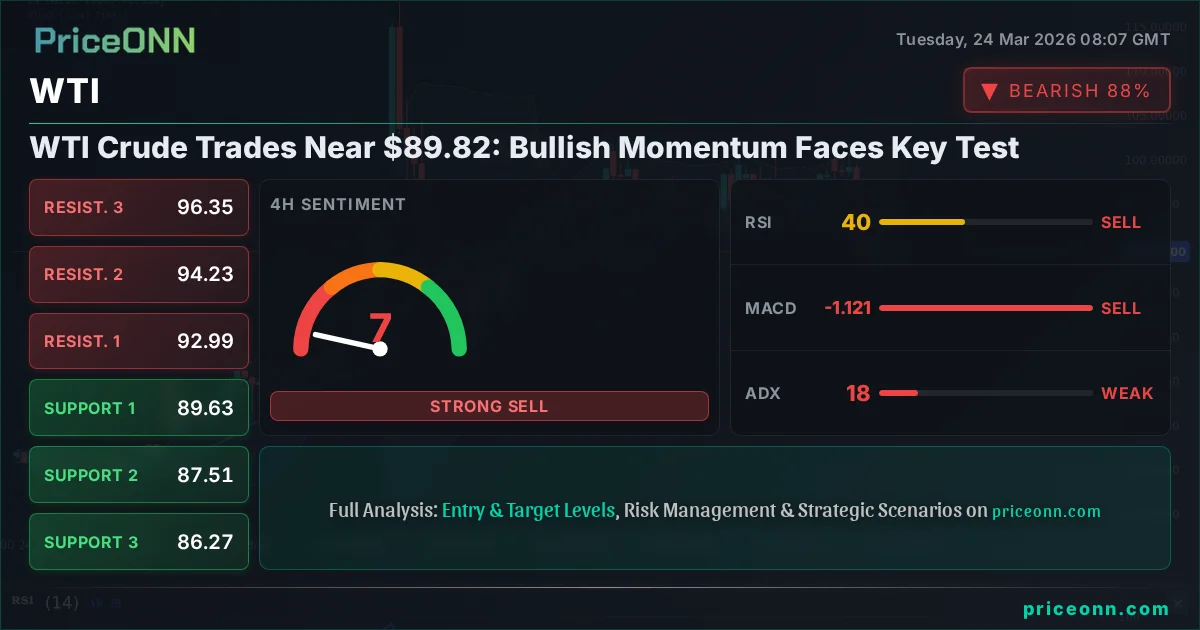
Traders should closely monitor supply chain developments, particularly in the Middle East and East Asia. Key levels to watch in crude oil will be the psychological $100 mark and any sustained breaches above it, signaling potential for further inflationary pressure. For rare earths, the focus will be on the progress of new supply projects outside China and the pricing power of emerging producers. The risk of further supply disruptions remains elevated, creating both opportunities for short-term trading gains and significant risks for long-term investors holding exposed assets. Understanding the interplay between resource control and geopolitical strategy is no longer optional; it is a critical component of navigating today's markets.
Track markets in real-time
Empower your investment decisions with AI-powered analysis, technical indicators and real-time price data.
Join Our Telegram Channel
Get breaking market news, AI analysis and trading signals delivered instantly to your Telegram.
Join Channel