
Saudi Arabia Trades Oil Barrels for Batteries
 PriceONN Editorial Desk
Multi-source verification
PriceONN Editorial Desk
Multi-source verification
A Desert Kingdom's Ambitious Energy Shift
The global spotlight remains fixed on the flow of crude oil, particularly as Saudi Arabia strategically reroutes shipments westward for safer export. Yet, beneath this familiar narrative of oil geopolitics, the world's second-largest crude producer and foremost exporter is orchestrating a dramatic pivot. The kingdom harbors significant ambitions in a burgeoning sector: battery storage. This technology is widely hailed as the cornerstone of the energy transition, offering a crucial solution to the intermittency of renewable sources like wind and solar power.
Despite substantial cost reductions in battery technology, its widespread adoption still presents financial hurdles. A more pervasive challenge for many nations striving for energy independence is the overwhelming dominance of China across the entire clean energy supply chain, from solar panel manufacturing to essential lithium processing. It was this very landscape that created an opening for Saudi Arabia to redefine its global role just a few years ago.
In 2022, the nation launched the Future Minerals Forum, an annual event designed to attract substantial investment into its rich mineral reserves. These subterranean riches are not limited to traditional resources; they encompass vital battery components like lithium and vanadium, alongside other critical metals such as copper, all essential for the global energy transformation. The initiative positions Saudi Arabia not just as an oil giant but as a potential future hub for the materials powering tomorrow's world.
Vision 2030 Drives Mineral Sector Expansion
The expansion into metals and minerals forms a critical pillar of the ambitious Vision 2030 program, championed by Crown Prince Mohammed bin Salman. This strategic diversification aims to drastically reduce the nation's reliance on oil revenues. Projections indicate that by 2030, the mining sector could contribute a staggering $64 billion to the national economy, according to reports from The National. This bold move signifies Saudi Arabia's calculated bet on a post-oil future, a wager that appears increasingly plausible given current global energy dynamics.
The urgency for such diversification is amplified by global supply chain vulnerabilities. Industry leaders highlight the critical bottleneck in battery material processing, which remains heavily concentrated in China. Emilie Bodoin, CEO of Pure Lithium, recently articulated this challenge, noting that nations venturing into battery production without prior experience face severe constraints. "By leapfrogging the current lithium-ion technology with lithium metal technology, we can circumvent Chinese dominance of the supply chain," Bodoin stated, as reported by The National. This strategy offers a pathway for countries to transition away from fossil fuels without creating a new dependency on Chinese-controlled material flows.
This confluence of factors presents a golden opportunity for the battery and critical minerals sector. With oil and gas supplies from traditional producers facing unprecedented disruptions, the impetus to accelerate the adoption of alternative energy sources, heavily reliant on robust battery storage, is immense. Analysts have long foreseen a dramatic expansion in the battery storage market. Rystad Energy, for instance, forecasts a ninefold surge in global installed battery storage capacity between 2024 and 2040. Such growth, however, is intrinsically linked to material costs. For Saudi Arabia to effectively challenge China's established position, it must compete not only on resource availability but also on price competitiveness.
Domestic Battery Capacity and Future Exports
The ongoing global energy crisis inevitably strains the finances of nations pursuing energy transition goals, particularly in Europe. This economic pressure underscores the importance of cost-effective material sourcing and domestic production capabilities. Saudi Arabia is actively addressing this by investing in its own substantial battery storage infrastructure. The kingdom has set an ambitious target of achieving 48 GWh in battery storage capacity by 2030, a development that aligns with its expanding solar energy generation projects.
This dual strategy serves a crucial purpose: it aims to reduce the kingdom's internal consumption of oil for power generation, thereby freeing up more crude oil for export. This plan hinges on the continued availability and security of export channels, a factor that has become increasingly precarious in recent times. The kingdom's strategic positioning in both fossil fuels and future energy materials places it in a unique, albeit complex, geopolitical and economic space.
Market Ripple Effects
Saudi Arabia's strategic diversification into battery minerals represents a significant development with far-reaching implications. For investors, this signals a long-term shift in the global energy landscape, moving beyond the traditional oil narrative. The kingdom's proactive stance in securing critical raw materials for the energy transition could reshape supply chains and influence commodity prices.
Traders and portfolio managers should monitor several key areas. Firstly, the price of lithium and other battery metals like vanadium and copper will be critical indicators of Saudi Arabia's success in developing its mining sector and its ability to compete with existing players. Secondly, the performance of global battery manufacturers, particularly those seeking to diversify their supply chains away from China, will be directly impacted. Companies that can secure stable, cost-effective supplies from new sources like Saudi Arabia may gain a competitive edge.
Furthermore, this move could have subtle but significant effects on the US Dollar Index (DXY) and broader currency markets. As Saudi Arabia diversifies its revenue streams and potentially reduces its reliance on oil-denominated transactions over the very long term, it could alter global financial flows. Additionally, the success of Saudi Arabia's mining ambitions could influence the trajectory of sovereign wealth fund investments, potentially directing more capital towards green energy infrastructure and related resource companies. The geopolitical implications are also noteworthy, as a more diversified Saudi economy might lead to shifts in regional influence and global energy policy.
Track markets in real-time
Empower your investment decisions with AI-powered analysis, technical indicators and real-time price data.
Join Our Telegram Channel
Get breaking market news, AI analysis and trading signals delivered instantly to your Telegram.
Join Channel PriceONN News
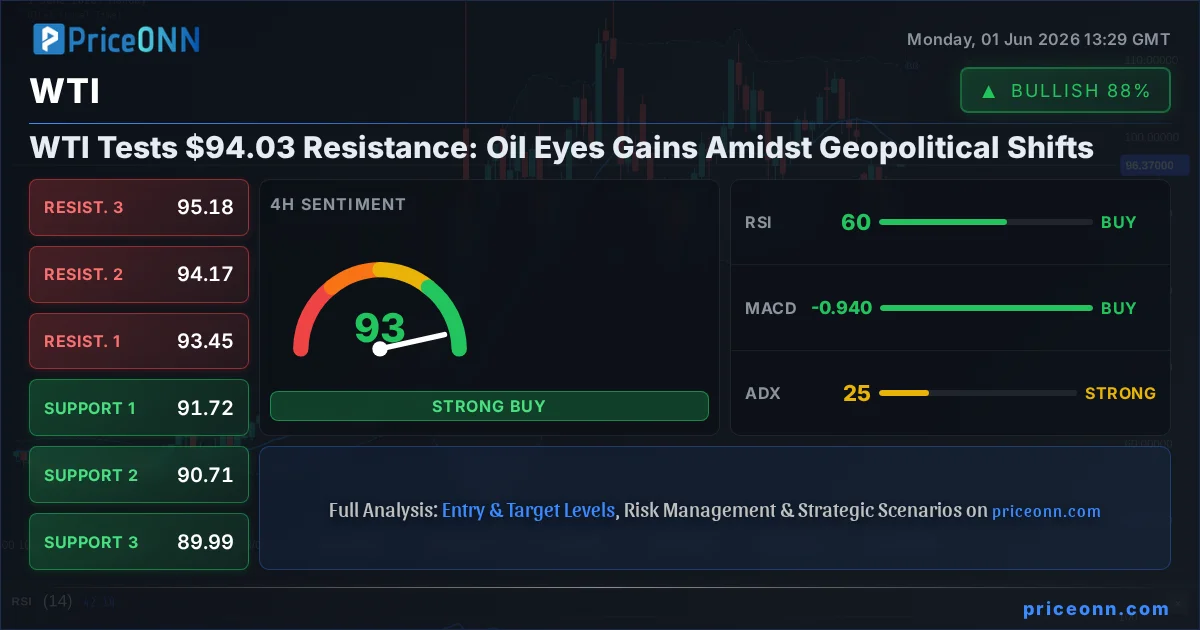
WTI crude oil: ⬇️ Sell WTI crude oil reversed from resistance zone Likely to fall to support level 95.00 WTI crude oil recently reversed from the resistance zone between the pivotal resistance level 105.00 (which has been reversing the price from the start of April) and the upper daily Bollinger Band. The downward reversal from […] The post WTI Crude Oil Wave Analysis appeared first on ActionForex.
PriceONN News
BP will sell 5% in the $35-billion Browse LNG project in Australia, which Australian energy giant Woodside is looking to progress, the UK-based supermajor told Reuters on Monday. BP is selling the 5% stake, out of its total of its 44% interest, to South Korea's GS Energy. “The dilution reflects BP’s disciplined approach to portfolio management by bringing in a committed partner,” BP said in a statement emailed to Reuters. The Browse LNG project in Australia, proposed by Woodside Energy, entails...
PriceONN News
The Iran war suddenly turned what had started as a year of oversupply in global oil and LNG markets into the worst oil and gas supply disruption in history. Three months after the U.S.-Israeli strikes on Iran began on February 28, the world has already lost 1 billion barrels of crude oil supply, oil and gas prices have found a new, much higher floor, and whipsaw with violent volatility nearly every day, trade routes have shifted, and tanker rates have spiked. Actual supply shortages are...
PriceONN News
Nuclear fuel is becoming a geopolitical battleground as the world increasingly turns to nuclear energy to contend with skyrocketing energy demand projections. The combination of an oil-based energy crisis emanating out of the Strait of Hormuz, the enormous and ballooning energy needs of artificial intelligence, and the urgent imperative of decarbonization is garnering a renewed interest in nuclear energy as a carbon-free, efficient, and round-the-clock power source. Moreover, nuclear energy can...
PriceONN News
Over the last two decades, solar panels have fallen in price while efficiency has increased. Greater uptake and high levels of investment in research and development have led to vast improvements in solar power technology. As panel prices fall and governments worldwide look to diversify their energy mix and cut emissions, several developers are now launching mega-projects to meet the growing demand. Most major solar projects developed in recent years provide hundreds of megawatts of clean...
PriceONN News
China has been cited as an example of a country that has managed to insulate itself relatively well against oil crises. With over a billion barrels in estimated inventories before the war in the Middle East started, China was the poster child of forward planning in energy security. But this could change, and if it does, it would make an already severe crisis even worse. Kpler sounded the alarm about that prospect earlier this month, reporting that Chinese refiners have reduced their purchases...
PriceONN News
The Iran war has handed the United States a rare opportunity: a new dawn of energy dominance in an increasingly fractured world. With coordinated US-Israeli strikes disrupting the Strait of Hormuz from late February, roughly 20% of global LNG supply has been stripped from the market since early March. Prices have surged across Asia and Europe. And into that vacuum, American gas has flowed. The numbers speak for themselves. US LNG exports to Asia jumped sharply in April, with nearly a quarter of...
PriceONN News
Cuba has been experiencing a worsening energy crisis for several years, which previously led it to rely heavily on Venezuela for its fuel. Following the United States’ intervention in Venezuela in February, the energy crisis has grown even worse, as Cubans face regular blackouts and the economy suffers. Cuba requires about 100,000 barrels a day to power its grid and meet the regular transportation demands. It fulfils just 40 percent of this demand domestically. In January, the Trump...
PriceONN News
Crude oil prices experienced a significant drop, with WTI futures falling over 1.8% to $87.25, as optimism grew for a U.S.-Iran deal potentially reopening the Strait of Hormuz.
PriceONN News
Crude oil prices experienced a significant downturn as market sentiment shifted towards optimism about a potential US-Iran Memorandum of Understanding that could reopen the Strait of Hormuz. WTI futures fell nearly 2% on the news.
PriceONN News
(RTTNews) - Crude oil prices have tumbled on Friday as expectations of the U.S. and Iran signing a Memorandum of Understanding run high. The MoU would allow for immediate reopening of the Strait of Hormuz and pave the way for the resumption of oil and energy trade.
PriceONN News
Crude oil futures experienced a dramatic intraday reversal on Thursday, soaring overnight on geopolitical fears only to pull back significantly as reports of a potential diplomatic understanding between the U.S. and Iran emerged.