
The Iran War’s First 90 Days Upended Energy Markets
 PriceONN Editorial Desk
Multi-source verification
PriceONN Editorial Desk
Multi-source verification
Global Energy Landscape Upended
What began as a year anticipated to be defined by surplus in crude oil and liquefied natural gas (LNG) markets has been violently reshaped. The U.S.-Israeli strikes on Iran, commencing February 28, have triggered the most severe oil and gas supply shock on record. In just 90 days, approximately 1 billion barrels of crude oil have vanished from global availability. This dramatic reduction has established a substantially higher baseline for energy prices, now characterized by near-daily, sharp price swings. Crucial trade arteries have been rerouted, and the cost of chartering oil tankers has surged dramatically.
The repercussions are acutely felt in Asia, where tangible supply deficits are surfacing. Concurrently, worldwide stockpiles of crude oil and refined fuels are depleting at an alarming rate. This inventory drawdown suggests the market may soon deplete its existing buffers, the very cushions that previously prevented prices from escalating to extreme levels seen in past crises. The de facto closure of the Strait of Hormuz, a critical artery handling 20% of global oil and LNG transit, has seen traffic plummet by roughly 90%.
Middle Eastern energy producers have been compelled to significantly scale back upstream operations as their storage facilities reached capacity. Daily global crude production volumes have been slashed by over 10 million barrels per day, a deficit that no increase in output from other regions can realistically compensate for. Beyond crude, LNG shipments from key producers like Qatar and the United Arab Emirates (UAE) are also severely impacted. Qatar, for instance, halted LNG production as early as March 2.
Qatar's LNG Production Faces Long-Term Setback
The damage inflicted on the Ras Laffan complex, the world's largest liquefaction facility, by Iranian missile strikes has led Qatar to issue advisories indicating that its LNG export capacity might not recover to pre-conflict levels for as long as five years. This protracted recovery period for a major LNG hub adds another layer of uncertainty to global gas supplies, particularly for Asian markets heavily reliant on these shipments.
Data compiled by Kpler reveals the staggering scale of the crude and condensate supply loss, confirming the depletion of 1 billion barrels by the close of May. As of May 22, cumulative losses in the Middle East alone neared 961 million barrels. Further production curtailments are anticipated, with an additional 100,000 barrels per day potentially offline due to ongoing pressures in Iraq and Saudi Arabia.
Naveen Das of Kpler noted the complex regional dynamics, stating, “Seasonally-higher demand is approaching, which could incrementally boost regional supply to meet demand, though the economic realities in the region may force some organic demand destruction as well, capping any summer-linked marginal increase in production levels.” This suggests that while demand may rise, economic constraints could temper any significant supply rebound.
Inventory Drawdowns Accelerate Globally
Amidst this unprecedented supply crunch, global inventories are shrinking at an accelerating pace. Even the United States is experiencing significant inventory drawdowns. Excluding China, which has strategically built substantial reserves exceeding 1.2 billion barrels over the past year, the rest of the world's onshore stocks are depleting faster and faster, according to Kpler. The global drawdown rate, which was just over 1.5 million barrels per day in early May, has now climbed to nearly 1.7 million barrels per day. This intensifying depletion rate signals a potentially tighter market ahead.
Shipping Routes and Tracking Become Opaque
The conflict has fundamentally altered global shipping patterns and the ability to track energy movements. Saudi Arabia, a primary crude exporter, is now routing oil from its Red Sea port of Yanbu, effectively bypassing the Strait of Hormuz. Similarly, the UAE is enhancing its export capacity outside the chokepoint, including through a new pipeline to Fujairah.
The elevated threat to vessels traversing the Strait of Hormuz has fostered a new era of shipping opacity. Commercial vessels, not just those linked to Iran, are increasingly operating with their transponders switched off. Vortexa data indicates this “dark mode” activity has broadened beyond sanctions evasion to become a commercial strategy driven by conflict risk and operational uncertainty. Claire Jungman, Director of Maritime Risk & Intelligence at Vortexa, explained, “AIS-off movements through Hormuz are no longer only a sanctions-evasion signal. They have become a wider commercial response to conflict risk, operational uncertainty, and the need to keep Gulf cargo moving through one of the world’s most important energy chokepoints.”
This increased obscurity makes real-time tracking of oil shipments exceptionally challenging. Jungman elaborated that when clean products, LPG, and LNG also exhibit reduced Automatic Identification System (AIS) visibility, the uncertainty cascades into refinery supply chains, product availability, regional inventory assessments, and demand analysis at the destination level.
Market Ripple Effects
The sustained disruption to oil and LNG supplies stemming from the Iran conflict introduces significant volatility and upward pressure on energy prices. Traders are now grappling with an environment where supply buffers are rapidly diminishing, and transparency in shipping is compromised. The immediate aftermath has seen a dramatic spike in tanker rates, reflecting the increased risk and longer voyage times associated with rerouted trade flows.
The direct impact is felt most acutely in crude oil benchmarks like Brent and WTI, which are likely to remain highly sensitive to any further supply news or geopolitical escalations. The elevated cost of energy also poses inflationary risks, potentially influencing central bank policy and impacting currency pairs such as USD/CAD, given Canada's significant oil production. Furthermore, the instability in energy markets can spill over into broader equity indices, particularly affecting energy sector stocks and companies sensitive to input costs. Investors should monitor inventory data closely for signs of continued draws, as well as geopolitical developments in the Middle East, which will remain the primary price driver.
Track markets in real-time
Empower your investment decisions with AI-powered analysis, technical indicators and real-time price data.
Join Our Telegram Channel
Get breaking market news, AI analysis and trading signals delivered instantly to your Telegram.
Join Channel PriceONN News
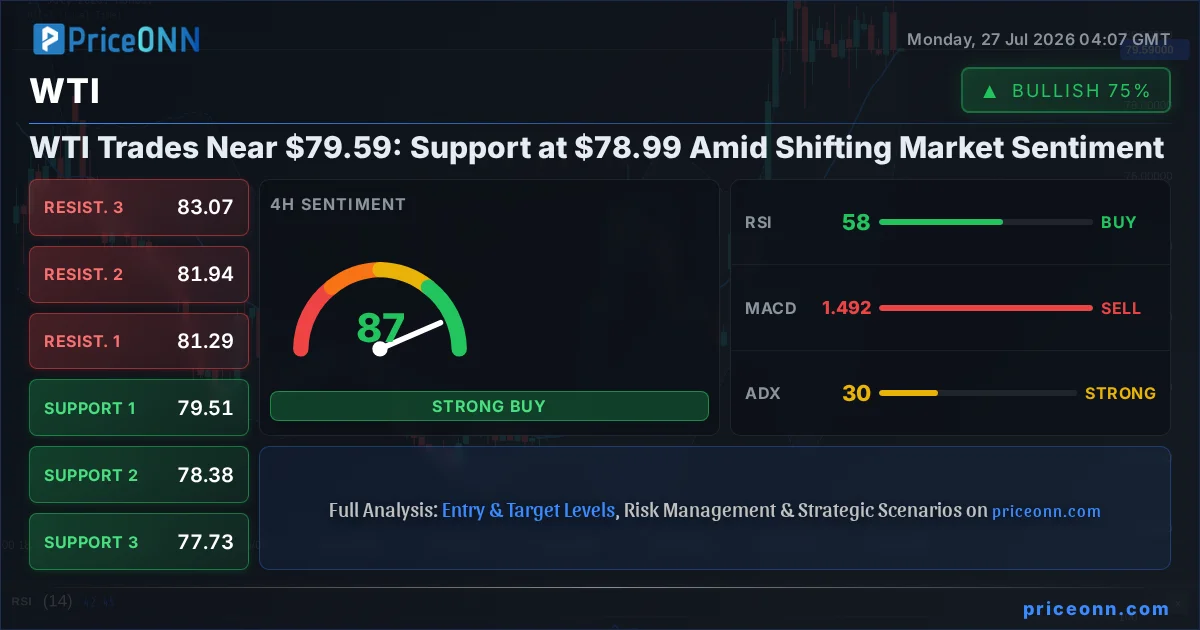
WTI crude oil plunged by more than 7% on 27 July 2026 after the US suspended a series of strikes against Iran over the weekend, raising hopes of a diplomatic solution and the reopening of shipping through the Strait of Hormuz. Brent crude also fell below $90 per barrel. Meanwhile, Bloomberg reported […] The post WTI Analysis: Gap Breaks Short-Term Trend as Price Remains Trapped Between the Poc and Profile Boundary appeared first on ActionForex.
PriceONN News
Oil prices continued to trend lower in early Asian trade on Tuesday as a fourth night passed without any attacks from either Iran or the United States. At the time of writing, WTI crude was trading at $81.55 per barrel, down 1.28% on the session, while Brent crude had slipped to $87.36 per barrel, a decline of 1.13%. On Monday, President Trump sought to boost hopes of a diplomatic resolution between Washington and Tehran by claiming that the U.S. was engaged in "good talks" with Iran. Iranian...
PriceONN News
(RTTNews) - Crude oil prices have gone into a tailspin on Monday, extending the losses from Friday's plunge after the U.S. halted nearly two weeks of military attacks against Iran following which near-term oil supply-disruption concerns reduced.
PriceONN News
Oil prices plunged by more than 5% in early Asian trade on Monday as the U.S. and Iran halted attacks after two weeks of escalation that had driven Brent above $100. At the time of writing, WTI crude was trading at $84.47, down 5.39%, while Brent crude had fallen to $91.80, a decline of 5.15%. The retreat came after Washington signaled on Friday that it would temporarily halt its bombing campaign against Iran. Talking to Face the Nation on Sunday, U.S. Ambassador to the United Nations Mike...
PriceONN News
Chinese buyers that received the first U.S. LNG cargo in over a year plan to resell it on another market to profit from higher prices elsewhere and avoid paying a 25% tariff, sources familiar with the plans told Bloomberg on Monday. The Yangpu port in south China earlier this month received a cargo of U.S. LNG from the Plaquemines LNG export terminal operated by Venture Global in Louisiana’s Plaquemines Parish. This was the first U.S. shipment of gas to China in more than a year. But the gas...
PriceONN News
The Houthi threats to shipping in the Red Sea and its chokepoint, the Bab el-Mandeb Strait, have forced at least one oil tanker carrying Saudi crude to Asia to choose the much longer route through the Suez Canal, the Mediterranean, and around Africa. The supertanker Olympic Luck, partially laden with Saudi crude at Yanbu on the Red Sea, transited the Suez Canal into the Mediterranean late on Sunday, according to shipping data monitored by Bloomberg. The U-turn from Bab el-Mandeb indicates that...
PriceONN News
Tanker traffic through the Bab el-Mandeb Strait slumped to a multi-month low on Sunday amid Houthi attacks on Saudi oil infrastructure on the Red Sea coast. Only 11 tankers carrying commodities transited the Bab el-Mandeb chokepoint between the Red Sea and the Arabian Sea on Sunday, the lowest in months, according to Kpler’s shipping data cited by Reuters. Tanker traffic at the Red Sea started to slow a week ago after the Iran-aligned Houthis in Yemen announced a blockade on Saudi shipments and...
PriceONN News
European natural gas prices plunged by 8.6% at the open in Amsterdam on Monday as the United States paused strikes on Iran over the weekend and Tehran signaled a halt to retaliatory attacks across the Middle East. Hopes of de-escalation sank oil prices on Monday in Asian trade, too, with Brent Crude dropping to $90 per barrel. Europe’s benchmark natural gas prices, which had surged in the past two weeks amid the renewed hostilities, retreated on Monday from the multi-month highs of last week,...
PriceONN News
China is likely to have increased its crude oil imports this month, with the daily average at 7.8 million barrels, according to calculations by Kpler, as cited by Bloomberg. Refiners have been buying more Russian crude and have seen more tankers arrive from the Middle East, the report noted. The figure could add fuel to oil’s rally, as the July average would be a solid increase from the 6.2 million barrels daily that Chinese refiners imported in June. That was the lowest import rate for China...
PriceONN News
U.S. airlines are grappling with soaring jet fuel costs again after the return of hostilities in the Middle East shattered the three-week-long U.S.-Iran ‘deal to make a deal’ and sent Brent crude oil prices soaring past $100 per barrel again. The U.S. jet fuel market has been tightening since March, although there haven’t been concerns about any shortages in America, unlike in Europe, which in April was supposed to run out of stockpiles within six weeks. Europe didn’t see shortages, but the...
PriceONN News
Less than a month ago, analysts were warning of a looming glut of crude oil as tanker traffic via the Strait of Hormuz began to recover amid a U.S.-Iran ceasefire. Within days of these warnings, the ceasefire was a painful memory, missiles were flying again, and now Yemen’s Houthis are striking tankers in the Red Sea, which makes two blocked oil chokepoints and a very real danger of a global recession. Brent crude this week topped $100 per barrel on reports that the Houthis had struck two Saudi...
PriceONN News
Saudi Arabia may raise the price of the crude it ships to Asia via the Suez Canal, Reuters has reported, to reflect higher shipping costs due to the Houthi maritime blockade in the Red Sea. The price hike could reach $5 per barrel of crude. Citing unnamed sources, the publication said Aramco was responding to the need to redirect oil flows from its Red Sea port of Yanbu to the Ain Sukhra port in Egypt, from where the crude gets transported via the Suez-Mediterranean pipeline to the port of Sidi...