
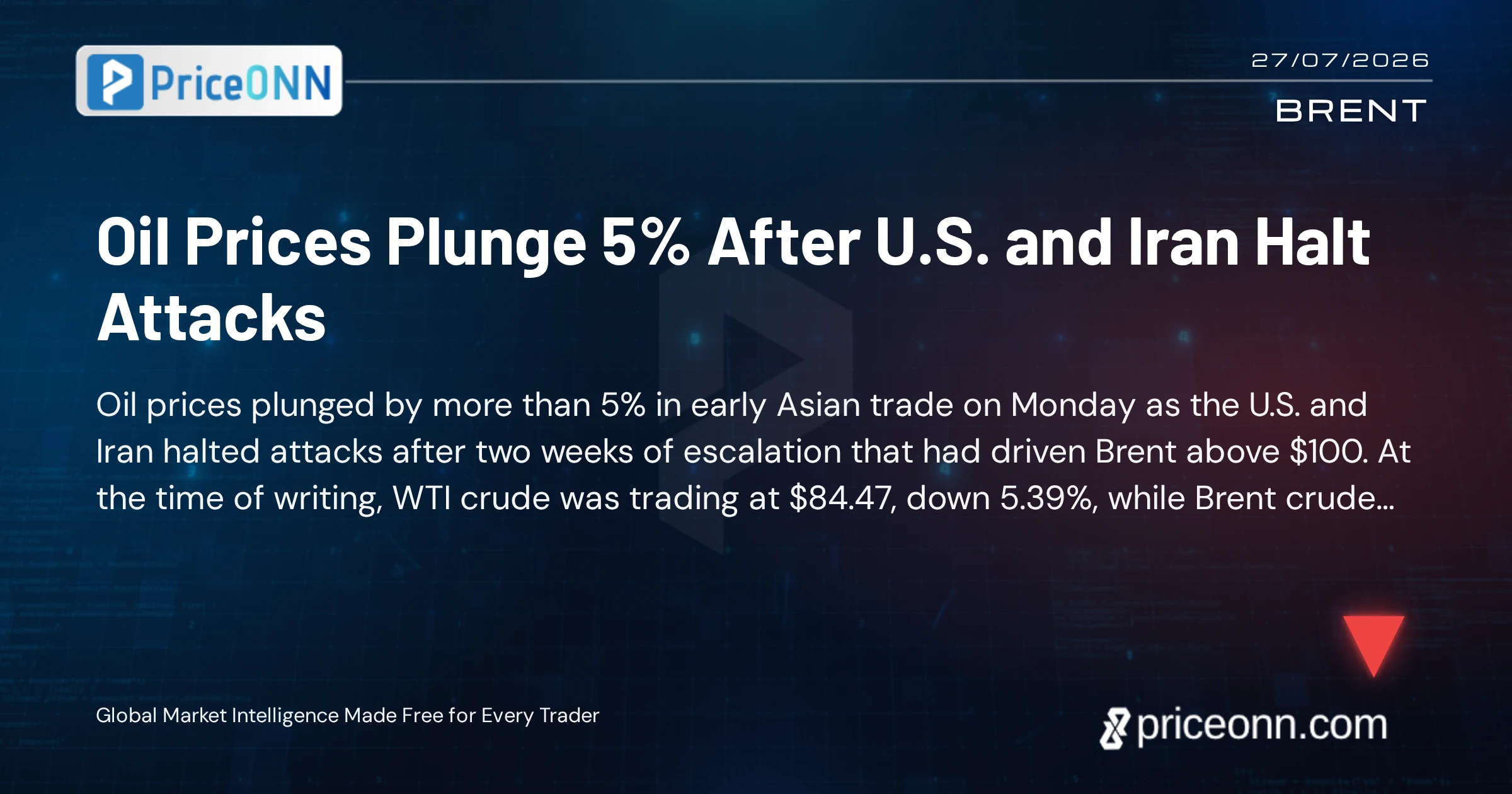
Oil Prices Plunge 5% After U.S. and Iran Halt Attacks
 PriceONN Editorial Desk
Multi-source verification
PriceONN Editorial Desk
Multi-source verification
Market Rebounds as Diplomatic Signals Emerge
The global oil market experienced a significant downturn on Monday, with prices shedding more than 5% in early Asian sessions. This dramatic fall followed a period of intense escalation between the United States and Iran, which had propelled Brent crude to heights exceeding $100 per barrel just weeks prior. Currently, West Texas Intermediate (WTI) is priced at $84.47, marking a 5.39% decrease, while Brent crude has settled at $91.80, down 5.15%. This sharp correction was triggered by Washington's indication on Friday of a temporary pause in its aggressive actions against Iran.
U.S. Ambassador to the United Nations, Mike Waltz, speaking on Sunday, characterized the pause as an effort to "give diplomacy some space." However, he also noted the strategic repositioning of additional military assets in the region, serving as a contingency should diplomatic avenues falter. For oil traders and investors, this temporary détente was sufficient to initiate an aggressive unwinding of long positions built up during weeks of sustained upward momentum. Yet, the sustainability of any significant price decline hinges on a substantial increase in maritime oil transport activity.
The fundamental risk to oil supply, particularly concerning tanker operations in critical waterways, remains a potent factor. Until a stable, long-term accord is achieved, vessels will continue to navigate the operational hazards that previously caused freight rates to skyrocket over the past fourteen days. Several external elements contributed to the cessation of recent hostilities. The most recent U.S. military campaign, for instance, had largely addressed its initial objectives while depleting considerable munitions and interceptor resources.
Furthermore, domestic political considerations for President Trump likely played a role in the decision to pause. With the midterm elections looming just 100 days away and the national average price for gasoline in the United States hovering above $4 per gallon, the administration faced growing pressure. Consequently, the coming days in the energy sector are expected to be characterized by heightened volatility, with market sentiment closely tethered to developments and pronouncements from Washington and Tehran.
Reading Between the Lines
The immediate risk premium that had inflated oil prices is beginning to dissipate, but the full restoration of confidence in shipping routes, including the vital Strait of Hormuz and the Red Sea, will be a gradual process. It will require time and consistent, reassuring signals from both sides to rebuild market trust. The underlying geopolitical tensions have not vanished; they have merely been placed on a temporary hold. This creates an environment ripe for headline-driven trading, where any perceived shift in diplomatic stance or a minor incident could reignite price swings.
For those managing portfolios, the current environment demands a keen eye on geopolitical developments. While the direct military confrontation has eased, the potential for renewed friction remains. Traders should monitor shipping indices and insurance rates for the region, as these are often leading indicators of renewed supply chain anxieties. The market's reaction function to news from the U.S. and Iran will be amplified in the short term, making nimble trading strategies essential.
The current price action suggests that a significant portion of the 'fear premium' has been priced out. However, the structural issues impacting supply chain reliability are not resolved. Any future disruptions, even minor ones, could see prices rebound sharply, especially if tanker traffic has not significantly increased to absorb potential shocks. This presents a dichotomy: a short-term relief rally versus the persistent medium-term risk of supply vulnerability.
Track markets in real-time
Empower your investment decisions with AI-powered analysis, technical indicators and real-time price data.
Join Our Telegram Channel
Get breaking market news, AI analysis and trading signals delivered instantly to your Telegram.
Join Channel PriceONN News
Indian state-controlled oil refiners continue to search the market for spot crude supply as term deliveries are constrained by the ongoing crisis in the Middle East and its key oil chokepoint, the Strait of Hormuz. Mangalore Refinery and Petrochemicals Limited (MRPL) and Hindustan Petroleum Corporation Limited (HPCL) are looking to buy a combined 6 million barrels of crude oil via spot tenders, Reuters reported on Wednesday, citing tender documents it has seen. HPCL is seeking up to 4 million...
PriceONN News
The IEA has slashed its 2026 global oil supply forecast, with output now expected to plunge 4.3 million barrels per day this year as the failure to reopen the Strait of Hormuz pushes the market deeper into deficit. The latest forecast is considerably worse than the 3.7-million-bpd decline the agency projected just last month and would leave global supply at 102.02 million bpd, its lowest forecast for 2026 yet. Supply is now expected to fall 1.27 million bpd short of demand for the year,...
PriceONN News
(RTTNews) - Crude oil prices have surged on Tuesday, extending the gains from the two previous sessions as the U.S.-Iran stalemate over new demands for compensation for war-related damages continued, diminishing the expectations of an early reopening of the Strait of Hormuz.
PriceONN News
Crude oil inventories in the United States saw a massive increase of 17.4 million barrels during the week ending August 7, according to new data from the U.S. Energy Information Administration (EIA) released on Wednesday. The increase brings commercial stockpiles to 424.4 million barrels, according to government data, which are now just 2% below the five-year average for this time of year. The EIA’s data release follows API’s figures that were released a day earlier, which reported that crude...
PriceONN News
Brent Crude oil prices rose above $89 per barrel in early trade in Europe on Wednesday as Iran and the United States offered contrasting claims about who controls the Strait of Hormuz. Brent Crude prices were up by 0.64% at $89.60 in the morning in Europe, and WTI Crude was rising by 0.94% at $83.90, amid persistent supply concerns and risks despite claims from the U.S. that traffic at Hormuz had normalized. Iran, for its part, said on Tuesday that the Strait of Hormuz will remain closed unless...
PriceONN News
Oil flows from the Middle East have normalized, with Sunday traffic alone above pre-conflict averages, U.S. Secretary of Energy Chris Wright said on Tuesday in a claim that appears not to be backed by ship-tracking data. On Tuesday, Secretary Wright posted on X that “Thanks to the coordinated efforts of the U.S. military and our gulf allies, the seven-day average for oil leaving the Strait of Hormuz is currently up to almost 9 million barrels per day.” He went on to add that “When combined with...
PriceONN News
The American Petroleum Institute (API) estimated that crude oil inventories in the United States rose by 9.072 million barrels in the week ending August 7, compared to analyst expectations for a 500,000-barrel draw. In the week prior, U.S. crude oil inventories rose by 2.69 million barrels. The larger-than-expected build was driven in part by higher crude imports relative to exports during the week. Commercial crude oil inventories excluding the SPR have lost just over 49 million barrels over...
PriceONN News
Five months after the U.S. and Israel opened a war with Iran, global fuel markets still haven't settled down, and the latest IEA data prove it. The IEA's monthly end-use price tracker, updated Aug. 7 and covering prices through July, shows the average per-liter cost of automotive diesel across the countries it tracks sitting near $1.94 in U.S. dollar terms. That's roughly 14% above where it stood in February, before the war started, and it's actually higher than June, even as crude oil kept...
PriceONN News
Hormuz tensions are flaring again as Iranian exports collapse, pushing Brent toward $87 and raising the risk of another run toward $100. China’s Crude Drawdown Puts Iranian Barrels Back in Demand - Shrinking crude inventories in China might spur a buying spree over the upcoming weeks, particularly for Russian and Iranian crude, buoyed by a record-high July stock draw in Shandong. - Chinese teapots are expected to boost their purchases of Iranian oil in the upcoming days as stockpiles in the...
PriceONN News
The national oil company of the United Arab Emirates has issued its eighth spot tender since June, trade sources told Reuters on Tuesday, as the Gulf producer that has just left OPEC pushes to sell increased crude volumes to international markets. Abu Dhabi National Oil Company (ADNOC) is offering in the latest spot tender cargoes of the Upper Zakum, Umm Lulu, and Das crude grades for loading in October and November’ sources. These crudes are produced within the Persian...
PriceONN News
OPEC’s total oil production jumped by 1.17 million barrels per day in July from June as many Gulf producers restored some output that was shut in for three months due to the closed Strait of Hormuz. Output at the 11-member OPEC rose to 19.85 million bpd in July, extending the monthly increases for the second consecutive month, according to a based on ship-tracking data and information provided by sources at OPEC, oil companies, and consultants. In May, when major Gulf producers...
PriceONN News
Libya’s National Oil Corporation may declare force majeure on exports from the Zawya oil terminal as a result of drone attacks on the facility. The Zawya terminal has a daily capacity of 120,000 barrels, sourced from the country’s largest oil field, Sharara, which can produce up to 300,000 barrels daily, Reuters noted in a report on the possibility of a force majeure declaration. According to reports, a drone strike had destroyed a storage tank and another drone had targeted an oil blending...