
Brent Could Hit $100 as Hormuz Crisis Flares Again
 PriceONN Editorial Desk
Multi-source verification
PriceONN Editorial Desk
Multi-source verification
Geopolitical Storm Brews Over Critical Waterway
The vital Strait of Hormuz is once again at the center of escalating global energy concerns. Reports indicate that Iranian crude exports have effectively ground to a halt, a development that is now pushing the benchmark Brent crude price precariously close to $87 per barrel. This dramatic shift raises the specter of a renewed push towards the significant $100 price ceiling.
The current pressure on oil markets is amplified by a significant drawdown in China's crude stockpiles. This reduction in inventory is poised to ignite a buying surge in the coming weeks, with a particular focus on barrels from Russia and Iran. This renewed interest is directly linked to a record depletion of stocks in the Shandong region during July.
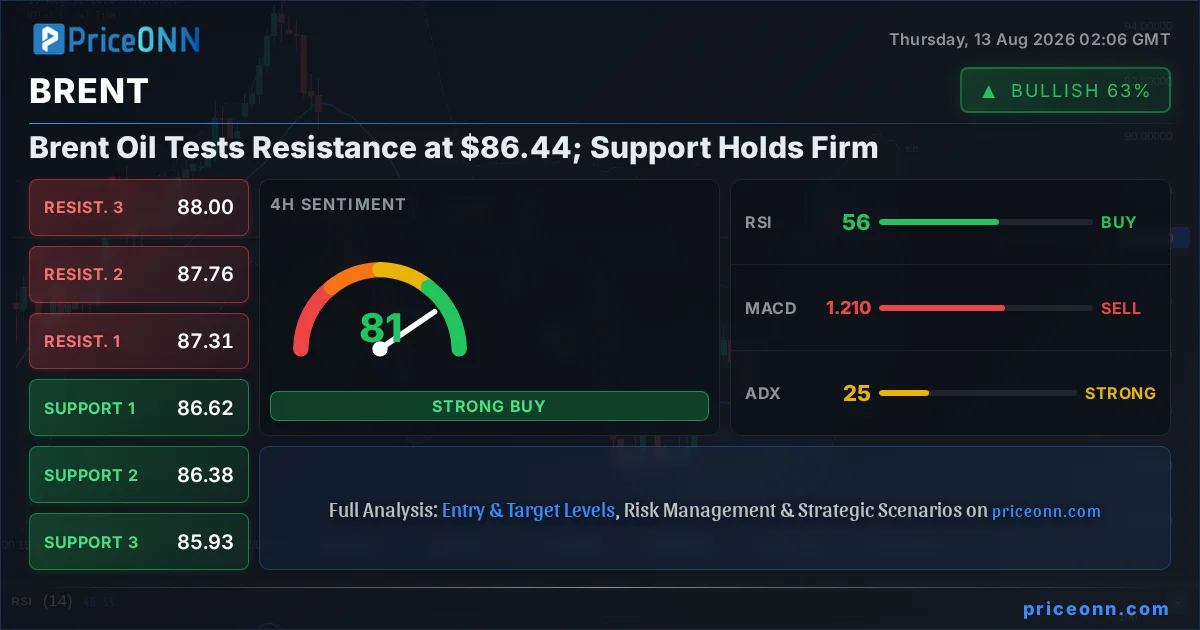
China's Inventory Slump Fuels Demand for Alternative Crude
Independent refiners, often referred to as 'teapots' in China, are anticipated to ramp up their acquisition of Iranian oil in the immediate future. This pivot is necessitated by a staggering 35 million barrel reduction in stockpiles across Shandong province throughout July. This represents an average daily draw of approximately 1.1 million barrels per day, a truly massive depletion.
The gradual resumption of product exports from China is also a contributing factor, compelling these independent refiners to increase their operational capacity. While utilization rates are currently hovering around 50%, they had previously reached multi-year peaks during June and July, indicating a strong underlying demand for refined products.
Adding to the supply-side squeeze, prices for Iranian crude are exhibiting an upward trend. The flow of new supply originating from Kharg Island appears to be diminishing rapidly. Data for the first ten days of August reveals that not a single Very Large Crude Carrier (VLCC) departed from Iran, a stark contrast to previous periods.
Furthermore, the volume of Iranian crude held in floating storage remains relatively stable at approximately 40 million barrels. This figure is double the amount observed in early July, a period when maritime transit through the region was largely unimpeded, underscoring the current logistical challenges.
Market Movers and Global Energy Infrastructure Shifts
Beyond the immediate supply concerns, significant developments are reshaping the global energy infrastructure. In the United States, energy firms P66, Kinder Morgan, and HF Sinclair have committed to a joint venture for the $5 billion Western Gateway pipeline system. This critical infrastructure will facilitate the transport of refined products from St. Louis, Missouri, to California.
In offshore exploration, UK energy major BP is acquiring a 70% stake in the Calypso deepwater project in Trinidad and Tobago from Australia's Woodside, assuming full control of the substantial 3.5 trillion cubic feet (TCf) asset. Simultaneously, Italian energy giant ENI has entered a strategic partnership with US driller APA for exploration activities in Block 6 offshore Uruguay, with significant funding allocated for work planned in 2027.
French firm Maurel et Prom has agreed to acquire Gran Tierra Energy's entire South American portfolio for $1.33 billion, consolidating its presence in Colombia and Ecuador. In a move to bolster its shipping capabilities and navigate the sensitive Hormuz chokepoint, the UAE's national oil company, ADNOC, has purchased 11 vessels (6 VLCCs and 5 VLGCs) on the secondary market for $1.3 billion.
The Bigger Picture
The current spike in Brent crude prices, nearing $87 and with potential to breach $100, is a potent reminder of the geopolitical premiums embedded in oil markets. The near cessation of Iranian loadings in August, coupled with heightened rhetoric and skirmishes in critical shipping lanes like the Red Sea and the Gulf of Oman, paints a volatile picture for energy supply.
While official negotiations surrounding the Strait of Hormuz may appear complex, the market's reaction is swift and decisive. The impact of disruptions in the Bab el-Mandeb Strait, where the first Houthi casualties were reported, and incidents involving shipping in the Gulf of Oman, cannot be overstated. These events directly influence risk premiums and can trigger rapid price adjustments.
Traders and investors should closely monitor the interplay between geopolitical events and actual oil flows. The resilience of global refining capacity, as seen with Chinese refiners increasing runs despite inventory draws, and the strategic moves by major energy players to secure supply chains, such as ADNOC's fleet expansion, offer crucial insights. The potential for a complete halt in Hormuz transits, while an extreme scenario, remains a significant wildcard that could rapidly accelerate price increases. Watch for any official statements from Iran or key players involved in Hormuz negotiations, as well as any further escalations in regional conflicts, as these will be the primary catalysts for near-term price action.
Track markets in real-time
Empower your investment decisions with AI-powered analysis, technical indicators and real-time price data.
Join Our Telegram Channel
Get breaking market news, AI analysis and trading signals delivered instantly to your Telegram.
Join Channel PriceONN News
The latest Bloomberg data show that shipping transits through the Strait of Hormuz remained largely disrupted Monday morning, even as Iran and Oman reportedly moved closer to a deal. Brent crude futures traded near $85 a barrel as markets priced in the possibility that a deal to reopen the maritime chokepoint could be imminent. Yet global supply-chain stress remains near its highest level since the pandemic, and any normalization could take months, even if shipping traffic resumes. UBS senior...
PriceONN News
Brent Crude oil prices rose above $89 per barrel in early trade in Europe on Wednesday as Iran and the United States offered contrasting claims about who controls the Strait of Hormuz. Brent Crude prices were up by 0.64% at $89.60 in the morning in Europe, and WTI Crude was rising by 0.94% at $83.90, amid persistent supply concerns and risks despite claims from the U.S. that traffic at Hormuz had normalized. Iran, for its part, said on Tuesday that the Strait of Hormuz will remain closed unless...
PriceONN News
Central Asia’s energy market is experiencing a rapid shake-up thanks to Ukraine’s drone campaign against Russian energy infrastructure. Russia stands to lose leverage and market share in the region over the long term as Central Asian states rush to diversify their fuel-supply options. Repeated Ukrainian attacks on Russian refineries have caused the Kremlin to limit exports of fuel products, including gasoline and jet fuel, to cope with deepening domestic shortages. That, in turn, is prompting...
PriceONN News
Crude oil inventories in the United States saw a massive increase of 17.4 million barrels during the week ending August 7, according to new data from the U.S. Energy Information Administration (EIA) released on Wednesday. The increase brings commercial stockpiles to 424.4 million barrels, according to government data, which are now just 2% below the five-year average for this time of year. The EIA’s data release follows API’s figures that were released a day earlier, which reported that crude...
PriceONN News
Indian state-controlled oil refiners continue to search the market for spot crude supply as term deliveries are constrained by the ongoing crisis in the Middle East and its key oil chokepoint, the Strait of Hormuz. Mangalore Refinery and Petrochemicals Limited (MRPL) and Hindustan Petroleum Corporation Limited (HPCL) are looking to buy a combined 6 million barrels of crude oil via spot tenders, Reuters reported on Wednesday, citing tender documents it has seen. HPCL is seeking up to 4 million...
PriceONN News
The IEA has slashed its 2026 global oil supply forecast, with output now expected to plunge 4.3 million barrels per day this year as the failure to reopen the Strait of Hormuz pushes the market deeper into deficit. The latest forecast is considerably worse than the 3.7-million-bpd decline the agency projected just last month and would leave global supply at 102.02 million bpd, its lowest forecast for 2026 yet. Supply is now expected to fall 1.27 million bpd short of demand for the year,...
PriceONN News
Oil flows from the Middle East have normalized, with Sunday traffic alone above pre-conflict averages, U.S. Secretary of Energy Chris Wright said on Tuesday in a claim that appears not to be backed by ship-tracking data. On Tuesday, Secretary Wright posted on X that “Thanks to the coordinated efforts of the U.S. military and our gulf allies, the seven-day average for oil leaving the Strait of Hormuz is currently up to almost 9 million barrels per day.” He went on to add that “When combined with...
PriceONN News
A drone has struck a power station at the Zawiya oil export terminal in Libya, suggesting continued attacks on one of the country’s main oil hubs. The power plant is in close proximity to the largest oil refinery in Libya, the AP noted in a report on the news. The attack follows earlier ones that caused an explosion at an oil storage tank. No one has claimed responsibility for the drone attacks, the AP also reported. The tank, according to the company operating the facility, had 4.5 million...
PriceONN News
Whatever officially occurs next in the on-again/off-again negotiations towards a peace deal between the U.S. and Iran, unofficially Tehran knows that it has established de facto control over both the world’s two key maritime energy transit routes -- the Strait of Hormuz and the Bab el-Mandeb Strait -- for at least as long as the Islamic regime remains in place in Iran. Washington, London, Brussels, Beijing, and Moscow know it too. The Strait of Hormuz remains effectively controlled by vast...
PriceONN News
The Middle East conflict and the heightened threats to shipping in the Red Sea have prompted China to boost the use of the Arctic to move containers from the Chinese east coast to Europe. The fast-melting Arctic ice offers an alternative shipping route in the summer as the Houthi threats to shipping in the Red Sea and the Bab el-Mandeb Strait make cargo operators more cautious in transiting the key chokepoints in the Middle East. Shipping through the Arctic is not something new, but this time...
PriceONN News
(RTTNews) - Crude oil prices have surged on Tuesday, extending the gains from the two previous sessions as the U.S.-Iran stalemate over new demands for compensation for war-related damages continued, diminishing the expectations of an early reopening of the Strait of Hormuz.
PriceONN News
Five months after the U.S. and Israel opened a war with Iran, global fuel markets still haven't settled down, and the latest IEA data prove it. The IEA's monthly end-use price tracker, updated Aug. 7 and covering prices through July, shows the average per-liter cost of automotive diesel across the countries it tracks sitting near $1.94 in U.S. dollar terms. That's roughly 14% above where it stood in February, before the war started, and it's actually higher than June, even as crude oil kept...